
Skateboarding prodigy turned artist, Steve Olson is a child of wild Southern California where surf and skate were never only sports but second nature. He turned professional at sixteen and dragged punk rock into a sport that had no idea it needed it. Then he acted, made clothes, shot films and built a body of artwork, following nothing but instinct. He has treated life like one long downhill run, all speed and no map, committed to the ride, laughing at the fall, taking the work seriously and himself not at all. The one hill that ever mattered he has ridden with his loved ones, his older brother who first put him on a board and the grandchildren now bombing it beside him. Steve Olson is a member of the ASVOFF 2026 jury.
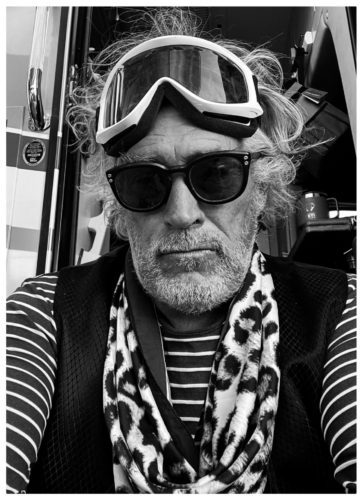
Steve Olson has charisma to burn. He has been surfing the ocean and riding the concrete of Southern California since before he could spell it. “I was also a swimmer. I was an athletic kid that played all the different types of sports.” He was sponsored on a surfboard by twelve, an age when most children are still wobbling on a bicycle, though to hear him tell it that was simply how life went there back then. Skateboarding was only what one did when the sea went flat. Then it came into its own, the gear catching up and the drought of 1976 draining Southern California’s pools into concrete bowls whose curved walls rode like frozen waves. The sport stopped imitating the ocean and became a world of its own, and it carried Olson off with it. “Skateboarding broke off from being the stepchild of surfing. And that’s when it happened.” He fell into it completely. His older brother Bucky worked at one of the new skateparks. “I lived in the skate park, basically, and developed my skills.” A child prodigy, he became world champion at 17. The night he collected his Skateboarder of the Year award he turned up in bondage trousers, a white blazer, a polka dot tie and shoes two sizes too small, dressed neither in line with trends nor against them but purely as he pleased, which is how he has done everything since. “Sometimes fashion feels no pain!” he quips. He was also, by his own cheerful account, completely drunk, and when the room called for a speech he spat at the cameras and flicked boogers at them, while his competitor, beaten into second, threw his own trophy in the bin. Attitudes! Cool! Youth! Energy! “I was completely, one hundred percent excited to win that award. I had no idea that was going to happen.” The sponsors were appalled. The kids understood at once, watching a man take the trophy and tell the whole world he will thrive in his own way.
By now you are surely wondering what a boy that age was doing out there while the rest were bored stiff at their desks. His family set a single condition. “I made an agreement with my parents and I honoured it.” He earned his diploma, then bolted straight back to what mattered. “I went and skateboarded.” Through all of it, one figure stayed close from the very start. His brother Bucky, who can turn his hand to anything, airbrushed surfboards, drew cartoons, and now teaches ballet, fences and shoots archery. “He can do whatever it was he set his mind to. He influenced me profusely.”
“I loved Vivienne Westwood at seventeen. And the glam, the Pistols, the fifties music. It was just what I enjoyed, not conscious decisions.”
His punk was never a costume he put on. It grew through him. The same instinct produced the emblem he is still known for, when he popularised the checkerboard. When Santa Cruz, the skateboard brand that had signed him, gave the young champion his own pro model around 1980, Bucky drew the pattern across the entire deck, and Olson’s fame as world champion carried it far past the skateparks. It reached sneakers he had commissioned long before a certain brand made its own. “People say Vans ripped me off. They didn’t. They just made a checkerboard sneaker.” He let it go, laughing that it might have been nice to take five cents a shoe.
“Then skateboarding died. Now what are you going to do with your life?”
What came next was less a career than a decade of open doors walked through on instinct. He started his own company, SOS – short for Steve Olson Skates – hiring a photographer to shoot models in deliberately disgruntled settings, half business and half art, with Malcolm McLaren’s “The Great Rock ‘n’ Roll Swindle” running somewhere behind it all. He picked up a bass and played in a band that only got big once he had left it. He turned up in “Thrashin'”, a cult film loosely lifted from “West Side Story,” cast in a gang called The Daggers, then moved to New York to study acting. “They told me ninety-nine percent of actors don’t work. I didn’t care.” When he got tired of life there, he headed back to Los Angeles and into the art department at Jimmy Z, cutting and sewing, then running its advertising, dreaming up a cowboy shirt with a punk edge and zebra on the pockets that he still misses. When he suggested the label add a skateboard line and was told that was not what Jimmy Z was about, he answered in the only way he knew. “I went to lunch and never came back.” After that came commercials, a few days of work a year that paid for all the rest, the money, the travel, the surf, and a downtown New York of drag queens and dressing up around Patricia Field’s world on 8th Street. “That was the best life.”
“Everything was accidental. It just happened. Opportunities came about.”
Art arises exactly as skateboarding did, by accident and appetite. He made his first piece for a Surfrider Foundation fundraiser, from a small surfboard he was handed and told to do as he pleased. He had been combing junkyards and salvage yards for the chrome emblems off old Cadillacs and Fords, and he fixed one of them, the Ford Futura badge, onto the board, raised it off a can and set the whole thing on a canvas wrapped in leopard print. The artists he looked up to called it the best piece in the show. A second work, built around a Cadillac emblem, sold for a small fortune. “I’m an artist now, I guess,” he thought. He was only half joking, and the market took him at his word. Assemblage gave way to sculpture, shown at Medium Exchange in New York, Diane Rosenstein and Nye in Los Angeles and Bowman in Beverly Hills, then to bronze, a life-size skater cast upside down in a twelve-foot pipe and a BMX rider that became the centrepiece of a park. He had never been taught to cast bronze and saw no reason for that to stop him. “Because I just do it. What do you mean, how you do it?” The same nerve ran through “Buy Sexual”, a blunt play on the way sex sells made while the country argued over same-sex marriage. And a great pun! Hung in a Santa Barbara government building with the arts council’s blessing, it so offended one district supervisor that he had an aide take it off the wall and lock it in a storeroom, turning a mild pun into a free-speech fight. A petition of two hundred and twenty-five names called for it to stay down, so Olson raised one of his own that gathered two and a half thousand to put it back, and the council won in court. He keeps the piece still. “It has too much meaning to me.”
“I’ve known Diane since the mid eighties. I was there for the very first festival she did, in Los Angeles.”
Film he came to sideways, like everything else. In Paris he became fast friends with a filmmaker who shot the backstage of the fashion world, asked what cameras he used and decided on the spot that the two of them should make a movie. They spent a day filming him skate from the Trocadéro across to République, a lone figure pushing through the city towards the quiet gift that gives the piece its heart. “The Pusher”, shot entirely on a phone, screened at the festival’s fifteenth edition. Diane Pernet had been in his life long before that, since he moved to New York in the mid eighties, and he stood at the very first edition of her festival, back when she staged it in Hollywood and called on him to round up friends and help her pull it off. He has followed her ever since, a film in one edition, a seat on the 2024 jury and now the 2026 panel, which he accepted with his usual benevolent shrug. “Yeah, why not? What’s the big deal? I watch the films, I write what I see, and vote on what I vote on.” On what drives her, he offers the clearest reason there is. “She does it because she loves it.”
Everything he has built, he hands on. Here he is now at the top of a hill with three generations of Olsons on their boards, his son Alex lifting the smallest of them, Steve arriving with a board of his own, a three-year-old in full denim and tiny Vans cruising back and forth beside them. Pure joy. The boy calls him Boom Boom. Watching that small delighted face, Olson feels the whole measure of his luck, and he will not pretend it ranks any lower than it does. “Probably the best experience of my life in skateboarding. Better than winning any contest.”
