
For LISA’s SaWaDiKa, On Aura Tout Vu covered a Muay Thai headguard, gloves and belt in crystals while preserving the padding, fastening and forms that identify them as sporting equipment.
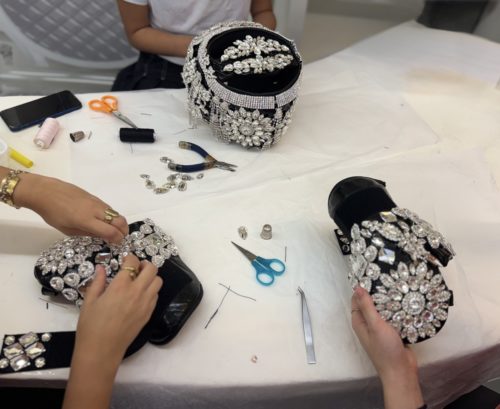
In the atelier photographs, the headguard sits among tools, loose stones and a pair of matching gloves. What holds my attention is what remains exposed: the black padding, the fastening and the blunt protective outline. The same detail appears in the SaWaDiKa music video, where the piece catches the hard daylight of the Muay Thai sequence. The crystals change the way the object meets the camera without disguising what it was built to do.
In written answers, designers Livia Stoianova and Yassen Samouilov explained that their commission specifically covered three Muay Thai pieces. A headguard, gloves and a belt, within a production involving several fashion contributors. They said the headguard was revealed for the first time in the music video, while the gloves and belt had already appeared in promotional photographs and teasers. The belt returns beside the headguard in the ring sequence.
See LISA’s crystal Muay Thai headguard and belt at 2:45 in her SaWaDiKa music video
The title SaWaDiKa echoes the Thai greeting sawasdee ka, while much of the video unfolds inside Bangkok’s Hua Lamphong railway station. Muay Thai enters as part of a wider visual language rooted in Thailand. The Thai government describes it as both a martial art and a national sport; in March 2024, Thailand’s Cabinet approved a proposal for the Ministry of Culture to submit Muay Thai to UNESCO’s Representative List of the Intangible Cultural Heritage of Humanity.
So these references matter because the scene does not rely on LISA’s nationality alone to communicate its context. Thailand is present through language, location, choreography and equipment. Muay Thai is therefore more than a convenient visual symbol of strength: it gives that strength a culturally specific form.
In the ring sequence, the headguard becomes the brightest object in the frame. Its scale surrounds LISA’s face, while the stones respond to every change in light and movement. To me, the effect is one of self-possession and feminine authority. The equipment carries the physical language of fighting, but LISA’s control of the image prevents it from becoming a generic empowerment costume. Her Thai background is not reduced to decoration; it is the source from which the scene builds its identity.
On Aura Tout Vu is a Paris-based couture house led by Stoianova and Samouilov, both born in Bulgaria and trained in France. The house dates its creation to 1995 and presented its first accessories collection in 1998, later producing couture accessories for houses including Christian Dior, Christian Lacroix and Givenchy. That history is relevant here because this commission begins with a technical question: how can a heavily embellished surface respond to an object that must remain wearable and recognisable? According to Stoianova and Samouilov, the entire commission including the drawings was completed in just four days by a team of more than five people in the On Aura Tout Vu atelier.
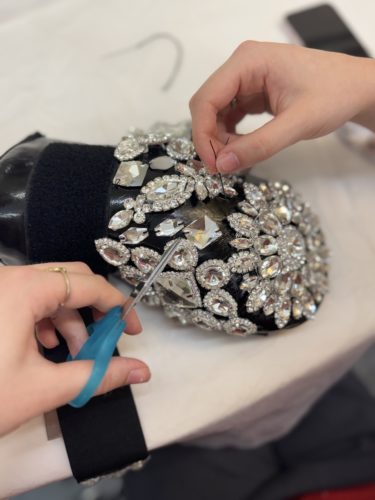
The gloves retain their padded knuckles, enclosed thumbs and curved fists beneath the stones. Their existing construction determines where the embellishment can sit and how much of the hand remains usable. Rather than treating the sporting object as an empty surface, the couture intervention has to work within its physical limits.
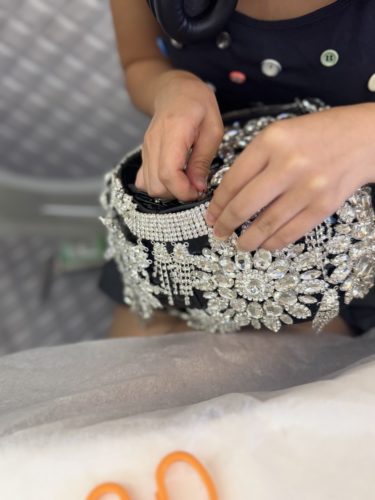
A closer view of the headguard’s edge shows large faceted stones placed among smaller crystals and flexible strands. The designers said some stones were mounted through a traditional setting technique. Visually, the variation in scale prevents the surface from becoming a single reflective plane. It breaks the light into individual points that shift as the headguard moves.
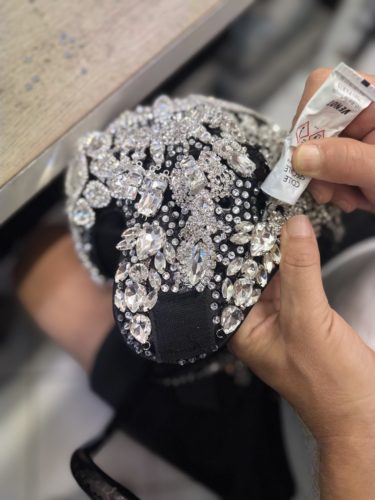
Choreography also changed the construction process. Knowing that LISA would dance extensively while wearing the headguard, the designers applied what they described as “glue inside the settings” as an additional safety measure. The adhesive reinforcement was intended to keep the stones secure through movement, an ordinarily invisible production decision that becomes central when couture is made for performance rather than a static image.
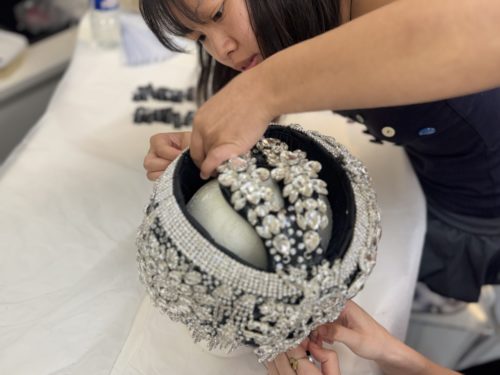
Asked how the pieces were sized, Stoianova and Samouilov pointed to the standard sizes already used for this type of sporting equipment. They said the pieces fitted comfortably and functioned as intended. In the interior photograph, the headguard rests on a head form with its padding and fastening visible beneath the embellished exterior. The contrast is direct: its inner construction serves the body while its surface serves the camera.
The belt carries a different history. The designers traces it to coming from Alchimia – On Aura Tout Vu’s Spring–Summer 2019 couture collection. Placed beside the newly embellished headguard in the ring sequence, it brings an earlier couture design into a new performance context and connects the commission to the house’s existing visual language.
What makes these pieces interesting is not simply the unlikely combination of boxing equipment and crystals. Their meaning develops through the tension between their two functions. A headguard usually protects by absorbing impact without demanding attention. Here, protection becomes the most visible part of the body. The stones produce the spectacle, but the padding underneath gives that spectacle its meaning.
With thanks to À PART for facilitating access to the designers.
Words by,
Ovlioxy Vleuryon
