







Dear Shaded Viewers,
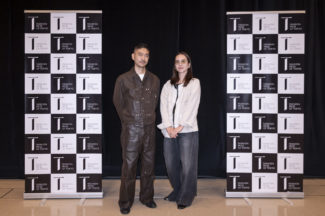
New York has always been generous to designers who refuse to choose a single lineage. TANAKA, the unisex label founded there in 2017, has made that refusal its entire premise — and this year, the industry caught up with what its followers already knew. The brand’s win of the TOKYO FASHION AWARD 2023 wasn’t a debut so much as a confirmation: proof that a label built on patience, technique, and a deliberately unfashionable time horizon can still win on fashion’s own terms.
TANAKA’s founding idea is almost architectural in its ambition: clothing that spins together the past and the next hundred years. Not clothing for this season, or even this decade, but garments conceived as new classics — masterpieces in the old sense, built to be loved long after the trend cycle that produced them has been forgotten. It’s a philosophy that could easily curdle into nostalgia. TANAKA avoids that trap by working from craft outward rather than from mood board inward, grounding every collection in modern Japanese denim and the artisan techniques behind it, then letting that discipline meet the borderless, multicultural pulse of New York itself.
What results is a kind of quiet border-crossing — between East and West, between art and utility, between the hand and the machine. TANAKA moves through art, craftsmanship, traditional textile technique, and technology not as separate departments but as one continuous practice, using clothing as the connective tissue between people, memory, culture, and society. It’s an unusually ambitious brief for a young label. That Bergdorf Goodman selected TANAKA as a Radar Designer, and that Blue Bottle Studio in Kyoto entrusted the brand with reimagining its uniforms — reconstructing workwear into something that reads as both utilitarian and quietly beautiful — suggests the ambition is being met rather than merely stated.
The 2025 launch of Art of TANAKA sharpened that mission into something closer to a creative instrument. The line exists to ask, directly, what a designer today can leave behind for the next hundred years — and to answer that question by fusing the authority of the human hand with the possibilities of technology. It is less a collection than a mechanism: a way of putting the brand’s founding philosophy into practice with each new object, rather than simply repeating it as tagline.
That same patience shaped the brand’s relationship to its own home. In August 2026, TANAKA AOYAMA was relocated and reborn as TANAKA ATELIER STORE — not a rebrand so much as a physical translation of everything the label has been building toward, a space meant to be walked through as an extension of the philosophy itself.
Taken together — the award, the Bergdorf recognition, the Kyoto uniforms, Art of TANAKA, the new atelier — TANAKA’s story so far reads less like a rise than like the early chapters of something meant to be read slowly. In an industry addicted to speed, that may be the most radical position a brand can take.
