



Dear Shaded Viewers,
Fifteen minutes after Annie Leibovitz photographed John Lennon curled naked around Yoko Ono, he was shot dead outside his building in New York. The image — the singer folded into a foetal position, clinging to the person he loved — hangs at the Bourse de Commerce this autumn across from another Leibovitz picture: a very pregnant Demi Moore, bare skin and all, the photograph that scandalized America in 1991. Death on one wall, birth on the other. Between them, a curator’s quiet argument about what a camera is actually for.
That argument is the whole of “Remember Me,” a show opening October 7 that does something Pinault Collection has never attempted: pull nothing but photographs — some 700 of them, by more than 70 photographers — from a holding of over 8,000 prints, and let them talk. Not lecture. Talk. There is no chronology here, no wall text marching visitors from daguerreotype to iPhone. Matthieu Humery, the collection’s photography advisor, built it instead as what he calls a fugue — a piece of music where the same theme keeps reappearing in different voices, never quite where you expect it.
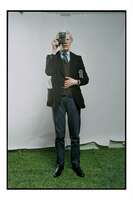
It starts, fittingly, with a joke about starting. The first image in the show is one Edward Steichen took of hands shuffling dominoes — never before exhibited — hung beside Annie Leibovitz’s portrait of Richard Avedon’s camera. Rules of the game, declared in the first five feet of wall space: these pictures are tiles, and you’re meant to see how they touch.
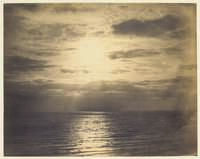
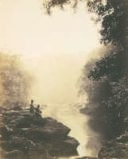
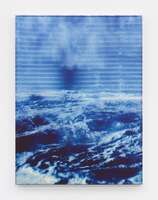
They touch in some strange places. Richard Avedon’s Marilyn Monroe, caught off-guard and unglamorous, hangs near a Cindy Sherman self-portrait that borrows the same vulnerability decades later. Gustave Le Gray’s nineteenth-century seascapes bleed into Eileen Quinlan’s abstracted waves. August Sander’s stern, taxonomic portraits of Weimar-era Germans meet their own echo in Sherrie Levine’s series shot directly after Sander — an argument, staged silently, about who gets to make an image and who merely repeats one.
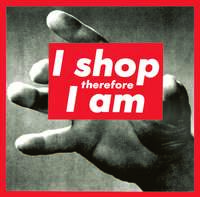
The show’s title comes from Barbara Kruger, who was given the Bourse’s rotunda to fill and filled it with an eye laid over what looks like skin, the words REMEMBER ME stamped across it in her signature red. It’s not just a centerpiece — Kruger’s work has been let loose on the building itself, her text-and-image messages about memory installed as lightboxes in the display cases that ring the rotunda, visible from the promenade two floors up. You don’t visit the Kruger piece so much as walk through it without quite realizing when you entered.
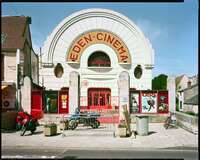
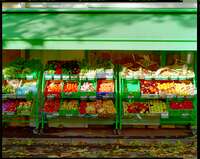
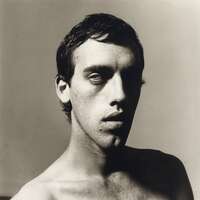
Two photographers get outsized rooms of their own, and the contrast between them is the clearest statement the show makes. Irving Penn — more than 400 prints, an installation on a scale the collection has never given him — worked entirely in the studio, obsessive to the point of writing chemical formulas on the back of every print, as though each photograph needed its own footnote to survive. His Cuzco Children appears here in three separate printing techniques, hung side by side, because Penn himself apparently couldn’t choose between them either. Across the museum, Raymond Depardon did the opposite: he took a view camera into the small towns of France and photographed its cafés, its shopfronts, its roadside houses in color, at scale, without a studio in sight — a country, as Humery puts it, that twenty-year-olds today will barely recognize.
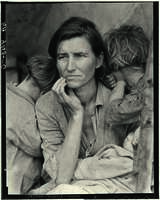
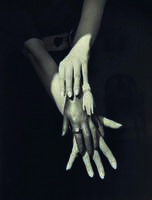
There’s a private history folded into the public one. Humery has said the exhibition reveals things about François Pinault that a wall label never would: the seascapes at the start speak to a well-known passion for the sea; an entire section devoted to hands — Dorothea Lange’s Migrant Mother, hands pressed to a child’s shoulder, is reportedly one of his favorites — traces back to rural roots he rarely discusses. The images are, in that sense, a kind of unauthorized self-portrait smuggled inside a survey of the medium.
It ends, deliberately, on a lie. Man Ray’s Ma dernière photographie — “my last photograph” — isn’t a photograph at all. It’s a painting of a black rectangle on cardboard. Humery wanted the show to open and close on abstraction, a loop that mirrors the Bourse de Commerce’s own circular architecture: you can walk the exhibition, and then walk it again, and each time it becomes a different sequence of tiles.
Photography turns two hundred this year. Charles Baudelaire, writing about the medium in 1859, worried aloud about its power to hold onto what should have been allowed to fade. “Remember Me” takes that anxiety and builds a whole architecture around it — not a history lesson, but something closer to what the title threatens: an instruction, whispered by seventy photographers across two centuries, not to let go.
“Remember Me. Masterpieces of Photography from the Pinault Collection,” curated by Matthieu Humery with Lola Regard, opens October 7 at the Bourse de Commerce, Paris.
Later,
Diane
