
Dear Shaded Viewers,
This season I felt there were several stories at haute couture in Paris, although I was not invited to everything, I saw a huge amount of collections and also took any re-see opportunities, plus high jewellery and exhibitions. I have, like any fashion writer, my favourites and collections I am out of tune with, or simply don’t understand other people’s over enthusiastic reactions. In any area of creativity, from music to painting, we will have artists who we respond to or others we fail to be inspired by. Also a fashion designer, like a musician may have an off night, change repertoire or simply lose their inspiration. It’s a tough world, but our need for joy and beauty is assuaged by a great collection, a wonderful singer or whatever soothes our personal soul. I hope you enjoy reading my thoughts, which may or may not coincide with yours. Thank you as always Diane Pernet. 🖤
TIME TRAVELLERS
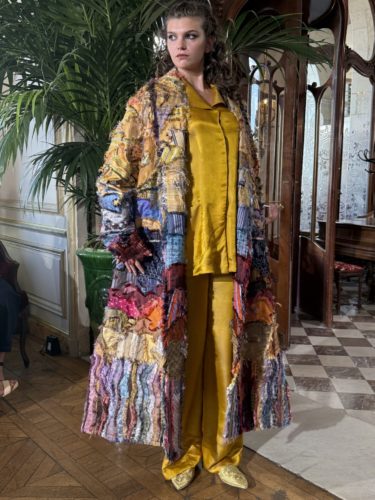
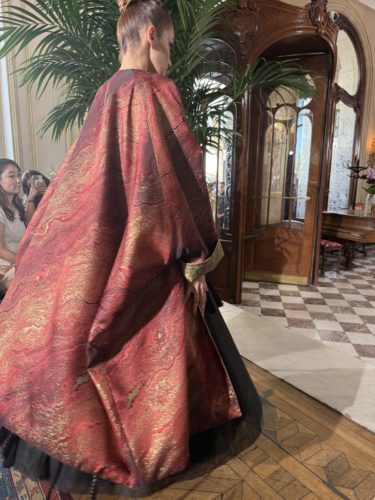
Franck Sorbier himself opened the show as he came through the revolving doors of the Hotel Regina reception with his antique suitcase, he started the theme of the globe trotters. That these characters were not all from today or even recent decades, but possibly from the imagination of Jules Verne or perhaps Agatha Christie was brilliant. The collection was marked by sumptuous fabrics from extraordinary patchwork sumptuous satins from Japanese cranes to Mogul Paisleys, from slender kimonos to swirling capes from neat silhouettes to swathes of fabric in circling the body and draping. That was a richness to the collection alongside the characters that gave a certain spirit of beauty across the world from the silk route of legend to the luxury liners of the art deco and on to the mysterious trains so beloved of Miss Christie, each model entered as a character and yet the collection was not costume, it was fashion. This is because Monsieur Sorbier offers pieces that work in a multitude of ways, worn as he shows them in opulent mood, or paired with simple classic pieces or even jeans. As the travellers passed we could make up our own story as to where they’d been or where they might be going, I for one suspected “Murder on the Orient Express”, but one thing was absolutely certain, they were impeccably dressed.
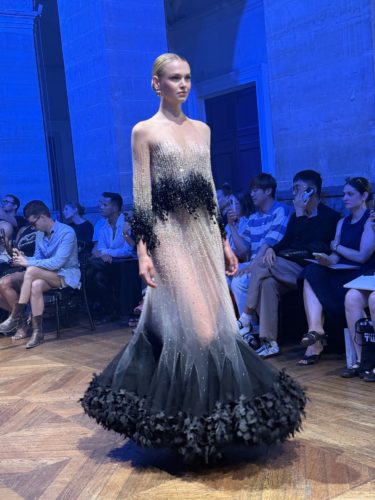
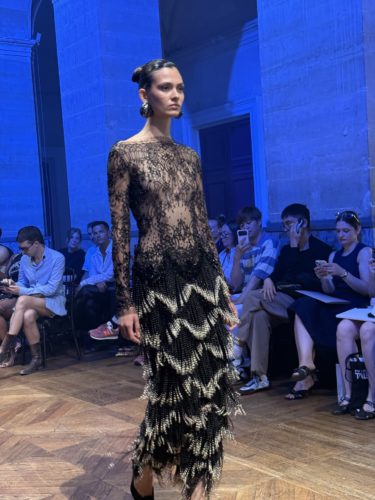
Georges Hobeika has been joined by his son Jad, they take their bow together at the end as of the show demonstrating perfectly the family continuity of the house. In the shimmering light as each piece passed it has a certain visionary quality to it the decoration and embellishments glittering and glimmering but never vulgarly over sparkling . The use of ombrée and dégradée the delicate use of shading and subtlety is apparent even in the strongest statement pieces. The technical expertise is demonstrated time and time again by the silhouettes from a bubble of a ball gown to a seductively draped dress from the slenderest siren silhouette to the soft trailing of the romantic. This season nature, possibly the sea, from its deepest tropical depths through to its brightest sunniest shores imbued the collection with a colour palette to dive into. as you watch the collection pass by one of the key elements is the movement the way the skirts sway gently the way the fringe sways as well the way hems flip up as the models walked past the way beads or loops of fabric follow a rhythm as the gentle waves lap on a shore or leave traces in the sand so these clothes have a gentle beauty and a splendour. This is truly couture where loveliness and serenity are in the hands of designers and ateliers at the peak of their craft the magic the brilliance and the beauty is reached through these experts whose vision we should value in a troubled world.
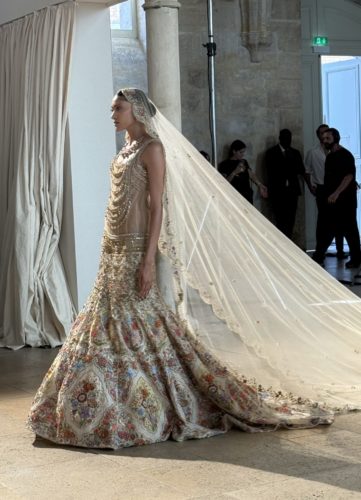
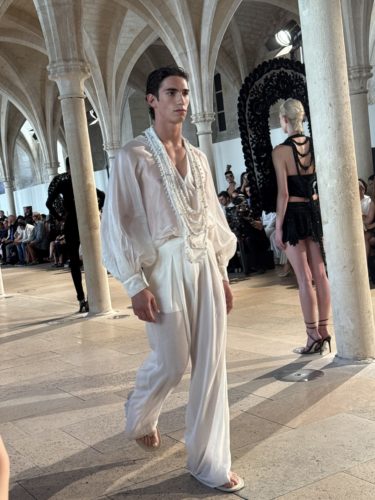
There is always a strong narrative and a deep thought process behind each couture collection created by Rahul Mishra and his team. This season from ancient temples to traditional dress, from tales and legends through beliefs and culture he crafted a show where black, faux black, charcoal, pewter, jet, ink, raven and smoke provided the initial colour palette. The sculptural pieces and the outlines of temples, worship and history were allied to pieces that emulated sculpture itself, and the dexterity and skills of the workrooms was dazzling. Gradually couture evening wear emerged still in this colour palette, where black on black on black was the focus. Later in the show the exquisite floral work that Mishra and his team handle so beautifully gradually appeared until a bridal lehenga closed the show. This final look encapsulated the craft, the tradition, the beauty and the integrity of the house, it showed that India and its extraordinary beauty does not need to be “modernised or updated” it is different yes, and new, but respect for tradition is essential. There were Rajah coats and trompe l’oeil Maharajas to rival those festooned with Cartier in the past. There were hints and details from the past and there were extraordinary embroideries always. The house has shown it can time travel through both India and couture history, it can create a seductive evening dress of couture curves and the cover it with decoration inspired by a carving thousands of years old from a specific region of India. It’s again a magic trick, it’s a balancing act, and it’s all because of one thing; the creator and designer Rahul Mishra can do it.
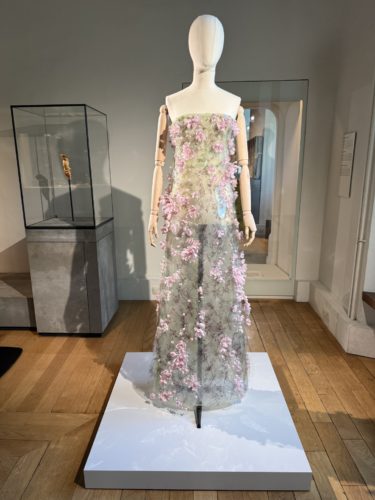
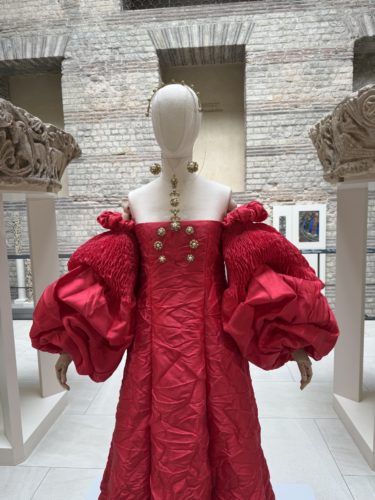
Silvio Giardino showed his collection at the Musée Cluny. Spaced throughout the galleries, carefully situated and placed, each piece was set within the permanent exhibition at the museum. Each piece matched perfectly within this middle ages focused location, yet for me I felt for some reason the shadow of Lucretia Borgia. The first red dress was a masterpiece of silhouette, colour and technique and this followed through the entire series of pieces. Perfect judgement is a strange attribute to identify, yet it’s essential for working in couture. The the proportions of a garment, the placement of decoration, the lines, shapes and silhouettes, and how to judge each element perfectly is not given to everyone but in couture they are necessities. Each piece here demonstrated an understanding of how couture fashion works, it interprets a vision of how a woman might dress but not just one woman, many and offers her options from short and flirty, long and languid, to splendid and strong.
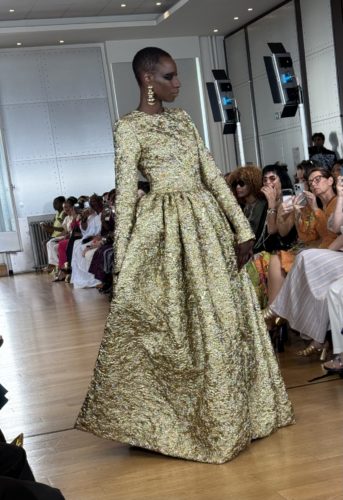
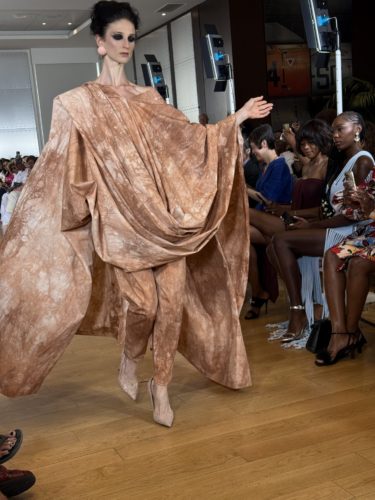
Imane Ayissi took us back to the heyday of couture, and it wasn’t just with the clothes shown in the collection, but by the models giving us a master class in posing, pausing and selling the looks as they paraded. It was charming, elegant, and witty. The clothes remain outstanding in their silhouettes colours and surprising cross cultural references. Being Cameroonian the designer substitutes raffia for feathers, swathes of fringed raffia for fur and swags taffeta in the mode of chieftains robes rather than an atelier. Colour vibrated throughout the collection from deep crimson red to a dense Azure sky blue to neon fuchsia accessorised with long scarlet gloves. A standout gold brocade ball gown and a sharp dandy tailored trouser suit in the same gold brocade recalled Yves Saint Laurent and his love of this fabric. Monsieur Ayissi took no prisoners in his sharp severely clean lines in both these looks, with no fuss, no accessories, merely gold earrings. Superb. The models had posed and offered drama on every entrance and the finale found them not only taking this on, but now dancing broke out with of course, as an ex dancer, the designer shaking a leg to tumultuous applause. As ever it left the audience, many already wearing Imane Ayissi, joyful and excited to purchase from the new collection.
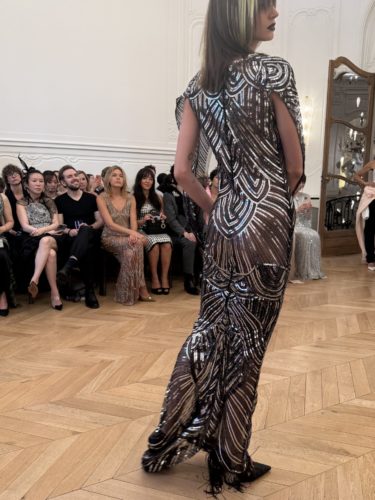

Is time travelling possible? Do couturiers have a different sense of time and fashion through the transformation of the past to create the future? Peet Dullaert tumbled me from 1960’s Biba in animal patterned narrow, narrow coats with peaked sleeve tops, through ruched pale apricot Fragonard taffeta, and even offered me Lord Henry Wooten from The Picture of Dorian Grey with a black severe, tailored look that spilt like ink behind the wearer from a fluid panel. An Art Deco passenger from the Normandie luxury liner sparkled in shimmering crystals. One black silk taffeta dress had a necklace like and inverted tiara, yet I then see in the ruched and ruffled “sleeves” concealed within them each hold another “tiara’ barely visible, perhaps the wearer is an international jewel thief from Raffles or Arsene Lupin, Jade Parfitt closed the show in a gown fit for Madame Bovery, or perhaps a John Singer Sargent portrait. These references I use are for me to explain or conjure up the incredible repertoire of fashion Peet Dullaert seems to employ to create his collections, his narrative and mine overlap but it’s mostly about plundering couture techniques to make extraordinary pieces. I love it so much, and my prejudice is transparent!
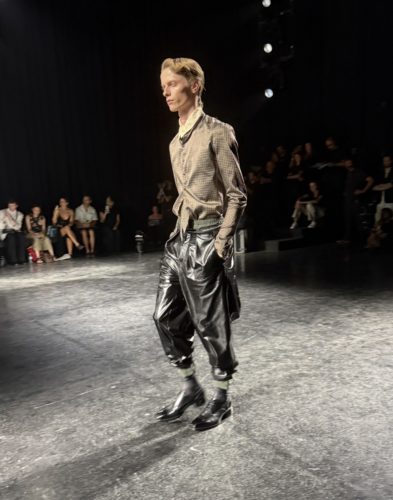
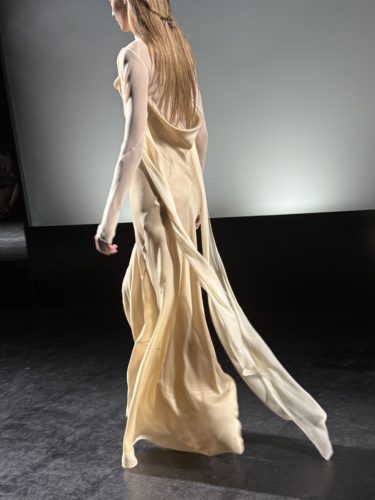
Boloria. This was a superb return for Olivier Theyskens, from own label, through Rochas, Nina Ricci, Theory, Azzaro and his own label, for those of us who love his work we have followed every move. This debut collection was entitled Le Monde Flottant, the floating world, the thought behind the collection was that it had a past. The collection hinting at the past and the way we’ve dressed across the decades and eras. With both the menswear and the women’s wear there was both a feeling of chic nonchalance, as well as a homage to the classic in fashion be that a trenchcoat or a ball gown. Theyskens demonstrated that his classic skills of understanding and creating a collection from sketch, through pattern and fabric choice, to the final details were all demonstrated in this version and vision of Belgian luxury. There were layers and juxtapositions of pieces with each element lovely in itself. The spectacular full skirts looks of the opening were matched by bias cut siren dresses later in the show. The darkness of the venue and the billowing smoke filled boxes still reflected the lightness of the clothes, a perfect example was a long, two button, double breasted coat dress in crepe that from a slender torsos flipped into a flared silhouette lower down. The atmosphere for me interestingly conjured up both the dandy and the gothic but across a genderless beauty of harmony. In the final analysis I’d say, I’d wear ever single piece of menswear in the collection, and for me it was a triumphant return for the designer.
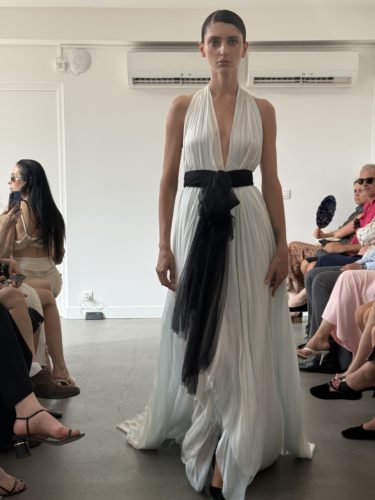
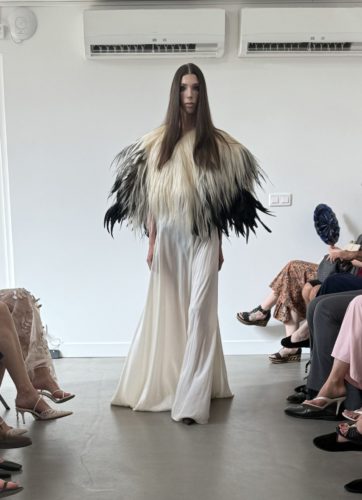
Aelis wandered through the salons of Nordic melancholy, the Polish enchantments of Chopin, and the misty regions of Camelot, creating clothes which filtered across the centuries to arrive at a modern romanticism. Sofia Crociani creates her collection each season with a continuing story, it’s one that links her work with a powerful consistency giving her pieces a unfolding harmony. A black velvet enfolding and unfolding robe featured white feathered cuffs ready to take wing, a fluid gown was sashed high, wide and deeply as though ready to be painted by Ingres or perhaps Boldini, the sheer layers drifted by recalling Les Merveilleuses and the bi-coloured black and shell pink wrapped dress had a vaguely familiar feeling, which I attributed to it reminding me of a sketch by René Gruau. The final pieces are modern and to some there might even be a punk or deconstructed story as the key element, but for me always with Aelis it’s her focus on a loveliness, yet one with a hint of sadness, love lost, something gone awry.
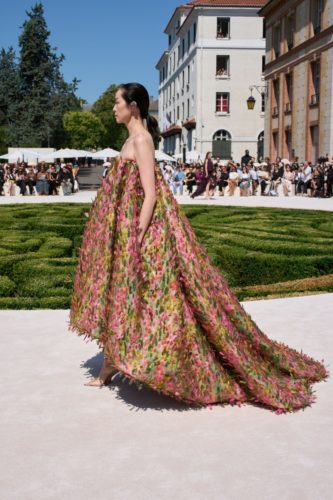
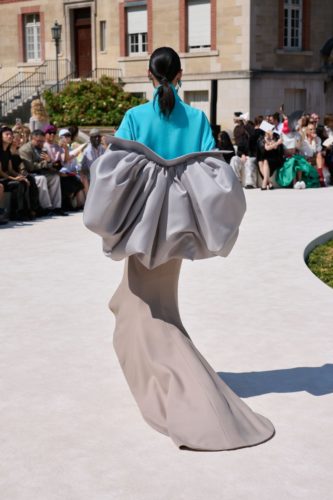
Pier Paolo Piccioli showed his first Balenciaga haute couture collection. It demonstrated perfectly a designer understanding the heritage of a house, the signatures of its founder and yet both acknowledging that and putting their own stamp on the pieces. He also made it look modern and desirable and also moved it on from Demna without demolishing or ignoring this strong predecessor. Shape and silhouette and line were always paramount to Monsieur Balenciaga and Pier Paolo took the past and reinvented it. Those of us with deep knowledge of the house could see the references from many seasons through the years the founder was at the helm, but often switched, twisted, lightened, or transformed. If a swinging and swaying trapeze line dress appeared, or a huge bubble of skirt, it wasn’t “old” Balenciaga it was modern because it was truly the new designer being inspired by the master. Indeed the colour usage was pure Pier Paolo one of the great modern colourists working in fashion. Indeed there was less black than might have been expected. There were also many stunning pieces of pure simplicity which balanced the extravagancies, a simple silk vest, a pair of wide trousers, a neat coat, a crew neck blouse, or a floor length shift. It’s a tightrope walking skill to understand how a collection may have an explosion of brilliant coloured feathers in one outfit and then a sharp linear black piece soon after, or a floating weightless drape of mousseline quickly followed by the scrunch and swell of taffeta. Pier Paolo Piccioli knows and understands couture, he took his bow with the workroom staff, without whom none of this is possible, but alongside his technical knowledge he is a true visionary alchemist of clothes, and this collection demonstrated this gift perfectly.
Later,
Tony Glenville
