At the Musée des Arts Décoratifs, a Brazilian photographer turns the language of fashion into an act of reclamation.
Dear Shaded Viewers,
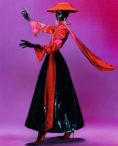
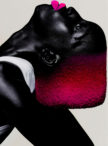
The room is dark before it is anything else. Then the colour arrives — a wash of hot pink and gunmetal violet, a woman named Naomi Apajok caught mid-turn in a Balmain gown so dark it seems to swallow the light around it, one hand lifted like a conductor cueing an orchestra only she can hear. This is the first image visitors meet at the Musée des Arts Décoratifs this autumn, and it announces, without a single wall text, what the following months will ask of them: to look at fashion photography the way one looks at cinema — not for the clothes, but for the charge in the air around them.
«Rafael Pavarotti, photographe» is the first major museum survey of a photographer who, barely a decade into his career, has become one of the most sought-after image-makers in fashion. More than 130 prints fill the galleries — magazine covers, campaign images, portraits of Rihanna, Harry Styles and Beyoncé — assembled under the eye of curator Sébastien Quéquet and staged within a scenography designed by Ibby Njoya, the artist’s longtime collaborator. It is less a retrospective than an immersion: a sequence of rooms built, like his photographs, around colour, texture, and the insistence that every body deserves to be looked at as if it were sacred. Even the sequencing feels directorial, as if Pavarotti and Njoya were cutting a film rather than hanging a show — each gallery holding its own temperature, its own palette, its own held breath before the next one opens.
Rewind to Belém, 1993 — a city at the mouth of the Amazon, humid air, green pressing in from every side. A twelve-year-old picks up his father’s camera and starts shooting the world within reach: the beach, the crumbling shell of an abandoned building, the ordinary textures of a childhood that will later flood back into his work as a private mythology. Then, in 2004, a grainy video finds him — John Galliano’s Ancient Egypt collection for Christian Dior — and something clicks into place. Photography, he decides, will be his life inside fashion. At sixteen he is already on the move: Rio, São Paulo, London, before Paris finally claims him in 2025.
Everything he shoots still carries the residue of that journey. The strong women of his family. The bright, cluttered objects on his grandmother’s shelves. The textures of his father’s handiwork. The forest itself, endlessly present as colour and atmosphere even when it is never named outright. Pavarotti is Afro-Indigenous Brazilian, and he has said that his images — and this exhibition with them — are made for the generations coming after him: pictures in which anyone, regardless of skin colour, might finally recognize a version of beauty built with them in mind.
“Colour has always been more than pigment to me. It is an ancestor, a rhythm, a spirit, a memory — a voice that existed before me and will outlast me. It belongs to the South, and to the new world now emerging.”
— Rafael Pavarotti
That politics of visibility runs through the whole show. One wall traces the history of Black models in fashion — Donyale Luna, Beverly Johnson, Naomi Campbell — before arriving at Pavarotti’s own 2022 British Vogue cover, “As the World Turns,” which put Adut Akech and Anok Yai at the centre of a new generation’s arrival. Elsewhere, silhouettes on mannequins face off against the magazine pages that inspired them, so the dialogue between image and garment becomes physical — something you walk through rather than simply read. Sketchbooks sit alongside finished covers, the whole apparatus of image-making pulled into view: nothing here pretends these pictures simply happened.
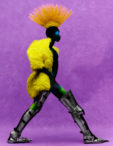
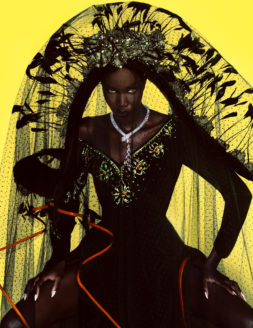
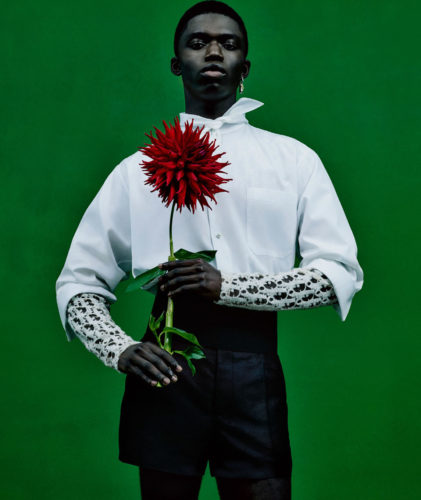
The photographs do the rest of the talking. A veiled figure glows in acid yellow, crowned in tulle and Bulgari diamonds, more summoned than styled. A dancer in a Balenciaga feather headdress strides across violet seamless paper, half bird, half warrior, for a story Pavarotti and stylist Katie Grand called Bird of a Feather. Nyaueth Riam, shot for Matthieu Blazy’s Bottega Veneta, commands a British Vogue cover with the stillness of a portrait bust. Jeremiah Berko Fordjour holds a single red dahlia against a field of green, made in collaboration with painter Amoako Boafo — quiet where so much of the show is loud, proof that Pavarotti’s register runs wider than spectacle.
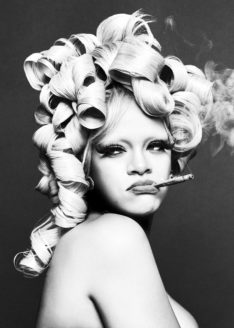
An earlier, rougher body of work threads through the later spectacle too: a 2019 series of male portraits for Double Magazine, made before the big campaigns and the magazine covers, when the language was still being worked out. Placed near the finished commissions for Balenciaga, Balmain, Chanel, Dior and Ferragamo, and the celebrity constellation of Beyoncé, Bad Bunny, Kate Moss, Rihanna, Harry Styles and Madonna, it lets visitors watch a signature style arrive in real time — the same conviction, still finding its full voice.
Across all of it, Pavarotti returns his women to the same handful of archetypes: empresses, goddesses, queens, warriors, each fully conscious of her own political, social and seductive power. It is a theatrical vocabulary, built from couture accessories and pieces of the artist’s own invention, developed alongside collaborators like Feben and Ib Kamara who, in the wake of Virgil Abloh, have spent recent years rewriting fashion’s visual grammar. Nothing in these rooms is neutral. Every gesture, every prop, every shard of colour is doing work.
Ibby Njoya’s scenography treats the museum like a set rather than a container: walls shift colour from room to room, sightlines are staged so one print announces the next before you’ve fully left the last, and the transitions between commissioned fashion work and personal projects are deliberately porous. You are meant to lose track, occasionally, of which image was made for Vogue and which was made for no one but the artist himself. That blurring is the point — Pavarotti has never treated the difference between a magazine assignment and a private photograph as a difference in seriousness, only in occasion.
The exhibition doesn’t end on a fashion image at all. Its final note circles back to where Pavarotti began — the Amazon — and an environmental urgency he has never separated from questions of identity and belonging. It is a quiet way to close a very loud, very colourful show: a reminder that for a photographer who has spent a decade insisting that skin, hair and body deserve to be seen as extraordinary, the ecosystem that shaped his eye in the first place is asking, now, for the same kind of attention.
«Rafael Pavarotti, photographe» runs at the Musée des Arts Décoratifs, 107 rue de Rivoli, Paris, from 2 October 2026 through 2 May 2027. H&M is principal patron, with support from Iguatemi.
Later,
Diane
