
Dear Shaded Viewers,
There was no shade. That is the first thing to say about this show, because it matters: the umbrellas came down, the sun landed flat and merciless on that long flight of pale stone steps rising out of the greenery of the Cité Universitaire on Boulevard Jourdan, and several hundred people who had dressed for couture and not for the park in July sat there fanning themselves into a slow, collective rhythm, waiting. They had given us glass bottles of water, already warm to the touch, and paper fans that fluttered up and down the rows like a flock of restless birds deciding whether to take flight, and umbrellas for anyone who hadn’t thought to bring their own — which was almost everyone, except me, shielded under my own pink Japanese parasol while the rest of the row stirred the air with paper fans and warm water. And then it began, and none of us cared anymore.
Fifteen minutes. That’s all it took. Fifteen minutes for Pierpaolo Piccioli to walk out from behind the curtain of his own history — Valentino’s twenty years, the romanticism, the color theory, all of it set down like a coat on a chair — and step into a house that asks a completely different question of its designer. Not “how do you make someone beautiful,” but “how do you make architecture breathe.” And on those steps, in that impossible heat, he answered it.
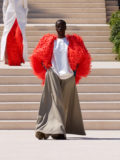
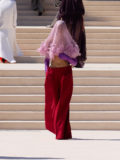
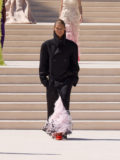
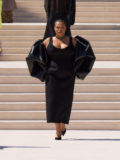
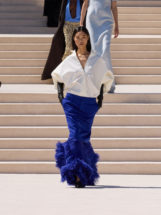
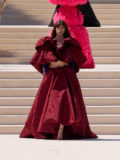
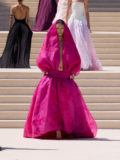
The first cape came down the stairs like a held breath — a sunset-red silk gazar balloon, feather-embroidered, worn over nothing but a white t-shirt and a pair of trousers wide enough to hold weather in them. It should have felt like a costume. It felt like a proposition. This is what Piccioli understood before anyone else in the audience did: that Cristóbal Balenciaga was never a romantic in the way people use that word carelessly. He was a builder. A man obsessed with the distance between fabric and body, with silhouette as engineering, with the idea that a coat could stand on its own the way a piece of architecture stands on its own, independent of whoever happens to be inside it. Piccioli, for the first time in a very long time, let himself be a builder too. And it turns out it was in him all along — this is, after all, still haute couture’s most patient student, a man who has spent a career listening to what fabric wants to do before he decides what he wants it to do.
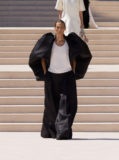
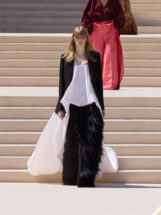
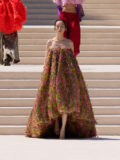
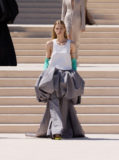
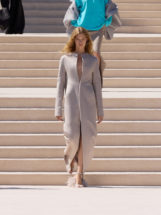
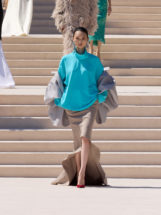
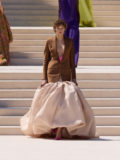
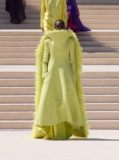
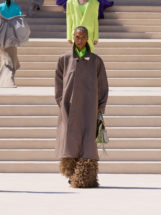
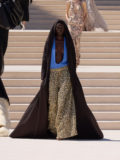
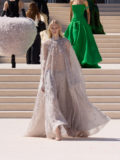
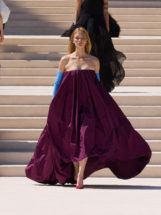
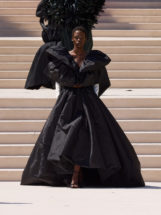
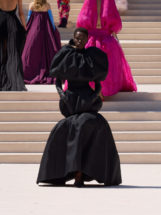
You could see it best in the pieces that shouldn’t have worked and did: molded cashmere cocoon coats built from three-dimensional scans of real bodies, their leather understructures cut like internal carapaces, giving those improbable, ballooning shapes an architectonic lightness that had no business existing. A grey moiré silk skirt-trouser hybrid inflated into a bell around the legs. A taupe kick coat with a turtleneck the color of a struck match underneath it. Tailoring dissolving into flou and then hardening back into tailoring again, two centuries of couture vocabulary fused into a single sentence.
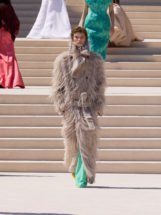
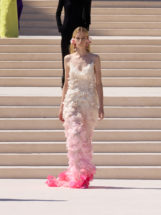
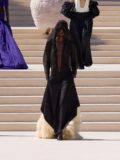
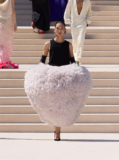
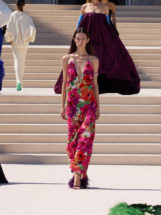
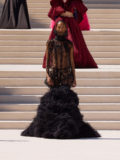
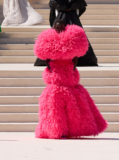
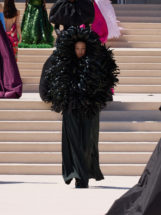
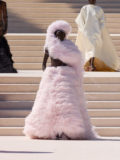
And then, impossibly, feathers — used not as embellishment but as argument. Piccioli’s collaboration with Philip Treacy produced headpieces that erased the line between millinery and garment entirely: a face swallowed by a corona of black rooster feathers, a body disappearing into a cloud of quartz-pink ostrich plumes, a girl walking down those blazing steps wearing what looked like a fistful of hot-pink chrysanthemums grown into a dress. Feathers, the notes said, as metaphor — weightless, delicate, yet possessed of real tensile strength. Watching them move under that sun, catching light with every step, you understood exactly what they meant. There is a kind of strength that only shows itself when something fragile refuses to break.
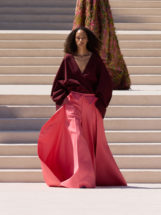
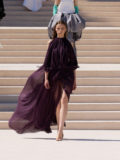
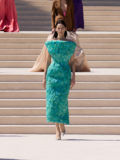
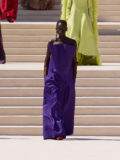
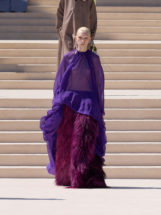
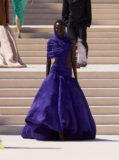
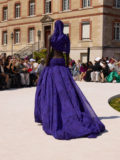
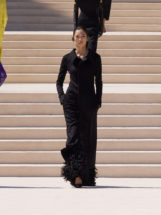
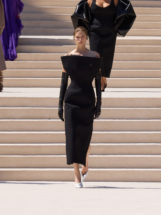
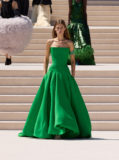
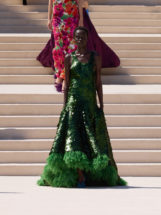
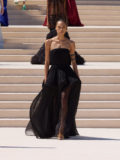
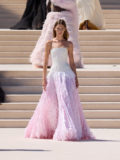
The color, when it arrived, arrived like punctuation: a violet gown so saturated it looked wet, a bottle-green sequinned dress with a hem gone to feather, a wall of red femininity followed immediately by a procession of black that reduced the same silhouettes to shadow — Piccioli’s own device, repeating a look in pure black to reset the eye, to force you to see shape and nothing else. It is the oldest trick in couture and one of the hardest to pull off, and here it read like punctuation in a story that already knew exactly where it was going.
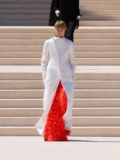
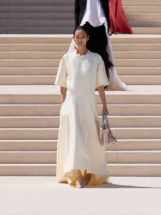
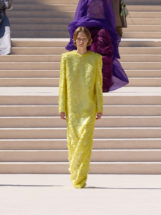
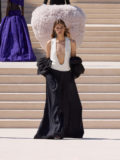
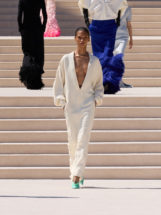
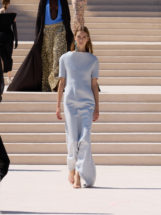
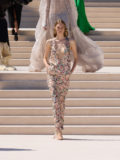
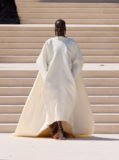
What struck hardest, though, wasn’t the spectacle — Balenciaga has never lacked for spectacle — it was the restraint underneath it. The white plunge-neck jumpsuit, hands in pockets, walking down the steps like a closing statement. The monastic ivory wool-and-silk dress near the end, almost severe, almost a habit. Piccioli has always known how to build toward silence, and here, sandwiched between all that feather and color, the plain pieces did more work than anyone expected them to.
By the time the last look passed — Gigi Hadid all but disappeared into a wreath of black feathers, only her face left uncovered, dragging a dark green train down those sun-scorched steps — the heat didn’t matter anymore. Nobody was thinking about the umbrellas or the time we’d spent squinting into a Paris sky with nowhere to hide. We were thinking about what we’d just seen: a designer who had spent a year, in his own words, “getting to know” a house — searching, trying, remembering — and who had come out the other side having found not a new voice, but his oldest one. Because Piccioli’s real gift was never colour or drama for their own sake. It is his native fluency in haute couture itself — its grammar, its impossibilities, its insistence that a piece of cloth can become something closer to sculpture than clothing. Balenciaga didn’t soften him. It reminded him what he already knew.
Fifteen minutes, in full sun, with nowhere to sit and nowhere to hide. It felt like nothing. It will be remembered as everything.
Later,
Diane
