Fashion writing leans hard on the word new, as though talent condensed out of thin air the moment we happened to look. The word flatters the audience and insults the work. When Standing Ground showed on the first evening of the Fall-Winter 2026/27 haute couture season, in the celadon and gold salons of the Irish Embassy on Avenue Foch, nothing was new. Fifteen years of labour were finally granted a room, a public, and a place on the official calendar of Haute Couture Week. Michael Stewart has been walking towards this evening since before his 2017 graduation from the Royal College of Art. The only novelty is our attention.
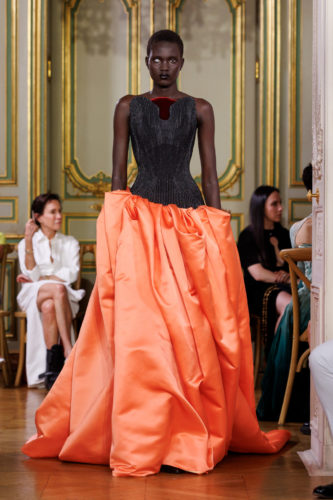
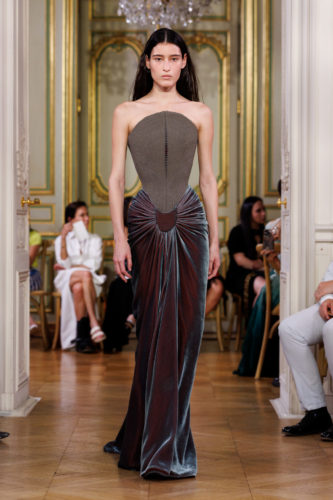
The opposite of new is not old. It is ancient, and ancient is what the room saw. Stewart keeps no moodboards and refuses imagery, and he has told Vogue that the standing stones of his native Ireland are less a reference than a way of working, the emanation of a powerful figure he imagines rising from a deep past. This season she walked. Look after look, women seemed to grow out of the ground rather than step out of a backstage, silhouettes with the density of megaliths and the pulse of skin, and every one of them organised around a single point of pressure, the waist. Laced, boned, compressed, then released into movement below. The show opens with tailoring in dove grey, black and emerald, jackets fastened along serpentine channels that loop over the hips like contour lines on a survey map. Draped columns follow, silk jersey in cobalt, chocolate, sage and lilac. The final act belongs to corsetry proper, sculpted bustiers of suede and velvet erupting into volumes of taffeta and duchesse satin, one wisteria, one a burning apricot.
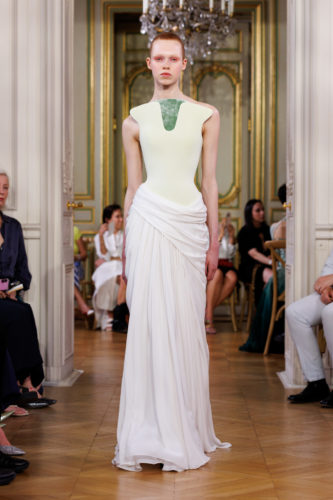
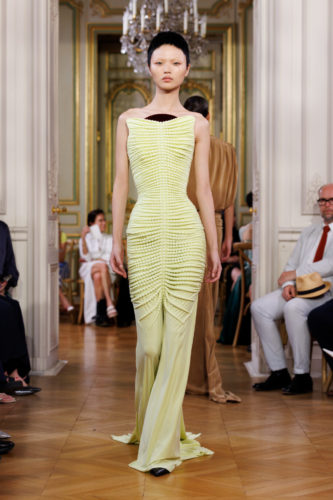
The closer you look, the more the clothes resist first impressions. What reads at first as corded quilting reveals itself as rows of beads encased beneath the surface of the cloth, the technique Stewart has made his signature, and the same hidden strands weight the jersey so the fabric falls the way a current pulls a river. It was this quiet virtuosity that earned Standing Ground the inaugural LVMH Savoir-Faire Prize in 2024, recognising exceptional craftsmanship and technical expertise. The show notes thank Mr. Pearl, the most exacting corsetier alive, a name that tells you the standard Stewart holds himself to. Colour is tuned with a jeweller’s ear. Speaking to The Irish Times before the show, Stewart called one of his shades “pale goosebump green,” and the surfaces take him literally, several gowns ruched over rows of raised beads until the cloth prickles like chilled skin.
None of it condensed out of thin air. Stewart grew up in Kilkishen, County Clare, trained at the Limerick School of Art and Design, then moved to London. After graduating he spent five years making exacting pieces that almost nobody saw, work he once jokingly described to Vogue as his “bedroom couture.” He founded Standing Ground in 2022, and then three hands reached out, each worth naming. Lulu Kennedy, whose Fashion East incubator launched Jonathan Anderson, Grace Wales Bonner and Simone Rocha, pulled him onto her runway in 2023. Trino Verkade, Alexander McQueen’s first employee and now the head of the Sarabande Foundation, gave him studio space. Mark Wadhwa, the developer behind the 180 The Strand arts complex, followed with an atelier. Through it all Stewart refused wholesale and dressed only private clients, women he never sees photographed in his clothes and prefers not to. In 2024 the inaugural Savoir Faire award of the LVMH Prize brought the invitation to Paris, where he now shows as a guest House on the official calendar of Haute Couture Week. Then he chose silence, two years of it, on the principle that a mouth should only open when there are words worth the air. The label keeps an Instagram account and no website. Clients arrive by word of mouth or not at all.
From the front row, Delphine Arnault, Stewart’s champion since the LVMH Prize, and Alison Milton, Ireland’s ambassador to France, watched the closing look settle the argument between armour and skin. A transparent gown of Carrickmacross lace, its appliquéd vines and dragonflies worked over months by the lacemakers of County Monaghan in a technique dating from the 1820s, worn barefoot. After all that compression, fragility takes the last word, and so does a craft community older than any House on this calendar.