

Dear Shaded Viewers,
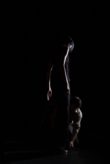
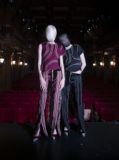
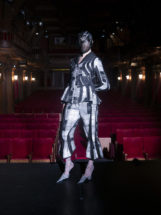
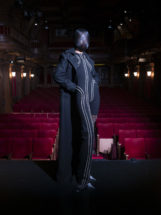
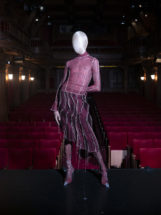
There is a particular kind of silence that falls over a theatre once the audience has gone — rows of red velvet seats standing at attention for no one, gilded balconies holding their breath in the dark. It is into this silence that Raphaël Traband sends his figures walking, one by one, faceless.
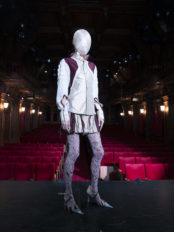
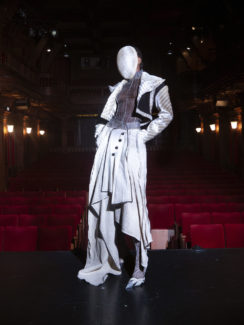
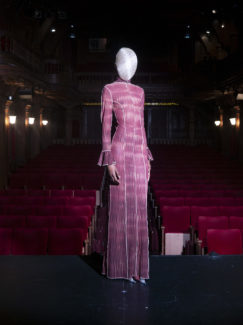
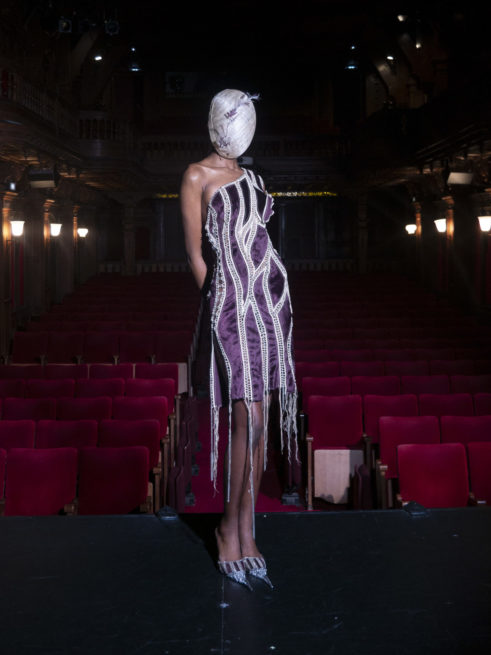
They arrive not as models but as apparitions: heads sealed beneath woven sinamay masks, blank ovals of straw-pale fiber or black mesh drawn taut over the architecture of a skull. No eyes. No mouth. No name to settle on. What remains instead is posture — a hand resting at the hip, a shoulder dropped in thought, a body’s private grammar speaking where a face cannot. Traband, who trained under Fred Sathal and Jean Paul Knott before striking out alone in 2021, has never been interested in the face as the seat of identity. INVISIBLES proposes something stranger and more tender: that the self might live instead in seams, in the way a hem frays and is left to fray, in stitching pulled loose and never tucked away.
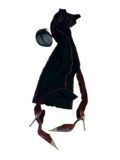
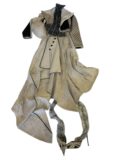
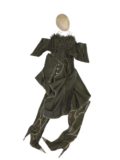
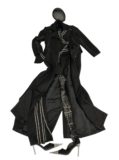
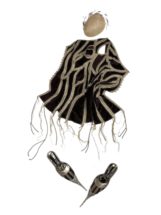
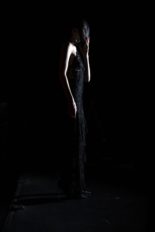
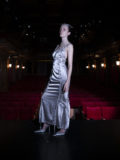
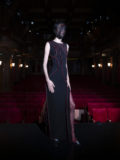
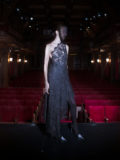
The garments themselves carry the same refusal of polish. A bias-cut slip dress in oyster satin is left raw at the edges, threads dangling like something still becoming. A corseted bodice of pinstriped wool splits open down its boning, feathers erupting from the neckline as if the body beneath were sprouting wings it hadn’t asked for. Elsewhere, a one-shouldered gown of black lace bares one breast through its floral net with the same matter-of-fact intimacy as the exposed stitching elsewhere — concealment and exposure treated not as opposites but as two threads of the same weave. Even the crystal-spiked heels, hard and glittering, seem grown rather than cobbled, claws at the end of impossibly long legs.
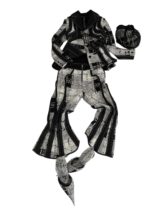
Colour moves through the collection like sediment through water: bone, oxblood, smoke, the deep plum-black of a bruise just turning. Pinstripes recur obsessively, sometimes structured into tailoring, sometimes liquefied into a paisley-soft jersey that clings and pools like something half-dissolved. A black-and-white jacquard suit, sharply tailored at the shoulder, flares without warning into trumpeting, ruffled hems — discipline giving way to excess at the ankle, as though formality could only be sustained so far down the body before nature reasserted itself.
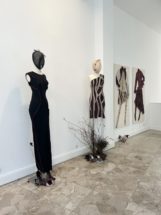
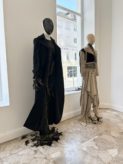
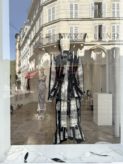
Staged at Galerie Maria Lund in Paris’s Marais, INVISIBLES extends past the garments into installation — mannequins dressed and arranged like reliquaries, dried branches and pressed ferns laid against silk the way a forensic team might lay evidence, a metal crown of thorns suspended mid-air over an empty satin dress. A second, narrower gallery space — windowless, lit in cold fluorescent strips — holds a single masked figure at its vanishing point, flanked by torn-paper portraits of bare-shouldered figures wearing the same blank straw masks. The cumulative effect is less runway than reliquary: a chapel built for bodies that have chosen to disappear.
It would be easy to read the masks as simple spectacle, theatrical flourish for flourish’s sake. But Traband’s project resists seasonality and serial production by design — these are not collections meant to be repeated or mass-produced, but singular garments built slowly, in dialogue with the body that will wear them once. The facelessness, in this light, reads less like erasure than like privacy reclaimed: a refusal to be consumed by the gaze even while standing, lit, on a stage built for looking. Invisibles — the invisible ones — are not absent. They are simply unwilling to be fully known. In an industry built on recognition, on the instantly identifiable silhouette, on the face as brand, Traband offers something quieter and more unsettling: fashion as a place to hide, beautifully.
INVISIBLES
Collection 2026
Lookbook photography: Lucas Pagès
Backstage photography: Syene Bernal Luna
Creative Director
Raphaël Traband
Masks
Brian Pucel
Feather Artistry
Fabienne Fleury
Later,
Diane
