
In 1896, the architect Louis Sullivan gave design its most enduring law, form follows function. He found it in nature, in the eagle’s flight and the opening apple blossom, and he meant it for the steel skyscraper, where structure was what set the space free. At the Cercle National des Armées, the officers’ club on Place Saint-Augustin, Hed Mayner showed a Spring-Summer 2027 collection that bends the old rule by a degree. Here form follows freedom. The clothes are built with great precision, yet everything is engineered toward the same end, to leave the body loose, light and entirely its own.
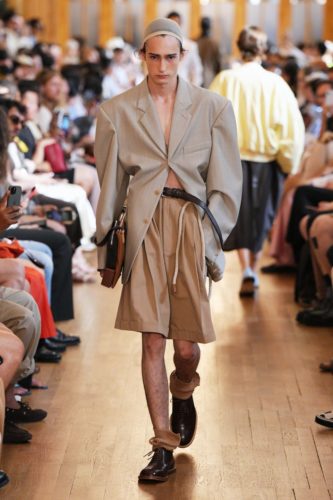
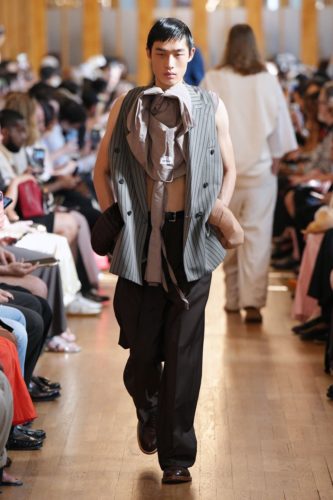
The real subject was fabric. A matte vegan leather coat in oat fell over wide trousers cottoned and crackled like dried paint. Supple jute met chalk-coated cotton and pleated linen. Strips of fabric hung loose from a jacket and a shirt, swinging as the model walked. Colour stayed low and warm, cream and rust and burgundy, with a pale blue surfacing here and there like a break in cloud.
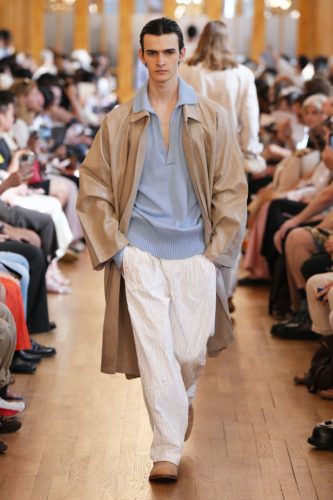
For all the volume, nothing dragged. The models walked at a brisk, purposeful clip, and the clothes moved with them, framing the body without ever pinning it down. Sleeves were cut so the gesture ran forward, ahead of the wearer. Hems swung. Some cuffs ended in stiff concertinas of pleated cloth, lanterns that held their shape at the wrist, firm where you would expect a sleeve to fall soft. A coat in pale blue-grey, its wide white collar thrown back, opened over a long shirtdress and kept pace stride for stride. A sky-blue knit polo sat easy under a matte coat, the trousers below crackled and loose. What might once have read as extreme, the sheer scale of it, now read as the most natural thing in the world, clothes you could live and move and cross a city in.
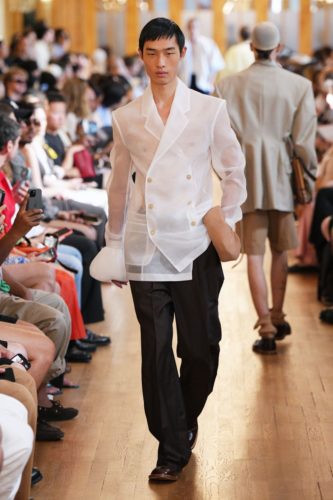
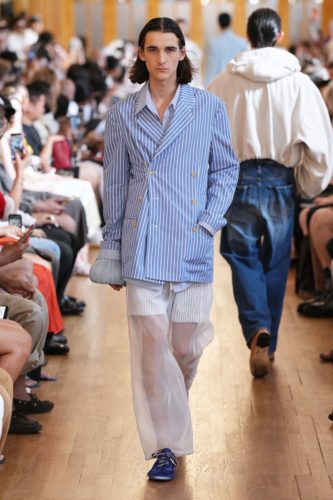
Here and there the paring went all the way to transparency. A double-breasted jacket in white organza kept every line of tailoring while letting the light straight through, a ghost of a jacket, the thing and its own shadow at once. Elsewhere the sheerness fell to the trousers, a veil of white over the leg, an ankle and a calf surfacing as the model walked. It was not a stunt but the idea at its furthest reach, the logic of the collection followed to its end, a wardrobe lightened until barely anything remained, yet still, unmistakably, clothes.
This refining has been a while in the making. Last January, Mayner was the guest designer at Pitti Uomo, the biannual Florence gathering that is the menswear world’s town square, and the critics read the collection as a turning point, the volumes quieter, the scale calmer, more coherent. Spring-Summer 2027 carries that on.
That command of volume has deep roots. He trained at the Bezalel Academy in Jerusalem, then at the Institut Français de la Mode in Paris, and founded his independent, unisex label in 2015. In 2017 he became the first Israeli designer on the official Paris calendar, and in 2019 the LVMH Prize handed him its Karl Lagerfeld distinction. His sense of volume owes much to a tradition in which clothing wraps the body rather than moulds it, the whole secret of a Mayner garment, it holds you without gripping. This season the shoes came from two collaborations, a flocked version of Aro’s Joaneta mesh sneaker in two colourways, and, with Sturlini, a heelless Oxford on a flat insole, soft moccasins and whipstitched canvas boots.
On the way out, a single case held two old army uniforms, one of them caped, its trousers gathered full at the ankle, cut to fix a man in place rather than set him free. The opposite of Mayner’s aim.
