






























Dear Shaded Viewers,
There’s a spinning wheel in one of the backstage images for John Alexander Skelton’s CXXI, and a model standing in front of a bobbin-winder stacked with spools of thread in another. It would be a heavy-handed prop in most collections. Here it’s closer to a citation. CXXI — Skelton’s twenty-first numbered collection — is an extended piece of research into a single square mile of East London and the refugees who turned it into one of the great textile centres of the 18th century.
Skelton’s starting point is Spitalfields, and specifically the Huguenots — French Protestants driven out by religious persecution who resettled there in the 1680s and built the area into a silk-weaving powerhouse, with as many as 40,000 looms reportedly running at its peak. What he’s drawn to isn’t just the textiles but the architecture they demanded: tall houses with a weaving garret at the top, lit by oversized windows angled for the long hours the work required, with the floors beneath given over to warping, spinning and dyeing, and only the ground floor left for actual living. It’s a cottage industry stacked vertically into a home — production, craft and domestic life sharing the same four walls, which is more or less the romantic ideal Skelton’s own practice quietly aspires to.
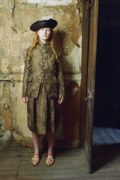
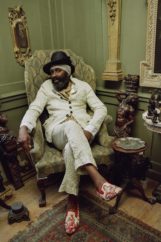
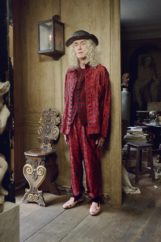
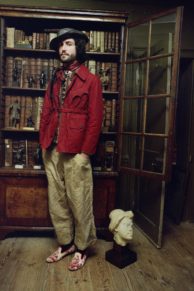
That history shows up directly on the runway. Tricorn hats — some in black straw, others in a weathered, almost leather-like finish — appear on nearly every model, the clearest silhouette cue to the period. Underneath, the clothes lean into rich, saturated colour in a way Skelton’s recent collections haven’t: crinkled, almost liquid-looking silk in crimson, burgundy and old gold, set against black and cream striped shirting that nods to the ticking and workwear cloth of the weavers themselves. A single accessory threads through nearly every look — a red-and-white printed loafer, the toile pattern doing double duty as both a literal callback to French textile tradition (toile de Jouy is, after all, a French invention) and a wink at the Huguenots’ own displacement from France to London.
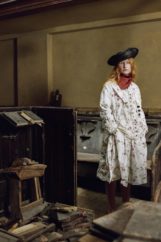
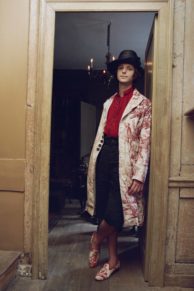
The collection’s most specific reference point is Anna Maria Garthwaite, by Skelton’s account the most prolific of the Spitalfields silk designers, who broke from the more geometric, East-Asia-influenced patterns of predecessors like James Leman in favour of designs built almost entirely from flora — gathered locally, then stylised into repeating, almost abstracted botanical motifs. Skelton calls CXXI an ode to her directly, and the clothes make the connection legible without being literal: floral embroidery sits at the chest of plain striped shirts, jacquard trousers in navy and ivory carry dense, repetitive blooms, and one coat-dress arrives printed all over in small multicoloured florals on white ground, worn with a blood-red neckerchief. It’s the most overtly decorative Skelton’s clothes have looked in several seasons, and it earns that decoration through research rather than reaching for prettiness on its own terms.
He pushes the horticultural thread further back than Garthwaite, too, into the ground Spitalfields stood on before the Huguenots arrived — working medicinal herb and flower gardens supplying the City of London, tended in part by the botanist Nicholas Culpeper, whose herbal compendium became one of the most influential of its kind. Skelton’s note draws a line, however indirect, from Culpeper’s gardens to Garthwaite’s silks to his own floral prints — three centuries of people in the same patch of London looking at plants and turning them into something else.
The lookbook itself is staged inside what reads as a series of genuinely lived-in antiquarian interiors — peeling green-painted panelling, gilt-framed oil paintings, cabinets crowded with blue-and-white delftware and Chinese export porcelain, a wing chair in faded damask, candlelit wall sconces. Nothing here looks art-directed into looking old; it looks like rooms that simply never stopped being old, which suits Skelton’s long-standing habit of treating location as a collaborator rather than a backdrop. The cast spans decades in age and is, as usual for Skelton, made up of real faces rather than agency types — a white-bearded elder in scarlet silk pyjamas-as-suiting, a younger model perched on a stool in a cluttered curio shop, an older man with long grey dreadlocks in a toile shirt that matches the collection’s signature shoe. A woman in the floral coat-dress continues the womenswear thread Skelton opened for the first time in Collection XIX, still small in scope but clearly not a one-off.
In his own note on the collection, Skelton frames all of this under a word he returns to often: romanticism, which he describes as a fascination of his and, more pointedly, a reaction against modern fashion and modern life in general. CXXI argues that case by example rather than slogan — by spending real research on a half-forgotten London industry and its refugee craftspeople, and by finding in their floral patterns and attic workrooms something worth carrying forward rather than simply quoting. Twenty-one collections in, that’s still the engine of Skelton’s whole project: history treated not as costume but as material, cut and worn like any other cloth.
Later,
Diane
