
This season, Kenzo came home. For Spring Summer 2027 the House took over the Place des Victoires, the circular square in the heart of Paris where Kenzo Takada opened his first boutique in 1976. He turned the spot into one of the most alive corners of the city, a lively and legendary flagship that welcomed the world in. Half a century later, the House returned to the ground that made it, and the gesture mattered as much as the collection itself, the façade flowered for the day and five addresses around the square given over to Kenzo.
The man steering that homecoming is Nigo, who has led Kenzo since 2021. He arrived as one of the most influential figures in global streetwear, the founder of A Bathing Ape and later of Human Made, the designer who launched Billionaire Boys Club with Pharrell Williams, a DJ and producer as fluent in music as in clothes. His company Human Made has just moved to take over Undercover, the House of his old friend Jun Takahashi, the two of them bound since the Harajuku store they ran together in the nineties. At Kenzo he has spent nearly five years in patient dialogue with the archive of Takada, and this collection felt like that dialogue reaching the very place where it began.
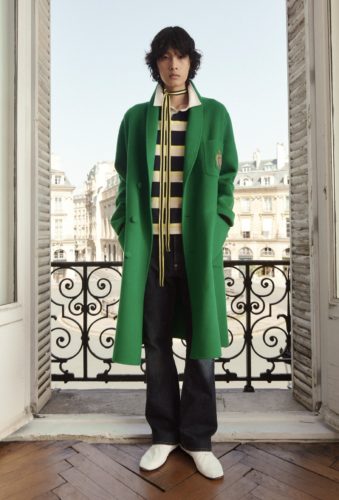
What unfolded across the two floors of the presentation was a wardrobe with the colours of a school and none of its discipline. The grammar was collegiate, varsity jackets, rugby shirts, heritage insignia, ribbons in the tones of a campus, yet Kenzo stripped the preppy register of everything that usually makes it stiff. This was the uniform of an institution that had decided to enjoy itself. Joyful, easy, a little cheeky, and never sage.
The piece that held the whole mood was a green coat. Not the polite green of a college blazer but a fir green pushed somewhere brighter and stranger, a fir green seen under a slightly altered light, finished with an embroidered collar that turned a point of construction into ornament. It read like the school colour after it had been let out for the holidays.
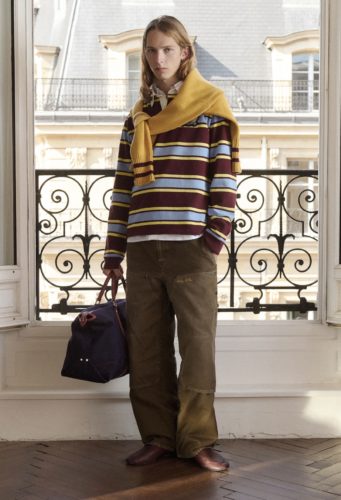
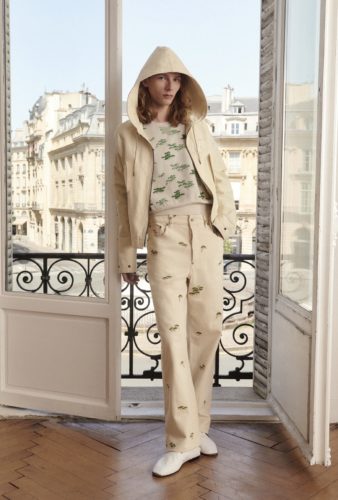
Behind the playfulness sat a careful conversation with that archive. The ribbons that ran through the collection were never decoration for its own sake. They reach back to the haberdashery shops that once lined the square, where Takada gathered the ribbons he loved, and to the embroidered ribbon dress he made to close his Autumn Winter 1982 show. Florals arrived in the same spirit, from faithful archival recreations to blurred painterly versions, alongside bonsai motifs drawn from one of Takada’s own poems. Those flowers did not stay on the cloth. A few doors along the square, the Parisian florist Debeaulieu dressed Kenzo Fleurs with seasonal arrangements pulled from the world of the House, and the printed blooms inside found a living echo in the street. On the upper floor the collection turned to the archive itself, where Japanese denim and houndstooth carried the heritage in a quieter key.
Nigo framed the season as a collection of meeting points, where sportswear met romance, the boyish met the soft, and the masculine and feminine crossed without friction. A knitted rugby shirt fell into a long gown. Varsity detailing migrated onto footwear. The clothes felt confident and eclectic, assembled with the happy logic of a chance encounter on a busy square.
The joy is also a plan. Kenzo staged no runway this season, the second in a row without one, and offered instead a takeover open to all for a week, the café and the konbini, the flower shop and the pop-up gathered around the square. Behind the choice is Charlotte Coupé, the new chief executive, who wants the House to reconnect with what Takada was before fashion turned solemn. She returns to his shows of the seventies, when his models paired off, danced and smiled their way through and made each one feel like a party, and she is clear that Kenzo can keep that lightness while the business beneath it grows up. Seen that way, the green coat and the campus colours are not only a mood. They are a direction.
For all the talk of plans and product, what Kenzo carried back to the square was a temperament. Takada built this House on the idea that clothes could be joyful without being slight, and Nigo did not so much inherit that idea as sit the same exam in his own hand. On the square where it all started, flowered and crowded again, the House looked like it had come home with honours.
