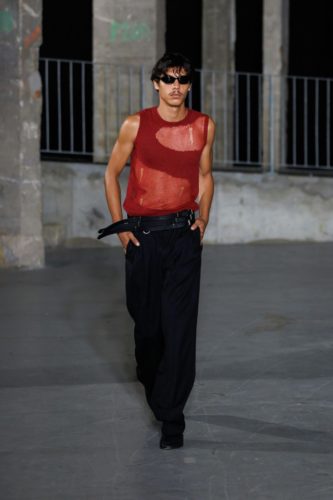
In the basement of the Palais de Tokyo, the fans were out, paper ones, battery powered ones, anything that could move a little air. On the opening day of Paris menswear, the audience came down to the foundations of the building in shorts of every length. Everyone had dressed for the short term while waiting on an eternity, which happens to be the name of the collection. Short Term Eternity. The phrase loops through a rhythmic jazz score by Pierre Rousseau as the silhouettes morph between tailoring and workwear and back again. The boys had come to work. Next summer looks a great deal like the last one, which may well be the point.
Études Studio is called Études, studies, for those among us who do not speak French, for a reason that is almost too simple. A study is never finished. It is provisional and precise at once, a sketch that hopes to outlast the paper it sits on. For their twenty ninth collection, Aurélien Arbet and Jérémie Egry found the ideal patron for that paradox in Gordon Matta-Clark.
The American artist, who died at thirty five in 1978, was a trained architect who spent a brief career cutting into buildings already condemned, turning demolition into drawing. He called it anarchitecture. The duo dwelt on one work above all, Conical Intersect, for which Matta-Clark bored a vast cone through two Parisian houses from the seventeenth century, both due to fall for the construction of the Centre Pompidou. The reference is almost too neat, since Études showed its autumn winter 2026 collection a few steps from that very spot, and the collection borrows its very name, Short Term Eternity, from a set of Art Cards the artist once made.
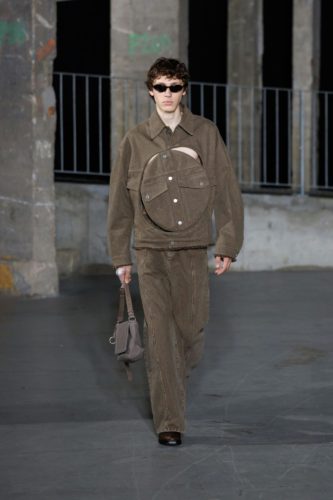
The real subject, though, is the city in flux. A photograph of the quarter, seen through the perforated concrete, becomes an all over print on a silk shirt. A heavy canvas jacket worn against bare skin opens with a circular hole at the chest and another in the back, and a long coat takes the same incision front and rear. Denim turns up overdyed, acid and stone washed, sprayed and sealed with resin, one ensemble printed with graffiti. The palette reads like a weathered façade, chalky beiges and greige sands, metallic browns and brick reds, dusty khaki and charcoal pricked with deep aubergine.
Beneath the statement pieces runs a steadier story of elevation. Études speaks most fully in winter, so rather than strain for a summer wardrobe the studio offered a midseason vision, the kind that holds together on the shop floor. The independent label now counts around sixty stockists, well up on a year ago, and the materials carry the ambition. Knitwear turns luxurious through openwork structures in cotton and nylon, jacquards and bouclé wool. Chalky white trousers, sand coloured blousons and tailoring cut from textured blends of virgin wool and viscose, of linen and washed silk, sit over shirts in Tencel and organic cotton, and the whole edges the house away from its streetwear and workwear roots.
One look lingers, a teal coat over fluid chocolate trousers gathered just above the ankle by a thin cord, finished with the studio bag, a generous piece in grained leather that gives the silhouette its weight. Even as the brand moves towards a more contemporary, more luxurious register, the hand of the designers keeps the Études signature legible, not least in the thick belts that borrow their logic from the support belts of the building trade.
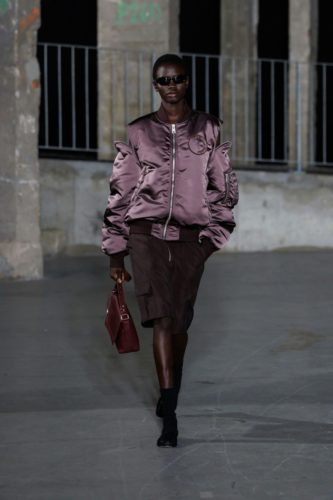
Études Studio has always dressed women as much as men, with female customers making up more than forty per cent of its base, so the half dozen women’s looks read less as a detour than as a homecoming. Among them, a satin purple bomber with detachable sleeves worn half open, and a treated denim jacket over supple, flowing leather trousers. Footwear made with La Botte Gardiane and Hereu, eyewear by Chimi and jewellery by Agmes round out the wardrobe.
And so the paradox holds. Matta-Clark cut his cones into buildings that were about to vanish, fixing impermanence on film. Études Studio, cutting the same circles into canvas and wool, is reaching for the opposite, for clothes that last, for a study that finally holds. A short term eternity, sung on a loop, for an industry that lives one season at a time.