
Running from 15 April to 16 August 2026 at the Fondation Louis Vuitton in Paris, Calder. Dreaming in Equilibrium brings together nearly 300 works spanning half a century of creation and one simple, radical idea: that art can be as light as air and as strong as steel, that a piece of painted metal turning softly in a draught can change the way you see the world. One hundred years after Alexander Calder first arrived in Paris, this retrospective gives him the space he always deserved, monumental in scale, effortless in spirit, and filled with pure, much-needed joy.

In the summer of 1926, a young American artist left New York on a cargo ship bound for England, then made his way by train to Paris. He was the son and grandson of sculptors, trained as an engineer, fresh from the Art Students League of New York. He was twenty-seven years old. What he did next took everyone by surprise.
The retrospective at the Fondation Louis Vuitton traces this revolution across every gallery and out onto the adjoining lawn. It opens with the circus, a miniature performing universe built from wire, cork and fabric scraps, which Calder performed himself in Parisian salons from 1926 to 1931, providing the sound effects with his own voice. Built from almost nothing, it holds everything. The acrobats, the trapeze artists suspended mid-leap, the ringmaster with his wire moustache: the tenderness of it is absolute, and it contains already every idea Calder would spend the rest of his life developing. Balance. Lightness. The refusal to take gravity entirely seriously.
From there, the show follows him into abstraction. A visit to Mondrian’s studio in October 1930, which Calder himself described as a shock that started things, marks the great turning point. The wire portraitist became an inventor of new spatial languages almost overnight, and Marcel Duchamp coined the word “mobiles” for his kinetic compositions the following year. Working between his studios in Roxbury, Connecticut and Saché in the Indre-et-Loire, using the most humble materials in surprising ways, Calder built a body of work in which nothing is fixed and everything is poised.
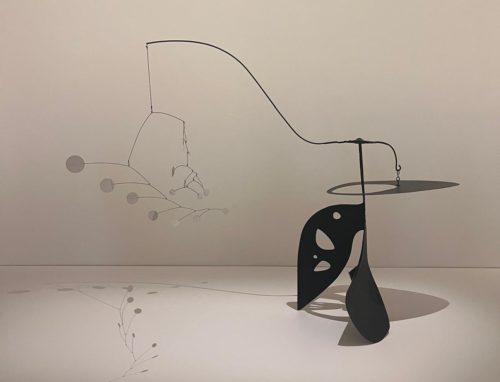
Oh, and the shadows. As the mobiles turn, their shadows move across the walls with a slowness that feels alive. It is not incidental; it is part of the work, as deliberate as the metal that casts it. Calder understood that a sculpture occupies not only the space around it but the light passing through it and the darkness it leaves behind. Outside, on the lawn, the monumental stabiles. These colossal steel forms command space without enclosing it, fill a room without touching the walls, articulate the void without filling it. They belong to no fixed dimension.
Gabrielle Buffet called him a sculptor of wind in 1946. Sartre described his objects as strange creatures, mid-way between matter and life. Both were right, and both were pointing at the same thing: that Calder’s works do not represent nature, they participate in it. Wind, gravity, light, shadow, the accidental movement of a body passing through a gallery, all become co-authors. To leave this exhibition is to re-enter a world that feels, briefly, lighter than before.
