


Dear Shaded Viewers,
380 people dressed, or possibly disguised, as trees to surround Bad Bunny at the Super Bowl 2026, the designer as a photographer, a pair of designers assembling a human kite in front of our eyes, or Jacquemus on the sea shore spring summer 2022, in a lavender field spring summer 2020, or Gaga in a dress that had dancers caged inside the skirt. These are just some thoughts on fashion and shows. Indeed, it’s all about the blurring of the lines between putting on a show, fashion as performance or the business of show business.
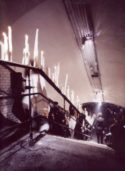
It’s not enough to sing, dance and perform or to simply show clothes on a catwalk; the presentation can be a major spectacle, or simply different, as you choose. Sometimes it’s a narrative, sometimes it’s the casting, plus actors or performers adding to the presentation, or it might be a venue or location that contributes to the special feeling of the show. How the space might be used can be all it needs to change our perception of the clothes being presented. Ever since that first fashion show designers have often thought up new or special ideas to show the collection, from tiny salons to vast stadiums. In July 1988 Yves Saint Laurent showed a fifteen minute retrospective of his forty year career on three hundred models in front of a live audience of 80,000 during the FIFA World Cup at the Stade de France, and who knows how many also saw it via television. Jean-Paul Gaultier was a casting and theme master showman, all of us who attended his presentations such as La Concierge est Dans l’Escalier 1988 will never forget them. Martin Margiela once showed the same collection simultaneously in two hospital wards, one collection black and one white, but then he’d shown in a post Office sorting depot, and a dusty candlelit disused Metro station amongst other venues. Last seasons Metiers d’Art of Chanel was shown in a New York subway station, and Paris Metro stations have also been used by Xuly Bet and Issey Miyake amongst others, circus tents, Embassy’s, Hotels, and Dries van Noten has shown in the gardens of the Palais Royal on bicycles in the sweltering heat of summer 1995 , and his very first womenswear collection with the audience on mattresses 1994, or in 1994 Passage Brady a narrow arcade with Indian and Pakistani traders serving tea and playing Bollywood soundtracks.
None of this is even remotely new, designers have been experimenting with how they show for over a hundred years. In the early 1900’s Paul Poiret took his collections travelling with a group of models accompanying him, in the 1920’s Jean Patou cast his shows with American girls, taller and fitter, to model his sportswear, and the 1930’s, Elsa Schiaparelli showed late at night at the races by floodlights for added glamour.
It’s important to note that the entire subject of fashion shows, presenting fashion and the various approaches to the task has been in conversations both at the luxury houses, the graduates and their first collection, and in academia and museums. An exhibition about fashion shows has just closed in Basel at the Vitra Museum, see the link below which gives a huge amount of insight into the subject’s history, and gives much interesting thought about the whole idea of that often brief moment of the presentation of a collection. It can also be seen at the V & A Dundee 3rd April 2026 to 17th January 2027. There was also Le Defile de Mode in 2006 at the Musee Galliera in Paris also covered the idea and the event called “the fashion show” and there are for both exhibitions’ publications.
https://www.design-museum.de/en/exhibitions/detailpages/catwalk.html
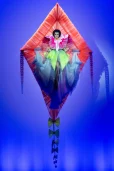
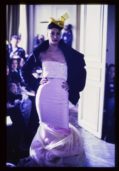
In Paris, this season for menswear Willy Chavarria set up an entire movie narrative and filmed it live to create a movie. There were several others menswear shows with brilliant productions, but it was at couture the diversity really showed up. Real firefighters started the Franck Sorbier show where many of the models were clients or friends and the narrative showed couples mixing and matching, dancing, and flirting, and the escorts could enter the scene from front row or descend the stairs alone. The charm of the casting was the unexpected and the delight the models took in being asked to twist and twirl in the Sorbier creations. At Ronald van der Kemp he took on the role of a fashion photographer asking each model to pose, directing them to show the pockets or reveal the back view. In the upstairs space real photographer Sonny Vandervelte took the girls through their paces. Viktor and Rolf had a single model centre stage, as the first long black evening dress entered, the model stopped and the designers removed a yellow ruffle from her and placed it on the waiting model. The show thus proceeded to show great black dresses each with a brilliant ruff, frill, basque, or bow, which was then removed and placed on the original model. On the final dress was a row of bows from large to small, which when removed become the tail of a kite and the model floated skywards to tumultuous applause and a standing ovation. Stephane Rolland showed at the Cirque d’Hiver, and alongside uniform drum majors he closed with an aerialist in clouds of silk organdie. Imane Ayissi had sadly damaged his back so four models were dressed in front of the audience and paraded around the salon. It not only showed a beautiful collection, but also demonstrated the construction of the clothes, and it was terrific to watch the models adjust a drape here, wrap a stole there, or simply the ease with which they zipped up a skirt and twisted into position on their hips. Julian Fournie showed in a theatre and each model’s personality was key to the look, and how they modelled and posed, it was a series of characters telling us a story and how their clothes suited them, and then finally the rabbit bounced onto the stage. It’s not directly Alice in Wonderland but Fournie does tell us a story often bordering on the surrealism of that all time classic. At Valentino they used the kaiserdrome, an 1890’s early form of film or type of magic lantern, making the audience watch each model in isolation through a peephole box window. Robert Wun showed on a broad stage at the Lido in the Champs Elysees and his models paraded in front of huge screens showing film of weather, but storms, heavy threatened clouds, thunder, and lightning. Only intermittently did a shaft of sun penetrate the gloom. It’s also another show where the great models, like Debra Shaw, are really required too act, perform, and present the clothes. It’s clear that when casting models have many different skills to bring to the art of showing a collection.
So, in the increasingly competitive world of fashion watch for new ways to show, even if like Alexis Mabille and his one hundred percent AI couture presentation it unleashes dismay, shock and some views verging on horror. Presenting a collection can be a classic catwalk and models parading the collection in order from daywear to evening wear, and even close with the traditional bride, or it can be a presentation like Mabille where not a stitch or a model, or even the audience, we are watching are real.
Across the world the layout of the space, the placing of the seating and indeed the seating itself from uncomfortable unpadded benches to tiny gilt chairs, is all part of the story designers and the brand wish to communicate. Tiny, interlinked salons, or huge industrial space, a live classical quintet, or a thumping house background. Casting is open to huge misconceptions as the audience both at the show and online pronounce. Size, ethnicity, gender, age, alongside the story of the hair and makeup teams is integral to the story. Natural, which takes hours, or elaborate which takes even longer, we all know call times for some houses are literally hours and hours before the show. We are also aware that in 2026 that there’s a fashion week somewhere in the world every single calendar date.
Anyway, during the four weeks of pret a porter that just closed, we jumped from show to show and city to city to see what the designers have in mind as a show. Some stay at the same venue and dramatically alter it each season, some switch where they show but keep to the same presentation wherever it’s held. Some designers clearly feel no need for tricks and let the clothes speak for themselves; indeed, The Row don’t even allow social media. A quick run through this seasons pret a porter shows that Marc Jacobs chose a vast space with a single file of models, something he loves, Ralph Lauren always takes us inside his own special world wherever and whenever he shows, Richard Quinn mixed the space age of the movie 2001 with glamorous 1950’s couture, several designers used grass or earthy ground, whilst Uniform tricked the audience into thinking they were watching a show elsewhere to the Chatelet Theatre when in fact it was there. TIME showed in the hallowed spaces of the Bibliothèque Nationale with the books setting the tone and Dior installed a huge pavilion in the Jardins des Tuileries with lily ponds. I guess for me, Glenn Martens at Diesel was a stand out with an accumulation of “stuff” from old shows, events and parties going back decades surrounding the models as they walked and it made an amazing statement. Of course, some shows favoured the front row, and some spread the audience out to allow everyone to get a great view. There were fewer clever ideas oddly enough during ready to wear but then this isn’t the laboratory of fashion. Mind you, even the basic element of the lighting can make major contribution to a show. Gloomy and atmospheric at Balenciaga, ultra bright and white at Tom Ford, classic good lighting at even avant garde shows means the team realise the photographers need support to get the great shots that travel the world.
Returning to Bad Bunny and performers and performance, fashion, and designers, I’d like to just note as an example how Harry Styles and Alessandro Michele have a bond in terms of style, and how Rosalia makes a major fashion statement both through her association with Matières Fécales, but also with her support for Spanish designers. The performance of fashion is so strong that when Teyana Taylor wore Matthieu Blazy at the Oscar’s she offered the camera a great deal more than a simple pose!
Of course, who attends shows is also fascinating from legendary movie stars to the hottest newcomer, from other designers to powerful editors, but once the show starts all eyes are on “the show.”
So, to sum up. Think about the shows and watch them carefully, the house team is telling you something about how they approach the season in every, moment and detail. The idea behind every show is to communicate a narrative, to gather social media mentions and to sell clothes. It’s up to the viewers to decide each season who achieves that. In fashion it is always another opening, another show in fashion.
Tony Glenville
