






Dear Shaded Viewers,
I visited Irakli Nassidze today in his Paris showroom at L’Aventure Hotel on rue Victor Hugo, and the encounter confirmed what his work has been suggesting for years: he stands at a rare crossroads where haute couture, fine art and jewellery design converge into a single, compelling narrative. The room itself felt like an extension of his imagination, a kind of intimate cabinet of wonders in which jewels and objects quietly conversed, insisting that jewellery can be as conceptually charged as any painting or sculpture.
Born in Tbilisi in 1973 and raised in an aristocratic Georgian family, Nassidze was immersed early in a cultivated visual world in which history, ritual and aesthetics were never far apart. A grandmother with a strong artistic sensibility pushed him toward the arts, and that encouragement carried him to the Academy of Fine Arts in Tbilisi, from which he graduated in 1996. Paris, with its promise of couture salons and grand maisons, became the logical next step, and he moved there soon after, determined to situate his vision within the city’s exacting fashion ecosystem. In the ateliers of Christian Lacroix and Jean‑Louis Scherrer he honed a sharp, theatrical eye; by 2002 he had launched his own haute couture house, becoming the first Georgian couturier to present collections in France and quietly inserting a distinct Georgian sensibility into the Paris fashion discourse. Over time, his practice widened beyond clothing into painting, illustration, furniture and jewellery—each discipline feeding the others and reinforcing his instinct to treat the body as a mobile stage for art.
The jewellery that now surrounds him in his Paris showroom feels like the distilled essence of this multidisciplinary trajectory. His pivot toward jewellery began more than a decade ago, when he started to conceive pieces that read less as accessories and more as small‑scale architectures worn close to the skin. Early on, he gravitated toward collaboration with Zarapkhana, the historic Georgian jewellery house that has long been associated with the country’s goldsmithing tradition. Their first joint project, a collection structured around bird motifs, already hinted at what would come: a jewellery language in which Georgian iconography and ornamental memory are translated into resolutely contemporary forms.
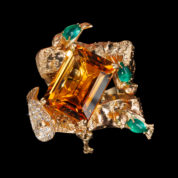
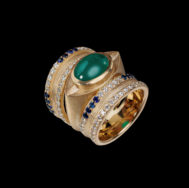
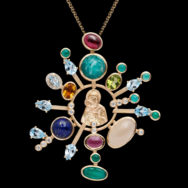
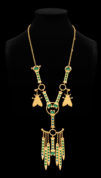
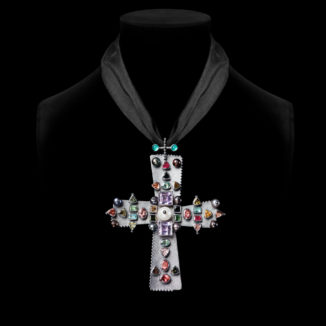
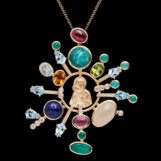
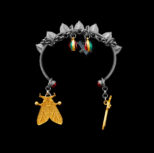
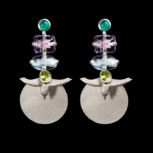
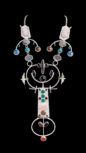
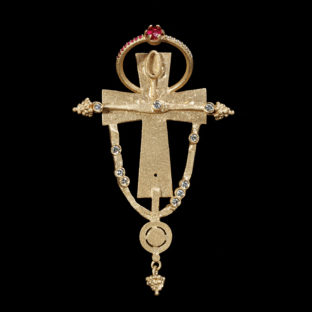
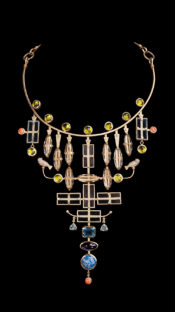
The work he is presenting today, shaped over the past year between Paris and Georgia, pushes that idea further into what might be called an archeo‑futurist register. Unique pieces and limited numbered editions harmoniously combine precious metals and fine gemstones, entirely crafted by the exceptional artisans of Zarapkhana, the iconic Georgian house founded in 1939. The city of Tbilisi—cradle of both Zarapkhana and Nassidze himself—remains central to this story. As Zarapkhana’s creative director since 2025, Nassidze is opening a new, international chapter that redefines the relationship between heritage and innovation. “I approach jewellery as I do clothing,” he says. “I am interested in the connections between archaeology and the future. I like to build bridges between the raw and the sophisticated.” For the collection The Contours of Mystery, he sculpted volumes using the lost‑wax technique, gave gold a matte finish to heighten the brilliance of the stones, and refined an ornamental technique specific to Zarapkhana—layering time, memory, and material into a single gesture.
Many of his pieces look like relics from a civilisation that has not yet existed: cuffs that flare like discovered fragments of armour; rings that coil around the finger like fossilised branches; brooches that could be excavated icons reimagined through a lens of science fiction. He favours high‑karat yellow gold and darkened silver with richly worked, almost time‑worn surfaces, punctuated by stones often shown on their reverse side—citrine, garnet and smoky quartz that echo the mineral warmth of Georgian landscapes. Volumes are bold, yet the touch is intimate and precise. You sense the draughtsman in the taut line of a talon‑like ring, the couturier in the way a necklace negotiates the clavicle, the painter in his calibrated use of colour and negative space. Seen together in the L’Aventure Hotel showroom, these pieces read not as a conventional collection but as a visual manifesto: jewellery as central text, capable of carrying cultural memory, fantasy and personal mythology all at once.
If Paris remains his laboratory, Georgia has become the stage on which this vision is now amplified. His appointment, one year ago, as creative director of Zarapkhana—the country’s most emblematic jewellery brand—formalised a dialogue that began with that early bird‑themed collaboration. Zarapkhana, deeply rooted in traditional craftsmanship and known for weaving national elements into modern jewellery, has handed him the keys to a powerful cultural vehicle. Under his direction, the house’s heritage is not polished into generic “luxury” codes but activated as a living laboratory. Historical motifs drawn from church facades, manuscript ornament and folk talismans are rethought as sharp, streamlined silhouettes that feel entirely of the present, while remaining unmistakably Georgian. Campaign imagery, store environments and object design fall into a single, coherent universe: moody, elegant, charged with symbolism rather than mere branding. In a global market where national brands often iron out their idiosyncrasies to fit international expectations, Nassidze insists on specificity—the weight of Georgian gold, the distinctive curve of a dome, the flight of a mythological bird—turning those details into his strongest luxury argument.
What becomes clear, standing across from him amid the gleam of metal and the hush of the hotel walls, is that this first year of creative directorship is less a strategic corporate appointment than a kind of homecoming. It is the story of an artist who left Georgia to refine his language in Paris and has now returned, through Zarapkhana, to carve that language into metal on his own soil. Between the Paris showroom on rue Victor Hugo and the workshops in Tbilisi, a new axis is forming—one that positions Georgian jewellery not at the margins of contemporary discourse but at its centre, and places Irakli Nassidze as one of its most articulate, and poetic, voices.

Later,
Diane
