
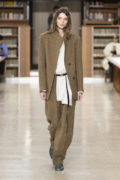
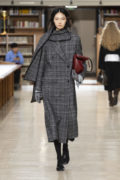
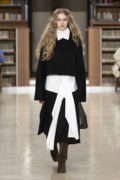
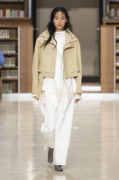
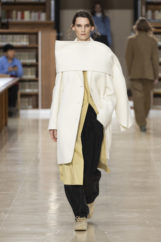
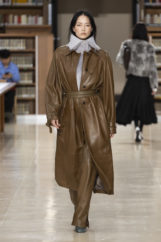
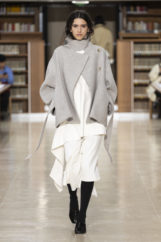
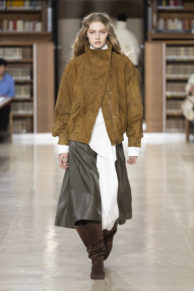
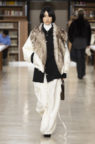
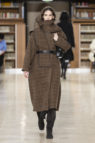
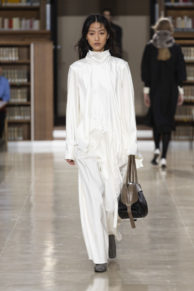
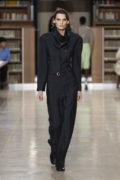
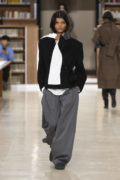
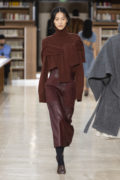
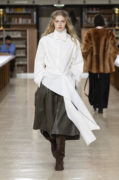
The South Korean label TIME unveiled its Fall/Winter 2026 runway show at the Bibliothèque Nationale de France in Paris. Titled Layers of Time, the collection imagines time as a process gradually gathering and deepening —an invisible architecture shaped by memory, lived experience, and subtle repetition.
Nestled inside the historic reading rooms of the Richelieu site, the runway carved a path through soaring bookshelves stacked with centuries of wisdom—proof that both librarians and fashion designers share a deep love for layers. Like pages stacking in a vast archive, each moment leaves a trace. The collection explores the notion that moments don’t fade away; suggesting that nothing truly disappears; it folds into what comes next.
Creative director Choi Jeong-in, approaches layering as a structural principle; volume here is built carefully through internal construction: cotton-metal-silk blends, soft lamb leather, and structured wool sit side by side. A mad crush for the monochromatic palettes – can’t take my eyes off the rusty-red leather skirt with suede pockets, paired with a soft knit sweater.
The season also reflects on TIME’s origins. Founded in the 1990s, during a period shaped by postmodern experimentation, the brand revisited elements from its archives and reinterpreted them through a contemporary lens—an approach comparable to the archival dialogues seen in British designer Phoebe Philo. Coats and trench silhouettes expanded outward with controlled volume, maintaining classical tailoring while altering proportion. With versatile, reconfigurable necklines, shirts are changing form according to how they are worn, adding a playful layer of customization. For the accessories aficionados, the runway also highlighted TIME’s ongoing collaboration with Spanish leather designer Fernando Bonastre, founder of BONASTRE. Known for his iconic bags for Lemaire, Bonastre works exclusively with vegetable-tanned cowhide, bringing minimalist, architectural precision to each piece.
If Layers of Time proposes a philosophy, it is one of continuity, favoring presence. A symbol of women’s empowerment and subtle evolution. The collection demonstrates that strength can be understated, power can reside in proportion, texture, and thoughtful construction.
