





Dear Shaded Viewers,
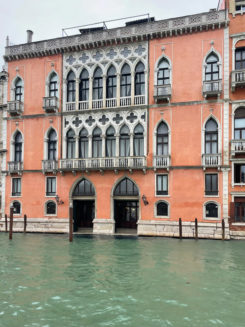
In Venice, where light keeps rewriting the surface of the water, a new kind of palazzo opens—one built as much from memories and gestures as from stone: the Fondazione Dries Van Noten at Palazzo Pisani Moretta, devoted to the idea that in such ugly times, the only true protest is beauty. I have been following Dries Van Noten’s collections since 1991, season after season watching silhouettes turn into sentences and fabrics into phrases, so I am sure that walking into this foundation feels less like entering an institution than stepping inside a long, unfolding conversation with his eye.
The title of the inaugural presentation, “The Only True Protest Is Beauty,” borrows a line from Phil Ochs, but here it becomes a manifesto made tangible: beauty not as consolation, but as a disturbance, a charged encounter, an unexpected harmony that slightly dislodges the ground under your feet. Curated by Dries Van Noten with Geert Bruloot, the exhibition treats craftsmanship as a living language, a way of thinking through the hands, where every stitch, casting, and brushstroke is a small act of resistance against speed and forgetting.
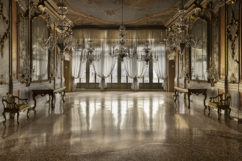
The heart of this experience is its setting: Palazzo Pisani Moretta, on the Grand Canal, a private historic residence offered, for a brief span from 25 April to 4 October 2026, in its current, pre-restoration state, like a grand, slightly faded stage that remembers every performance it has ever hosted. Across the ground floor and the first and second piano nobile, twenty intuitively composed rooms unfold like chapters in a novel, allowing more than two hundred works to enter into conversation with frescoes, stucco, and the slow, baroque patina of time.
The exhibition does not separate fashion from art, design from jewellery, or glass from ceramics; instead, it lets them bleed into each other, a constellation of encounters where established and emerging names share a single, vibrating field. Selected pieces from historic fashion archives hang beside contemporary textiles, their threads carrying both cultural memory and the urgency of the present, while collectible design objects stand shoulder to shoulder with experimental works that test the limits of material and form.
From the very first room, fashion is not an illustration of the theme but its engine: it appears as medium and method, tracing the arc of Dries Van Noten’s own creative trajectory, and echoing his lifelong fascination with the tension between opulence and restraint. Fifteen silhouettes by Christian Lacroix, some long unseen and drawn from private collections, swell into theatrically layered constructions that seem to answer the Palazzo’s ornamental language, as if the garments and the walls had been waiting for one another.
Nearby, Rei Kawakubo’s archival silhouettes for Comme des Garçons, from 2015 onwards, stand like sculptural riddles, their abstract volumes refusing any easy idea of prettiness and insisting instead on beauty as a question, an autonomous presence that rewrites the rules of proportion and allure. Extending this conversation into another register, the work of Palestinian designer Ayham Hassan transforms constraint into resilience, the raw materiality of his silhouettes carrying the imprint of growing up in the West Bank, turning fabric into a geography of survival.
Yet the story here is not only told through bodies but through objects that hover between the intimate and the uncanny. In the portego, the long axis that ties land entrance to water gate, a dust-laden sculpture by Peter Buggenhout stands like a relic from an uncertain future, its ambiguous form inviting contemplation of impermanence and the fragility of human structures. The Palazzo’s frescoed convivial scenes find their echo in the sinuous ceramics of Kaori Kurihara, where organic forms seem to grow and coil, as if the painted banquets on the wall had quietly sprouted three-dimensional offspring on the tables below.
The house of Codognato, the only jeweller invited into this first exhibition, brings with it more than a century of Venetian savoir-faire, distilled into fifteen pieces personally selected by Dries Van Noten. Their presence feels like an undercurrent of mortality running through the rooms: memento mori jewels, crowned skulls, prisoner skeletons in pendant earrings, and coffins rendered in enamel and gold, their glitter haunted by the knowledge of time passing. Some works come from long-standing clients, guardians of the house’s heritage, while others are newly created for the show, jointly designed by members of the Codognato family, balancing fidelity to archive designs with fresh interpretations of its symbolic, sculptural vocabulary.
In the first salon on the piano nobile, the ceiling’s Guarana fresco, The Victory of Light over Darkness, becomes a celestial canopy beneath which Steven Shearer’s photographs of sleeping figures converse with Codognato’s skulls and skeletons, Lacroix’s exuberant couture, and the radical silhouettes of Comme des Garçons. The effect is almost liturgical: a temporary chapel to ambiguity, where dreams, death, and dress occupy the same visual sentence, each clause complicating the others until beauty itself feels like a fragile truce between eros and extinction.
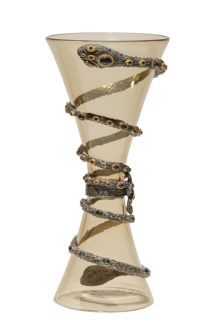
Elsewhere, the Palazzo’s historic glassware encounters the intricate contemporary works of Alexander Kirkeby, Ritsue Mishima, and Wave Murano Glass, tracing a continuum of transparency and fragility that stretches from the lagoon’s watery reflections to the vitrines of the galleries. In a chapel alcove once veiled by drapes, Misha Kahn’s sculptural assemblage introduces a playful irreverence that prepares the eye for Ann Carrington’s opulent compositions made from discarded metal elements, subtly unsettling the solemnity of the space.
Nature, too, insists on making itself heard: Isaac Monté’s mineral-crystallized vases look as if they had slowly grown overnight, while Hubert Duprat’s Tube de trichoptère shows insects building their armour from gold, pearls, rubies, and diamonds, turning instinctive survival into inadvertent goldsmithing. Chairs—those most everyday of objects—become actors in an investigation of use and desire, as the Palazzo’s antique seats are set in dialogue with works by Guillermo Santomà, Nifemi Marcus-Bello, and Lionel Jadot, each piece probing the line between functionality, collectibility, and sculptural abstraction.
Throughout, a single thread binds these disparate presences: the excellence of making and the deliberate play between harmony and rupture. Whenever serenity risks settling into mere decorum, a dissonant note—a disturbing form, a morbid jewel, a skewed silhouette—slips into the composition, reanimating it, insisting that beauty is most alive when it is slightly out of tune.
Behind the scenes, more than twenty short videos accompany the presentation, offering glimpses into studios and workshops, the gestures and pauses that precede each finished object, reminding visitors that every piece here is not just a thing but the trace of a time, a body, a decision. In this way, the Fondazione fulfills its mission: to honour the human dimension of making, the stories embedded in matter, and the delicate bridge between tradition and experiment.
Founded by Dries Van Noten and Patrick Vangheluwe, the Fondazione positions itself as a non-profit institution dedicated to craftsmanship as a vital language of cultural identity, rooted in Venice yet open to the world. By bringing together established voices and emerging creators from art, design, fashion, architecture, food, and beyond, it invites cross-pollination, encourages slowness, and proposes that the future might best be imagined not through spectacle, but through the quiet, persistent intelligence of the hand.
Access to this fragile universe is carefully choreographed: as the Palazzo is a private residence on the Grand Canal, entry to “The Only True Protest Is Beauty” is granted through the Fondazione’s Become a Friend affiliation program, the Friend Card opening the doors to the exhibition and selected events until April 2027. It is a fitting gesture for a place that treats encounter as a privilege rather than a commodity, asking its visitors to commit, to return, to look longer and stay with uncertainty, as Dries and Patrick themselves describe their intention.
For someone who has traced Dries Van Noten’s path since 1991, this foundation feels like the natural next movement in a long symphony, one in which clothes were never just garments, but propositions about how to live in colour, contradiction, and nuance. Now, in Venice, that ethos takes architectural form: a palazzo where beauty does not solve anything, does not tidy the world, but instead keeps posing the most difficult, necessary question—how to remain sensitive, and therefore resistant, in times that ask us to look away.
Later,
Diane
