





Dear Shaded Viewers,
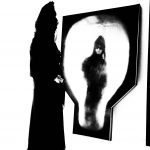
Caroline Hu’s recent Reverie collection, presented as a hybrid between a fashion show and a dance performance in Paris, feels like a continuation of her long‑standing obsession with fragility, movement, and the emotional weight of “ordinary” moments, but now with a sharper, more somber edge. The intimate, almost domestic scale of the presentation—more felt than measured—made it clear that this was not a spectacle of glamour but a kind of private ritual translated into fabric and choreography.
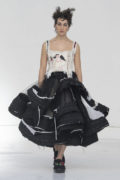
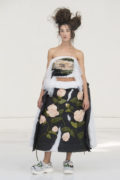
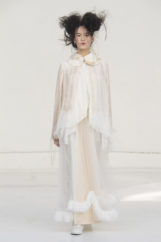
The show read as intimate and fragile but never weak: dancers moved through the space with restrained force, as if the garments were exerting a gentle pressure on the body. Hu’s signature sheer tulle, smocking, and layered florals met a more grounded palette, so that the romanticism felt less saccharine and more like quiet mourning or slow healing—delicate, yet insistently present. The choreography, echoing the “frozen moment in time” logic of her clothes, underlined a central tension: the body is both vulnerable and resilient, yielding to the fabric yet shaping it back into form.
There was a strong sense of hand‑made vulnerability, not only in the intricate embroidery and patchwork‑like floral appliqués, but in the way the garments seemed to catch motion, as if seams and boning were trapping gestures mid‑gesture. The clothes looked breakable, but the rigor of their construction and the athleticism of the dancers pointed to something structurally robust beneath the surface.
Caroline Hu is a China‑born, New York‑based designer whose work sits at the intersection of romanticism, emotional storytelling, and technical experimentation. She studied oil painting and fine art from an early age—her father is a painter and her mother a ceramicist—before turning to fashion as a way of translating that visual sensibility into the third dimension, a background that shows in her hand‑painted floral motifs, enlarged landscapes that become textiles, and her habit of treating garments as living canvases rather than static objects. She launched her eponymous label in 2018 and quickly drew notice for romantic dresses in sophisticated fabrics, winning the inaugural Business of Fashion China Prize and becoming an LVMH Prize nominee, before evolving her work into the Reverie by Caroline Hu line under the aegis of the Fédération de la Haute Couture et de la Mode, rooted in the idea that clothing can define moments drawn from her own experience.
Hu’s shows have long been performance‑driven—past seasons have included live dance collaborations that mirror the “arrested gesture” built into her silhouettes—and this latest Reverie outing feels like a logical intensification of that approach: the garments are not merely worn, but tested and questioned by the body, so the collection feels alive rather than archived. Reverie continues her exploration of love, loss, and memory, but the dance‑performance format pushes the emotion into a more physical, immediate register; the same codes—smocking, tulle, floral appliqué, sculptural skirts—are distilled into something more economical, almost frayed in its intensity. The result is a collection that feels both intimate and strong, an image of fragility that is anything but passive, as if Hu were recycling not so much fabric as emotion—revisiting motifs, gestures, and silhouettes and reassembling them into a new, more grounded dream, one of her most psychologically layered statements to date.
Later,
Diane