
Dear Shaded Viewers,
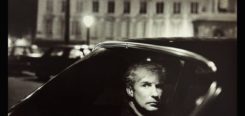
I regard attending fashion shows by Claude Montana as amongst the high spots of my career, they were truly fashion moments each season during his peak years. His signature style and individual viewpoint of both menswear and womenswear was truly special, but his legacy and his place in the history of fashion seems to be fading. I am going to try and explain a bit about Claude Montana.
I am often asked if I am excited about a forthcoming fashion exhibition, and my reply is always the same; “I don’t like dead clothes.” Let me explain, I think clothes are meant to be worn, and be alive, great clothes look marvellous moving and from every angle, that is 360 degrees. Clothes are also a reflection of the time, be they just clothing or fashion, and should be seen in context. So, for example I think most day clothes by Gabrielle “Coco” Chanel herself do not look great on dummies in a gallery, and exhibitions rely on the cocktail and evening wear to bring glamour to the galleries.
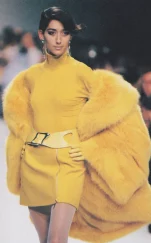
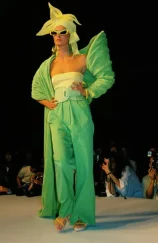
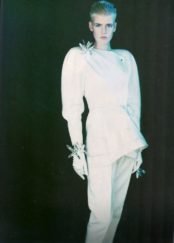
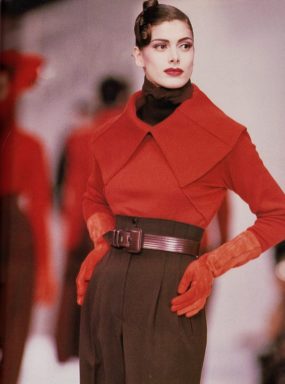
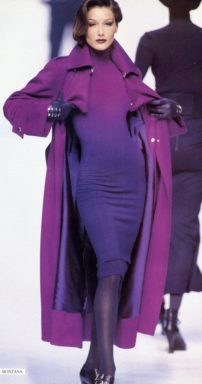
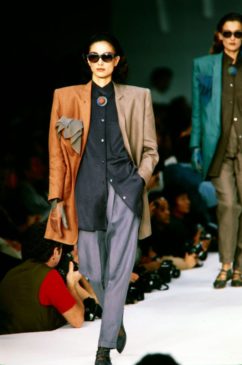
The fashion of Claude Montana will not make great exhibitions, it is not sparkling and glamorous, and the scrappily edited show videos, and sad second hand pieces on Ebay do nothing for his reputation. Some fashion photographs by people like Paolo Roversi are lovely but again they’re static. Montana designed in a remarkably low key way and much of his success both in womenswear and menswear was about the fact that he sold clothes that arrived in the stockists looking as they had on the runway. At retail, each individual piece stood up well as clean, modern, and with a bold silhouette, made with quality materials in great colours. Within each complete collection he created, from knitwear to leather, much of it with specialist companies who he worked with, it was about clothes as much as fashion. As a Montana fan I purchased many pieces, but rarely the most obvious. I had a sweater and it was a faux cardigan in pale camel with a polo neck insert in lilac, I also had a dark olive green jacket which was two button DB with the sharpest lapels possible and cut slender with no vents. I had a black and white ski sweater with a huge yoke which made my proportions look superb, as did so much of Montana’s work, especially in his sense of how he wanted to make his customers look strong. It is the lack of glitz or overstated “designer” that now makes the clothes look a bit dull, and especially since it is now decades since those collections it’s so hard to understand his magic and analyse his fame when the clothes seem to evaporate under deep scrutiny.
Firstly, it was the shows, the huge tent spaces were charged with atmosphere as we shoved and pushed and pleaded to enter. Beatrice Paul was like the gatekeeper to a deity with such power we were in total awe, alongside Bobby Butz and others a crowd we would never ever be a part of. The invitations were often huge or fold out on very heavy card, and again often just with a huge Montana signature sprawled and s railed across the. Once inside the tent it was so crowded with standing down the aisles the heat was intense. The huge white catwalk might be conventional straight down or be curved but always seemed huge in the space and as the lights dimmed the soundtrack would be amped up to the highest level, and what a soundtrack, Richard Strauss opera, symphonies or whatever supported the mood of the season. The models from Iman to Betty Largo to whoever was the most confident, posing longer, moving more marvellously than for any other designer (except always Thierry Mugler!) and wonderful show production where a single model might be followed by dozens in a huge crowd, or then two by two who then gradually filled the stage. Finally, the close of the show, the diminutive designer taking his bow, always surprisingly shy and then we screamed and applauded and left exhausted having had our Montana fix.
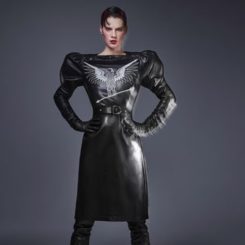
Yet it was about the clothes without any real tricks or oddities. Even from the beginning when stormtroopers or fetish were words used the collections; it was about beautiful clothes and a special kind of vision. It was bold and it was strong and the silhouettes were, at that point, innovative, but there was very little glitter of decoration, hats and hairpieces with Stephen Jones were amazing, but accessories were few and far between, and it was before the time of the importance of handbags. One season for the finale line up of evening wear it was all in grey matt draped jersey, I mean it was daring. The use of colour was so varied alongside his use of black; a summer collection in citrus brights for example which was so different many hated it. I always remember the season of red on red on red at both menswear and womenswear, where Montana layered different reds in long tailored coats, over wide pants and sharply shaped jackets. Pattern was rare but often slightly off kilter and more organic, in fluid linear patterns, and indeed in his use of geometric for Montana it could be both a sharp angle and a curve, often intersecting each other. A sweep of one line in a collar overlapping another line as the bottom of a jacket intercepted it.
It was about the clothes as I have said before, and the Claude Montana pieces have all but disappeared, and I also wonder if many Montana pieces got worn out and loved or later bastardised by alterations as shoulder pads faded away. I note that of around a hundred and eighty pieces of Montana on Ebay around only forty are clothes, the rest is fragrance, and ephemera. It is difficult to know how we might pay tribute to his fashion legacy, and his contribution to French Pret a Porter in the peak years, say from the end of the 1970’s through to the very first years of the 1990’s. His years at Lanvin designing the haute couture and regarded at the time as unsuccessful are a separate subject in some ways. Yet in their refinement and subtlety; as an example, the dress whose flared sleeves were embroidered on the inside, thus only revealing it as the model moved her hands, Lanvin perfectly displayed his “less is more” philosophy even in couture and working with glittering couture embroideries.
I am sad that scandal, gossip, mistakes, and the fall from grace colours his legacy, unlike his contemporary Thierry Mugler there is little to see or read, no extravaganzas or celebrity guest models on YouTube to delight us. If fashion is seen and defined as ephemeral today, two years after his death, Claude Montana exemplifies this description.
