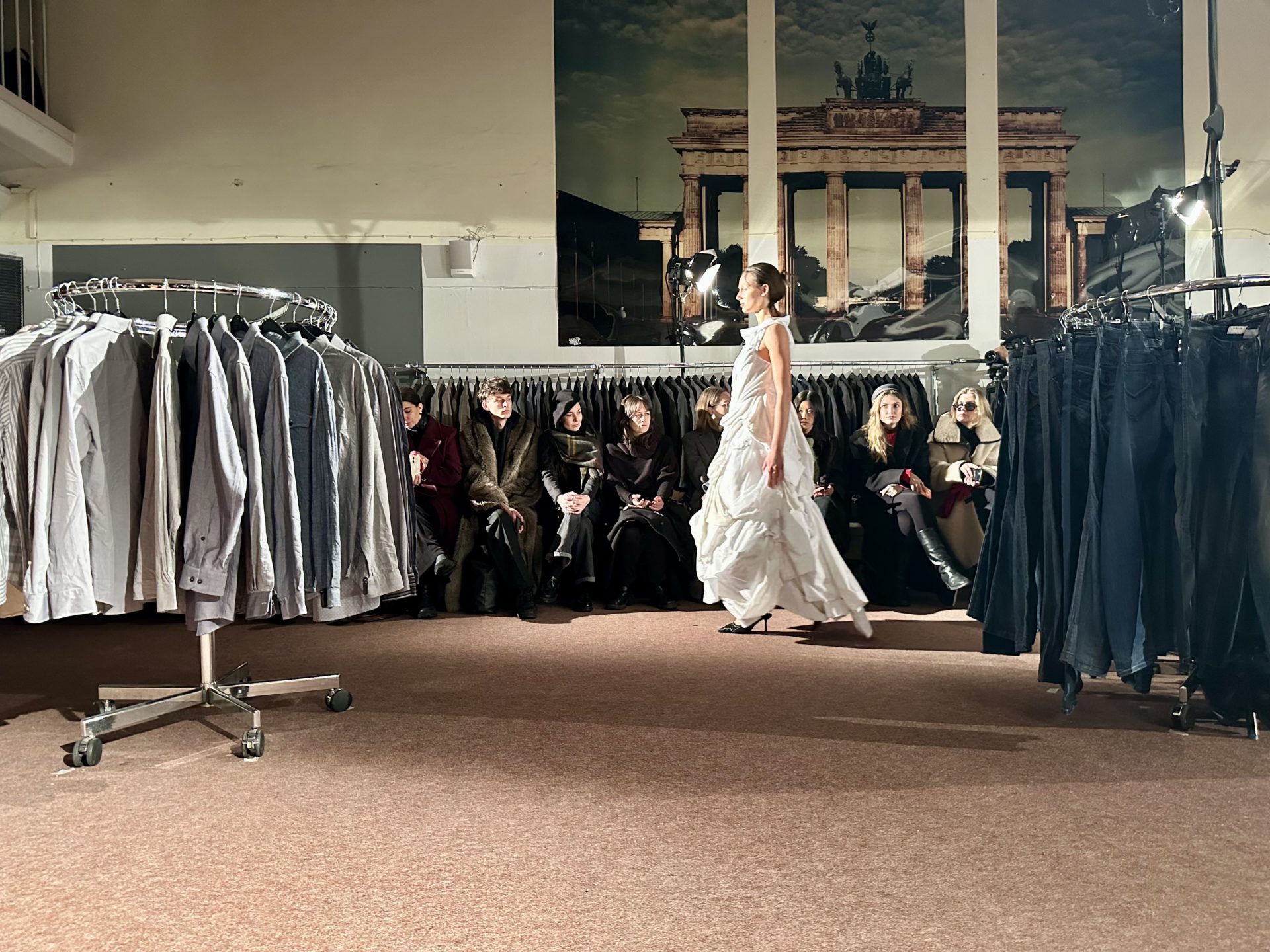
The recently concluded Berlin Fashion Week wasn’t just cool—it was downright freezing. This, however, was mostly thanks to the bitter cold that swept through the city, accompanied by an extra challenge: a public transport strike. Because many organizers made creative use of far-flung venues across Berlin—from secondhand stores and underground bunkers to hotels and the ruins of old hospitals—the city’s sprawling size quickly turned against them as icy streets made every trip sluggish at best and slippery at worst. Staying stylish in such conditions became the ultimate fashion challenge: defying the weather somewhere between aesthetic bravery and textile emergency.
Special venues included Plaid-à-Porter’s show, which brought operatic flair to the abandoned lecture hall ruins of the Charité, Kolya Bogatyrev’s presentation inside the multi-story Humana store at Frankfurter Tor, Vanessa Baernthol’s collection at the Schinkel Pavillon, and the oft-used Feuerle Collection, this time hosting the label UNVAIN.
The icy paralysis seemed to seep into other areas too—or at least brought a noticeable sluggishness. Many invitations arrived at the very last minute, making daily planning even more difficult. It often felt as though much of the week had come together in spontaneous bursts, which made the overall outcome all the more impressive: a colorful range of genuinely strong work and striking castings, set against a city that managed to stay in motion despite the frost. Even Berlin’s cliché of a monochrome, all-black wardrobe was stylishly disproven by the fashion on display.
Spotlight on these standout labels:
BUZIGAHILL presents its AW26 collection RETURN TO SENDER 12 during Intervention V, the showcase format initiated by Reference Studios, at Berlin Fashion Week. Founded by Bobby Kolade and based in Kampala, the label redesigns second-hand garments sourced from Owino Market and symbolically returns them to the Global North. The collection revisits the 1960s and 70s in East Africa, referencing post-independence optimism through flared silhouettes and relaxed tailoring. These historical cues meet contemporary influences drawn from boda boda riders, whose pragmatic alterations inform construction and proportion. Each upcycled piece carries a passport label documenting origin and material history, framing fashion as an act of reclamation.

BUZIGAHILL AW26 at Berlin Fashion Week Intervention V by Reference Studios. Credit: Finnegan Koichi-Godenschweger

BUZIGAHILL AW26 at Berlin Fashion Week Intervention V by Reference Studios. Credit: Finnegan Koichi-Godenschweger

BUZIGAHILL AW26 at Berlin Fashion Week Intervention V by Reference Studios. Credit: Finnegan Koichi-Godenschweger

BUZIGAHILL AW26 at Berlin Fashion Week Intervention V by Reference Studios. Credit: Finnegan Koichi-Godenschweger

BUZIGAHILL AW26 at Berlin Fashion Week Intervention V by Reference Studios. Credit: Finnegan Koichi-Godenschweger

BUZIGAHILL AW26 at Berlin Fashion Week Intervention V by Reference Studios. Credit: Finnegan Koichi-Godenschweger

BUZIGAHILL AW26 at Berlin Fashion Week Intervention V by Reference Studios. Credit: Finnegan Koichi-Godenschweger

BUZIGAHILL AW26 at Berlin Fashion Week Intervention V by Reference Studios. Credit: Finnegan Koichi-Godenschweger

BUZIGAHILL AW26 at Berlin Fashion Week Intervention V by Reference Studios. Credit: Finnegan Koichi-Godenschweger
Find more about BUZIGAHILL here.
UNVAIN showcases their debut runway show within the evocative setting of the Feuerle Collection, a former WWII bunker adorned with Southeast Asian sculptures and Imperial Chinese furniture. Founded in 2020 by Robert Friedrichs, the label translates Berlin’s subcultural energy into an aesthetic defined by brutalist clarity and understated rockstar chic. The collection focused inward, exploring architectural silhouettes, leather, transparent fabrics, epaulettes, studs, and upcycled fur accents. Minimalism intersected with vulnerability, creating tension in every garment. A scent installation developed with RYOKO expanded the experience beyond the visual, emphasizing UNVAIN’s philosophy of atmosphere, contrast, and essence over ornamentation or narrative.

UNVAIN AW26 at Berlin Fashion Week – Credit: Boris Marberg

UNVAIN AW26 at Berlin Fashion Week – Credit: Boris Marberg

UNVAIN AW26 at Berlin Fashion Week – Credit: Boris Marberg

UNVAIN AW26 at Berlin Fashion Week – Credit: Boris Marberg

UNVAIN AW26 at Berlin Fashion Week – Credit: Boris Marberg

UNVAIN AW26 at Berlin Fashion Week – Credit: Boris Marberg

UNVAIN AW26 at Berlin Fashion Week – Credit: Boris Marberg

UNVAIN AW26 at Berlin Fashion Week – Credit: Boris Marberg
Find more about UNVAIN here.
KOLYA BOGATYREV unveils its AW26 series, CONTRAARGUMENTUM: A Dialogue of Renewal, in the Humana Second Hand space on Frankfurter Tor. The Ukrainian label, founded in 2021, transforms discarded garments into expressive, wearable forms, exploring cycles of destruction and regeneration. With architectural silhouettes, uniform references, and a tension between masculine and feminine, the collection embodies movement, renewal, and critical design. The runway merged fashion, performance, and spatial interventions, positioning clothing as a medium for ecological reflection and artistic responsibility. Through this approach, Kolya Bogatyrev demonstrates how sustainability and creativity coexist, offering a transformative vision where materials, memory, and conscience converge in an evolving dialogue of fashion.

KOLYA BOGATYREV AW26 at Berlin Fashion Week – Credit: Robert Graeff

KOLYA BOGATYREV AW26 at Berlin Fashion Week – Credit: Robert Graeff

KOLYA BOGATYREV AW26 at Berlin Fashion Week – Credit: Robert Graeff

KOLYA BOGATYREV AW26 at Berlin Fashion Week – Credit: Robert Graeff

KOLYA BOGATYREV AW26 at Berlin Fashion Week – Credit: Robert Graeff

KOLYA BOGATYREV AW26 at Berlin Fashion Week – Credit: Robert Graeff

KOLYA BOGATYREV AW26 at Berlin Fashion Week – Credit: Robert Graeff

KOLYA BOGATYREV AW26 at Berlin Fashion Week – Credit: Robert Graeff

KOLYA BOGATYREV AW26 at Berlin Fashion Week – Credit: Robert Graeff
Find more about KOLYA BOGATYREV here.
ORANGE CULTURE explores memory, identity, and emotional resilience with its latest collection, Backyards of Memory. Founded by Adebayo Oke-Lawal in Lagos, the label transforms personal history and Nigerian heritage into fluid, gender-neutral clothing that defies conventional boundaries. The collection merges handcrafted techniques—macramé, crochet, pleating, and hand-dyeing—with sun-washed hues and relaxed silhouettes, evoking the intimacy and nostalgia of childhood spaces. Fabrics from Regenesis, handwoven Aso Oke, cotton, and wool are shaped into playful, expressive forms, where prints, beadwork, and reworked classics invite reinterpretation. Orange Culture continues to position fashion as a medium for storytelling, emotional exploration, and cultural dialogue, celebrating African creativity while challenging rigid ideas of gender, societal expectation, and traditional luxury.

ORANGE CULTURE AW26 at Berlin Fashion Week – Credit: Andreas Hofrichter

ORANGE CULTURE AW26 at Berlin Fashion Week – Credit: Andreas Hofrichter

ORANGE CULTURE AW26 at Berlin Fashion Week – Credit: Andreas Hofrichter

ORANGE CULTURE AW26 at Berlin Fashion Week – Credit: Andreas Hofrichter

ORANGE CULTURE AW26 at Berlin Fashion Week – Credit: Andreas Hofrichter

ORANGE CULTURE AW26 at Berlin Fashion Week – Credit: Andreas Hofrichter

ORANGE CULTURE AW26 at Berlin Fashion Week – Credit: Andreas Hofrichter

ORANGE CULTURE AW26 at Berlin Fashion Week – Credit: Andreas Hofrichter

ORANGE CULTURE AW26 at Berlin Fashion Week – Credit: Andreas Hofrichter
Find more about ORANGE CULTURE here.
IOANNES brings forth apokalypsis, a collection that embodies revelation rather than conclusion. Founded in Paris in 2019, the brand fuses meticulous craftsmanship with individuality, drawing on memories and cultural references to craft garments that balance understated elegance and daring expression. For this collection, designer Johannes Boehl Cronau revisited his archive, translating inspiration from his mother’s 1990s office suits, ’70s icons, and Madonna’s tracksuits into modern forms. Techniques like pyrography, hand-dyed cashmere, and precise tailoring create contrasts of texture and proportion, while slinky silhouettes meet structured suiting. Playful details—such as a fringe-draped mini shoulder bag—introduce humor, positioning IOANNES at the intersection of sensuality, memory, and unexpected theatricality.

IOANNES AW26 at Berlin Fashion Week – Credit: James Cochrane

IOANNES AW26 at Berlin Fashion Week – Credit: James Cochrane

IOANNES AW26 at Berlin Fashion Week – Credit: James Cochrane

IOANNES AW26 at Berlin Fashion Week – Credit: James Cochrane

IOANNES AW26 at Berlin Fashion Week – Credit: James Cochrane

IOANNES AW26 at Berlin Fashion Week – Credit: James Cochrane

IOANNES AW26 at Berlin Fashion Week – Credit: James Cochrane

IOANNES AW26 at Berlin Fashion Week – Credit: James Cochrane

IOANNES AW26 at Berlin Fashion Week – Credit: James Cochrane
Find more about IOANNES here.
KASIA KUCHARSKA approaches AW26 as an exploration of femininity, resilience, and the power of vulnerability. The Berlin-based label, founded in 2021, is known for reimagining traditional craft through technology-driven techniques, and this collection continues that trajectory. Liquid latex—treated like a printing medium rather than fabric—was grown layer by layer to create forms that oscillate between protection and exposure. Muted pastels, milky whites, and deep blacks evoke domestic spaces while letting the material itself speak. Sculptural volumes, cocooning shapes, and second-skin pieces redefine confidence, emphasizing the intricate balance between fragility and strength. Kasia Kucharska’s current work positions innovation at the service of emotional and corporeal expression, making garments both intimate and assertive.

KASIA KUCHARSKA AW26 at Berlin Berlin Week – Credit: Andreas Hofrichter

KASIA KUCHARSKA AW26 at Berlin Berlin Week – Credit: Andreas Hofrichter

KASIA KUCHARSKA AW26 at Berlin Berlin Week – Credit: Andreas Hofrichter

KASIA KUCHARSKA AW26 at Berlin Berlin Week – Credit: Andreas Hofrichter

KASIA KUCHARSKA AW26 at Berlin Berlin Week – Credit: Andreas Hofrichter

KASIA KUCHARSKA AW26 at Berlin Berlin Week – Credit: Andreas Hofrichter

KASIA KUCHARSKA AW26 at Berlin Berlin Week – Credit: Andreas Hofrichter

KASIA KUCHARSKA AW26 at Berlin Berlin Week – Credit: Andreas Hofrichter

KASIA KUCHARSKA AW26 at Berlin Berlin Week – Credit: Andreas Hofrichter
Find more about KASIA KUCHARSKA here.
KENNETH IZE celebrates the power of happiness with his collection JOY, translating inner emotions into tangible designs. The Nigerian designer fuses traditional Aso Oke fabrics with contemporary tailoring, deconstruction, and textured materials such as denim, velvet, and furry textiles. Trench coats, overalls, and hats become expressions of vitality, vulnerability, and community. Each silhouette reflects collaborative processes with family, friends, and creative partners, giving the garments narrative depth and emotional resonance. With this work, Kenneth Ize demonstrates how fashion can navigate personal and collective experiences, presenting pieces as living, tactile expressions of inner states. The show was part of the Intervention format series.

KENNETH IZE AW26 at Berlin Fashion Week Intervention by Reference Studios – Credit: Finnegan Koichi-Godenschweger

KENNETH IZE AW26 at Berlin Fashion Week Intervention by Reference Studios – Credit: Finnegan Koichi-Godenschweger

KENNETH IZE AW26 at Berlin Fashion Week Intervention by Reference Studios – Credit: Finnegan Koichi-Godenschweger

KENNETH IZE AW26 at Berlin Fashion Week Intervention by Reference Studios – Credit: Finnegan Koichi-Godenschweger

KENNETH IZE AW26 at Berlin Fashion Week Intervention by Reference Studios – Credit: Finnegan Koichi-Godenschweger

KENNETH IZE AW26 at Berlin Fashion Week Intervention by Reference Studios – Credit: Finnegan Koichi-Godenschweger

KENNETH IZE AW26 at Berlin Fashion Week Intervention by Reference Studios – Credit: Finnegan Koichi-Godenschweger

KENNETH IZE AW26 at Berlin Fashion Week Intervention by Reference Studios – Credit: Finnegan Koichi-Godenschweger

KENNETH IZE AW26 at Berlin Fashion Week Intervention by Reference Studios – Credit: Finnegan Koichi-Godenschweger
Find more about KENNETH IZE here.
LAURA GERTE returns with Deviant Defiant, a collection exploring female agency and the allure of villainy. The Berlin-based designer transforms deadstock and recycled textiles into hybrid garments that carry traces of past lives, reflecting reinvention and empowerment. Sculpted wool, fluid jersey, rigid leather, satin, and mesh form elongated silhouettes with unexpected volumes, balancing strength and vulnerability. Signature elements of movement and tension remain, while accessories, including reimagined Dr. Martens, shift function and meaning. Deviant Defiant celebrates rebellion, desire, and autonomy, positioning garments as both narrative and performative objects and Laura Gerte’s commitment to conscious, socially aware design.

LAURA GERTE AW26 at Berlin Fashion Week -Credit: James Cochrane

LAURA GERTE AW26 at Berlin Fashion Week -Credit: James Cochrane

LAURA GERTE AW26 at Berlin Fashion Week -Credit: James Cochrane

LAURA GERTE AW26 at Berlin Fashion Week -Credit: James Cochrane

LAURA GERTE AW26 at Berlin Fashion Week -Credit: James Cochrane

LAURA GERTE AW26 at Berlin Fashion Week -Credit: James Cochrane

LAURA GERTE AW26 at Berlin Fashion Week -Credit: James Cochrane

LAURA GERTE AW26 at Berlin Fashion Week -Credit: James Cochrane

LAURA GERTE AW26 at Berlin Fashion Week -Credit: James Cochrane
Find more about LAURA GERTE here.
Berlin Fashion Week put over 50 fashion presentations and shows on their feet, featuring both Berlin-based brands as well as those that had traveled to the city just for those days. From major established names to those occasionally still rather unknown, everything was there. So, it was precisely during the Kolya Bogatyrev show—perhaps inspired by the aesthetic proximity—that the mental analogy to a Margiela show from the ’90s arose. At the same time, the question is justified whether today, regardless of how frequently the last 30 years may have followed references upon references, a single designer or collective can still create such fashion-historical moments at all?
We live in an era of partial chaos and seemingly unpredictable world events, compounded by an overwhelming digital overload. It now seems more likely that a fast fashion company will quickly and profitably adapt creative impulses — especially those born from young artists — than that small, independent labels can turn such ideas into success without strong networks behind them. For that reason, fashion shown in Berlin demands to be understood in context, rather than isolated by collection — even though this Fashion Week certainly offered plenty of remarkable ones.
Several Berlin‑rooted labels have long since achieved international reach: Lady Gaga has worn designs by Maximilian Gedra, Thomas Hanisch, SELVA HUYGENS, and Marina Hoermanseder; Panos Gotsis’s creations have appeared in Sex and the City and Emily in Paris; Danny Reinke has designed for Bill Kaulitz; and Berlin mainstay Esther Perbandt gained wider recognition through Amazon Prime’s Making the Cut. Above all, the Fashion Council Germany (FCG) has spent recent years successfully cultivating and expanding interest in Berlin’s fashion scene through a growing range of initiatives, granting visibility to young talents while sharing valuable expertise through different programs.
New this season was RAUM.Berlin — a platform at the Atrium Tower that, over several days, offered space for both familiar names like Michael Sontag, Esther Perbandt, and LUEDER, as well as emerging talents such as Panos Gotsis, to showcase their artistic visions. In addition, the Berlin‑based council opened its new FCG Showroom at Hotel Zoo, giving participating designers a more intimate chance to present their collections to industry professionals. For the international guests staying on‑site, the short commute was clearly welcome. It remains to be seen whether such initiatives can compensate for the absence of Berlin’s once‑large trade fairs, but the effort is promising.
The METAMORPHOSIS talk series also returned, bringing together international voices such as Sara Sozzani Maino, who discussed how creatives merge culture and technology to spark originality, and Tim Blanks, who spoke with Dirk Schönberger about leadership, innovation, and the future of luxury fashion through the lens of MCM. Susie Lau (Susie Bubble) joined a panel on unconventional storytelling and brand communication in an oversaturated market — and proved her point by appearing as a model in William Fan’s show. Meanwhile, concept store PLATTE supported the next generation with the NEXT GEN Pop‑Up and Exhibition Opening by Sven Marquardt, the artist and emblematic face of Berghain, whose presence embodied radical self‑expression. Initiatives like these give young creatives a real boost.
Gathering points like the Fireside Dinner, hosted by the FCG alongside Berlin’s Senate Department for Economic Affairs, Energy and Public Enterprises — a key financial supporter of the Fashion Week — and the F.A.Z. fashion reception of the renowned newspaper, remain vital moments for industry dialogue. Newcomers also joined in, such as EDGELINE, an independent magazine recently started in Paris, which hosted its own launch party in Berlin and managed to draw crowds to the icy East‑side club DSTRKT despite treacherously slick streets.
Beyond the runway, Der Berliner Salon, curated by Christiane Arp, once again elevated the week’s aesthetic level through its 45 designers and Fashion X Craft—presented with Kings Foundation support and organized by Fashion Council Germany—at the Gemäldegalerie. Complementing this, the museum showed Gallery Looks, curated by Katja Kleinert in cooperation with Arp, timed perfectly for Fashion Week. The public can visit the salon until February 22, both exhibitions until May 31.
It is telling that J.W. Anderson found this unique Berlin venue so inspiring he used it as blueprint for Dior’s Summer 2026 show. The gallery’s simplicity and clarity let artworks radiate fully—a perfect springboard for Anderson’s collection, illustrating fashion’s close relationship to art.
In the Gemäldegalerie, that connection worked not as a mere backdrop but as a genuine space of resonance. Dr. Dagmar Hirschfelder, the museum’s director, describes the parallels between historical painting and contemporary fashion as remarkably consistent. Both engage with identity, performance, social status, and power. The works of the Old Masters, she notes, are anything but static; they remain acutely relevant, speaking — like the designs of young creators — of emotion, desire, hope, and beauty. Museums can offer a sense of continuity amid the fast pace of fashion, sharpening appreciation for craftsmanship, precision, and originality.
Berlin thus proves that fashion here becomes a vivid dialogue about zeitgeist and values. Hirschfelder’s insights on identity, presentation, and influence echo through the week’s showcases — from unconventional venues to gallery‑like spaces. Out of newcomers, established institutions, and fresh formats grows a network that counters transience with artistry and thoughtful design. That fusion of daring creativity and institutional support may just form the foundation Berlin needs for a truly sustainable fashion future.
Streetstyle images of Berlin Fashion Week:

Streetstyle by Ben Mönks for Berlin Fashion Week

Streetstyle by Ben Mönks for Berlin Fashion Week

Streetstyle by Jeremy Moeller for Berlin Fashion Week

Streetstyle by Jeremy Moeller for Berlin Fashion Week

Streetstyle by Jeremy Moeller for Berlin Fashion Week

Streetstyle by Jeremy Moeller for Berlin Fashion Week

Streetstyle by Jeremy Moeller for Berlin Fashion Week

Streetstyle by Jeremy Moeller for Berlin Fashion Week

Streetstyle by Jeremy Moeller for Berlin Fashion Week

Streetstyle by Jeremy Moeller for Berlin Fashion Week

Streetstyle by Jeremy Moeller for Berlin Fashion Week

Streetstyle by Jeremy Moeller for Berlin Fashion Week

Streetstyle by Jeremy Moeller for Berlin Fashion Week

Streetstyle by Jeremy Moeller for Berlin Fashion Week

Streetstyle by Jeremy Moeller for Berlin Fashion Week

Streetstyle by Jeremy Moeller for Berlin Fashion Week

Streetstyle by Jeremy Moeller for Berlin Fashion Week

Streetstyle by Jeremy Moeller for Berlin Fashion Week

Streetstyle by Jeremy Moeller for Berlin Fashion Week

Streetstyle by Ines Bahr for Berlin Fashion Week

Streetstyle by Jeremy Moeller for Berlin Fashion Week

Streetstyle by Jeremy Moeller for Berlin Fashion Week

Streetstyle by Jeremy Moeller for Berlin Fashion Week

Streetstyle by Jeremy Moeller for Berlin Fashion Week

Streetstyle by Jeremy Moeller for Berlin Fashion Week

Streetstyle by Jeremy Moeller for Berlin Fashion Week

Streetstyle by Ben Mönks for Berlin Fashion Week

Streetstyle by Ben Mönks for Berlin Fashion Week

Streetstyle by Ben Mönks for Berlin Fashion Week

Streetstyle by Ben Mönks for Berlin Fashion Week

Streetstyle by Ines Bahr for Berlin Fashion Week

Streetstyle by Ines Bahr for Berlin Fashion Week

Streetstyle by Ines Bahr for Berlin Fashion Week

Streetstyle by Ben Mönks for Berlin Fashion Week

Streetstyle by Ben Mönks for Berlin Fashion Week

Streetstyle by Jeremy Moeller for Berlin Fashion Week

Streetstyle by Ben Mönks for Berlin Fashion Week

Streetstyle by Ines Bahr for Berlin Fashion Week

Streetstyle by Ines Bahr for Berlin Fashion Week
Later,
Florian Müller