







Dear Shaded viewers,
This week, I attended Sébastien Meunier’s presentation, whom I had the opportunity to interview. In the heart of the Marais, the garments were presented in a gallery through a performance format, a neutral space conducive to creation and to a radical, sophisticated form of expression.
A calm yet deeply evocative soundtrack accompanies the performance. A passage from « Against Nature » by Joris-Karl Huysmans is read, while deliberately artificial voices and found sounds, digitally manipulated, suspend the space between fantasy and reality. Together, they narrate the journey of Des Esseintes, the novel’s central character.
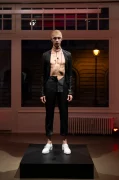
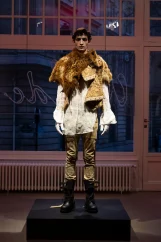
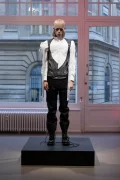
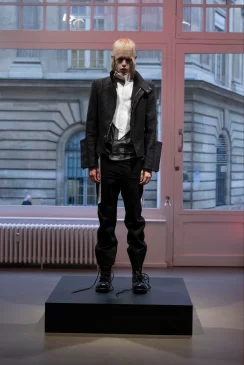
The presentation unfolds across three rooms. Models in their underwear enter, position themselves on a black platform, and begin to dress. The choreography is visible both from the street and from inside the gallery. This performance takes as its starting point the passage in the novel in which Des Esseintes, after having constructed a thebaid of extreme refinement within a sealed universe of artifice and excess, is ultimately forced to abandon it and return to reality. Sébastien Meunier stages this artistic performance as a natural extension of the decadence and artifices portrayed in the book. The models dress and undress continuously, attempting to reconstruct the looks imagined by the designer in an endless cycle where, over time, fatigue becomes apparent, makeup runs, garments wrinkle, and endurance becomes palpable.
The collection presents itself as multifunctional, offering numerous possibilities for layering, demonstrated by the performers and carrying aristocratic attributes across centuries. The silhouettes are slender and meticulously tailored, drawing from dandyism with subtle medieval resonances, while others evoke the cut of a Renaissance doublet. A double-breasted coat adopts the poise of a courtier’s attire and, when seen from behind, recalls the elegant slits of a Belle Époque frock coat. Attention to detail is almost ceremonial, fabric-covered buttons sewn with a single central stitch, structured collars, and plastrons reinforced with horsehair. Silk, grosgrain, and moiré ribbons stand alongside bonded cotton on metal, gold-printed viscose, and burned-effect denim, together composing a vision of modern decadence through reimagined Napoleonic jackets.
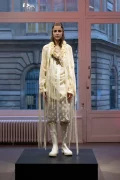


The feminine pieces appear as ghostly presences. Designed by Mirjam Van den Akker, these silk-veiled silhouettes evoke spectres from another era, infusing the collection with romance and fragility. Gloves, whether for gardening, cleaning, or medical use, act as a pointed reminder of contemporary fashion.
Interview with Sébastien Meunier:
Why did you choose “Against Nature” as your main reference?
Sébastien Meunier: The choice emerged from the anxious climate of the world we are living in. In Against Nature, Des Esseintes withdraws from Paris to take refuge in a world he constructs entirely by himself—both physically and mentally. Rereading the book today, I was struck by how urgently contemporary it feels. We are increasingly isolated, yet constantly exposed to a reality curated by our screens and sophisticated algorythms. In that sense, Huysmans’s novel has regained a troubling relevance.
How does the idea of a “dangerous book” resonate with your vision of fashion?
SM: A dangerous book is one that has the power to influence. That is exactly how I understand fashion—and how I design.
Where does this desire to integrate medieval, Belle Époque, and Renaissance references come from? Is it linked to the book?
SM: From the outset, I envisioned this collection as a layering of epochs and styles—a condensed history of the male wardrobe, recomposed to generate something new. This approach has always been central to my practice, remember that I spent ten years working with Martin Margiela, and it was also particularly present in my work at Ann Demeulemeester. In that sense, the collection is also a layering of my own identities and research.
Which elements of the collection best express this obsession with artificial beauty and the notion of rejection?
SM: A small waistcoat with an eighteenth-century tail, made in grey wool and entirely overlaid with lace and silver thread.
Do you really believe that fashion can corrupt someone?
SM: Fashion is everywhere now. It has infiltrated almost every aspect of our lives—entertainment, cinema, culture. So yes, ultimately, fashion corrupts each of us.
Is the notion of decadence embraced, critiqued, or both at once?
SM: I critique it—but I also succumb to it.
Later,
Alex.
