



nnnnneeeeeeeee nnnnoooorrrrrrrr nnnnneeeeeeeee nnnnoooorrrrrrrr. A particular sound of childhood. The youthful mimicking of a police siren or ambulance. The childlike impulse to elevate the mundane into play.
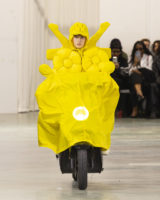
For the opening of Walter Van Beirendonck’s FW26 show Scare the Crows / Scarecrow, a young model zooms around a room that feels like a school assembly hall to an electronic rendition of that same sound. He rides a motorcycle and is draped in sunshine yellow. Two puffed flowers sit on his shoulders. Plastic artillery clings to his back. From the earliest moments of Van Beirendonck’s show, the clarity of his intention is sharp: a refusal to enter the social-aesthetic codes of adulthood. To remain in the world of play.
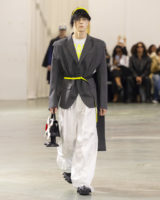
Garish acidity shocked me back to the late-2000s/early-2010s British neon revival. The shag bands of the school playground, the neon tutus of school discos and shutter shades, thrust into the mainstream by Kanye’s Graduation era. A reappropriation of aesthetic tropes of 80s club culture.
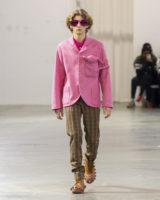
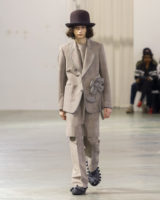
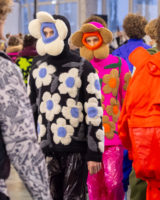
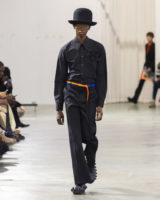
Van Beirendonck is toying with the 30-year nostalgia cycle, contextualising regurgitated aesthetics with their patron predecessors. 00s photo booth prop glasses are paired with Boy George revival hats made by milliner Stephen Jones: a soup of disappearing subculture. Presenting these aesthetics outside of their linear cultural anchorage forces us to confront them – or rather, they confront us. Everything in the collection vibrates between two states: aggression and play. At once alarming and disarming.
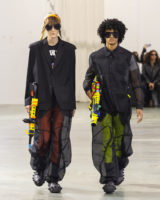
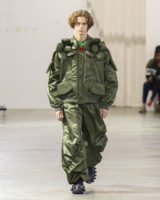
Two guns flank the zip of a camo green puffer bomber exploding into flowers that sit on the shoulders, their stems crawling down the arms. The images are rendered simply, referencing pop art by claiming an image through its most translatable form. The garments hold the same charged energy as a BANG! flag gun, aggressive in pretence, climaxing in comedy. This attempted disarmament seeps throughout: knitted flower balaclavas pacify the roadman.
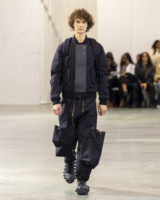
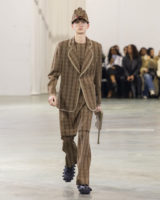
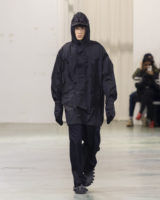
The entombment of violence is central to the collection. Plastic undergarments dangle out of sharp tailored suits, mimicking Afghan War Carpets. Made primarily in Afghanistan from the late 1970s onwards, the handwoven carpets became a record of war and violence, quietly contained in the everyday. Plastic artillery references outsider artist André Robillard’s gun sculptures constructed of scrap materials. What can’t be entombed is at least contained. Translucent plastic trousers protect legs like plastic sheeting over a crumbling building. Hooded raincoats echo vintage car storage covers.
Van Beirendonck’s boys storm the runway like a queer-coded video game rendition of war. In a time when conscription is becoming increasingly feasible, a growing anxiety builds in communities historically excluded from war. Does Van Beirendonck present a protest against violence? Or attempt to culturally entomb it in a futile act of disarmament? Here, violence is not erased, but staged as a spectacle where fashion becomes both costume and shield.
