
Dear Shaded Viewers,
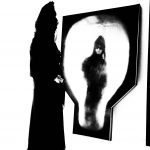
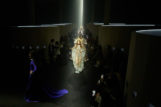
Michele built the entire experience around the Kaiserpanorama, a late‑19th‑century circular device where viewers sat around a wooden drum and peered through small ocular holes at stereoscopic images that slowly rotated before them. Instead of a standard runway, the Tennis Club de Paris was transformed into 12 white circular “chapels,” a contemporary altar where each look appeared as an apparition, seen alone, intimately, and never in a rush.
Guests sat on stools facing these cylinders and had to physically turn and lean into narrow windows to access the clothes, turning the act of looking into a ritual of concentration rather than a passive scroll of images. The usual soundtrack of cameras and phones was replaced by a techno score transfigured into “liturgical beats,” punctuating each emergence like bells announcing a new slide in the original Kaiserpanorama.
In his notes, Michele positions the show as a critique of our hyper‑accelerated, over‑photographed present, reclaiming couture as a space for slowness, proximity, and attention. Each garment is proposed as a singular encounter, an object that demands lingering and almost secret observation, more hierophany than product.
The Kaiserpanorama conceit is not treated as nostalgic fetishism but as a theoretical device: by restricting visibility rather than amplifying it, Specula Mundi questions who looks, how we look, and what it means to desire at a distance. Fashion here becomes a threshold where one pauses to contemplate the world, rather than a surface for endlessly circulating content.
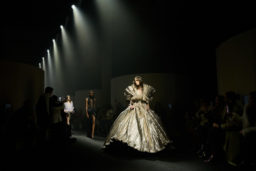
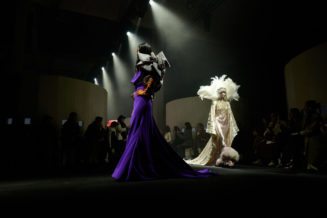
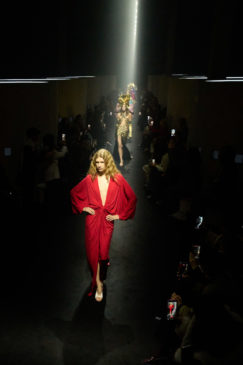
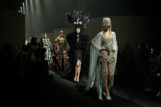
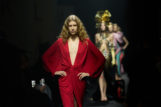
The collection itself draws deeply on Hollywood as a mythological archive, echoing Valentino Garavani’s lifelong obsession with cinema and Old Hollywood glamour. The very first look—a drop‑waisted gown in cardinal Valentino red—opened a procession of silhouettes that felt lifted from 1930s soundstages, refilmed through Michele’s maximalist lens.
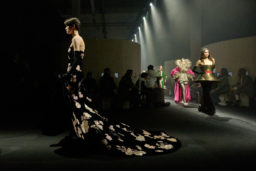
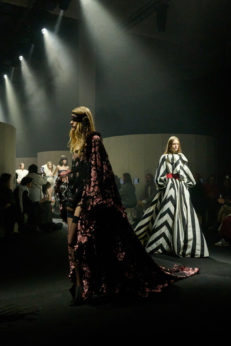
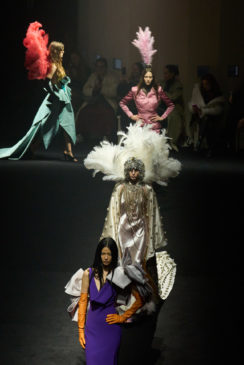
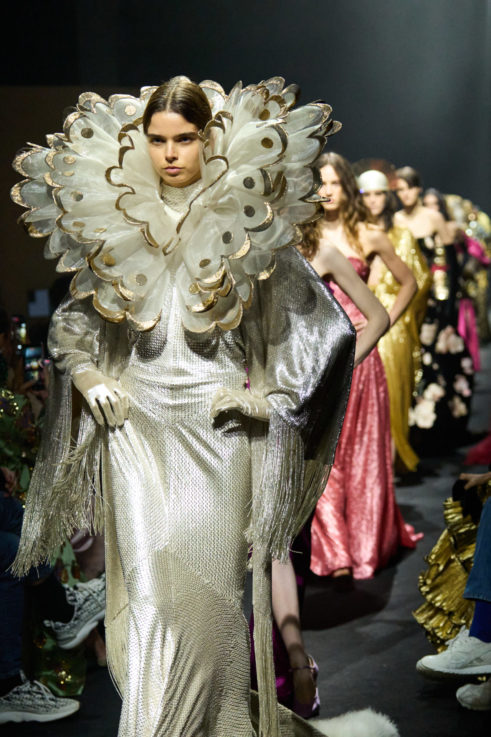
Gowns could have steped straight into a Biblical epic, with chain mail and headdresses, or into a Grecian drama via scrolling, columnar drapery and goddess dresses. Tailored suits, opera gloves, long trains and gleaming embroideries reinforced the sense that each model was less a passer‑by on a runway than an actor frozen in a still, suspended between costume and relic.
Those who have followed Michele’s work recognise his vocabulary—bows, archival‑feeling trims, embellished surfaces—but here they felt disciplined, monumental, “monumental yet tender, expressive yet disciplined,” as one reaction put it. Accessories and details were heightened rather than piled: bows clustered or exaggerated, embroideries pushed to a devotional intensity that suits couture’s demand for extremity.
At the same time, the collection carried a clear through‑line from his earlier couture for Valentino, where he had already begun to explore vertigo, excess and historical layering as couture values rather than ready‑to‑wear signatures. The manifesto‑like show text, written with Giovanni Attili, again framed couture as a poetic laboratory — a place of “epiphanies permeated with the divine,” as the notes described these looks emerging from an archaeological dig through Hollywood’s collective subconscious.
What feels undeniable is that Specula Mundi articulates a coherent thesis: couture as a contemporary altar of vision, where clothes are not simply worn but venerated, questioned, and remembered. In that sense, my instinct that it was “heavenly” is built into the show’s very architecture—the entire system is designed to turn looking into a tiny act of worship.
Later,
Diane