



Silent Earth: Yuima Nakazato’s Poetic Couture Reverie

Dear Shaded Viewers,

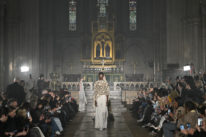
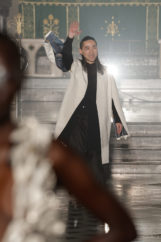
Silence has rarely sounded this loud. In Yuima Nakazato’s Spring–Summer 2026 couture, a word like “show” feels reductive; what unfolded was a quiet, seismic ritual in which garments seemed to carry the memory of earth, water and time itself.

The collection, titled SILENT, stems from Nakazato’s journey to Yakushima, an ancient island where millennia-old cedar trees and river-polished stones shaped his vision. Under that moonlight, he describes touching “streamlined stones carved by river currents and the tree rings of driftwood,” an encounter that ignited a desire “to replicate these forms” with his own hands.

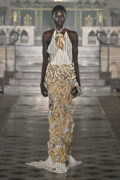
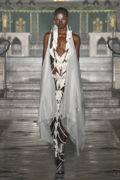
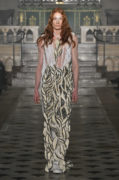
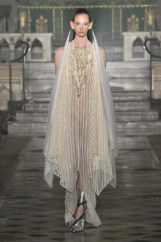
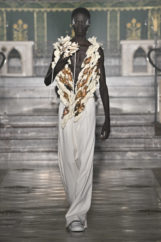
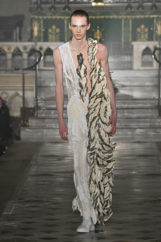
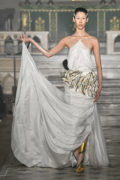
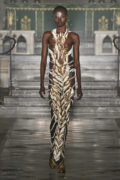
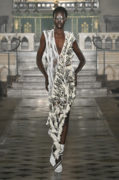
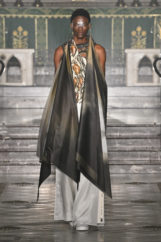
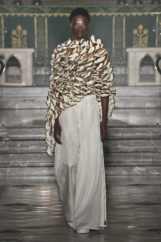
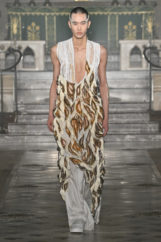
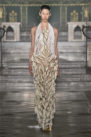
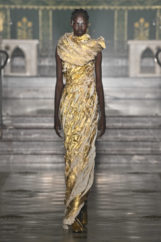
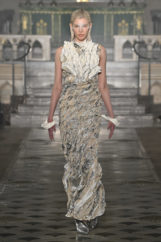
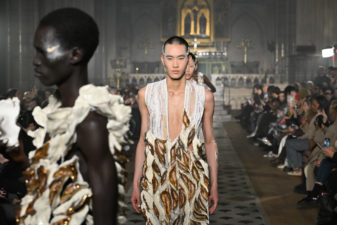
On the runway, you could feel that primal, almost pre-linguistic emotion: silhouettes read like moving topographies, dresses bearing echoes of tree rings, riverbeds and sedimentary time. There was no didactic nature theme; instead, bodies seemed to slip in and out of a living landscape, as if the garments themselves had grown rather than been made.

“Humans have always perceived a primal beauty in nature, desiring not only to wear it but to become a part of it,” Nakazato notes, locating couture in a very old human instinct.

For six months, Nakazato immersed himself in a process closer to sculpture than conventional dressmaking, personally spending over 1,500 hours working clay into thousands of ceramic elements. Through repetition, his “fingers gradually learned the movement of the earth,” and streamlined shapes began to emerge almost autonomously, as if the material were remembering itself through his hands.

This intimacy with process is what made the collection so transporting: each look carried the tension of fragility and resilience, ceramic components articulating along the body like strata, shells or skeletal architecture. The sensation he describes—“losing track of time, of body and clay becoming one”—translated into a choreography of clothes and skin that felt less like dressing and more like inhabiting a new layer of self.

He speaks of being “immersed in the vast flow of time and existing as part of an ecosystem,” and on the runway, that ecosystem was not a backdrop but a state of being.

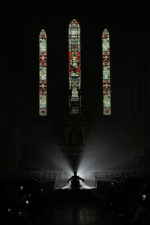
In a season addicted to sonic spectacle, Nakazato chose to remove music altogether, allowing the garments to generate the only score. Ceramic pieces brushed and collided as models walked, producing a delicate resonance “that might be described as the sound of the earth itself,” a soft clatter like distant rain on stone or shards shifting underfoot.

The silence sharpened perception. During those fifteen minutes, he invited the audience to focus on “the unstable, subtle sounds created by the garments” and on the breath of the bodies inside them, a request that turned spectators into almost meditative witnesses. This heightened attention made every sway of fabric and ceramic feel amplified, transforming the runway into a listening space as much as a viewing one.

“I would be honoured if the landscape I experienced in the silence of Yakushima could be shared with you through these garments,” he offers, and the collection makes good on that invitation.

Beneath the poetic surface lies a radical material rigor. Working with EPSON, Nakazato uses digitally output transparent ink on natural silk to prevent fraying, leaving raw, unhemmed edges that slice the air with an unexpected sharpness. The ink is invisible yet structurally decisive, “its presence… certain,” turning transparency itself into a tool and allowing silk to behave like a newly invented fibre.

Elsewhere, he continues his research into Dry Fiber Technology, transforming second-hand garments collected in Kenya into new material that is then fused with traditional Japanese Urushi lacquer. The result is a hybrid textile—recycled yet opulent, ancestral yet futuristic—that underpins couture with a clear stance on responsibility, crafting beauty not in spite of waste but from within it.

Together with evolving technologies, he pursues “new forms of expression and bridge[s] them to the future,” situating couture as a laboratory rather than a sanctuary of nostalgia.

What lingered after the final look was not a single dress or headline image but a feeling: of having been briefly relocated, away from screens and algorithmic noise, into a slower, older tempo of perception. In a world saturated with electronic sound and backlit distraction, Nakazato’s SILENT proposes fifteen minutes of recalibration, where listening to fabric, clay and breath becomes a form of resistance as well as reverence.

By binding Yakushima’s ancient cedars to cutting-edge print technology, clay to couture, recycled cloth to lacquer, Yuima Nakazato affirms that the future of fashion may lie not in ever-louder declarations, but in this kind of deliberate, breathtaking quiet.

Later,

Diane​

Diane Pernet

A LEGENDARY FIGURE IN FASHION and a pioneer of blogging, Diane is a respected journalist, critic, curator and talent-hunter based in Paris. During her prolific career, she designed her own successful brand in New York, costume designer, photographer, and filmmaker.

SHARE