




When I was a young child, my sister and I would stage theatre productions in our living room at least once a week. My parents bought us a fog machine and one morning before school, we secretly switched it on and taped down the button so that when we returned, the house had disappeared into smoke. In the home, theatrical fog warps reality and casts a chimera over domestication. Bodies can appear and disappear into thin air. The magic of a city at dusk, one that melts into clouds, can condense in front of a sofa. Fog makes air tangible. It reveals the matter that enswarms us.
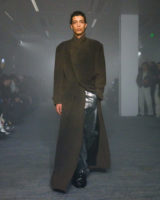
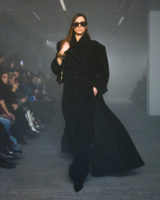
For their FW26 collection entitled Air, Doublet attempted the near-impossible task of making the invisible visible through the medium of ready-to-wear clothing. The show took place in a disused office building clad in grey. Inside, the room slowly filled with smoke. The atmosphere felt taut, like a balloon about to burst. My lungs (and hangover) were agitated by this atmospheric disruption and I realised that before a model had even stepped onto the runway, Doublet were already manipulating our perception of air.
At the core of the collection were experimental fabrics distilled from air itself: yarns spun from CO₂ harvested from the atmosphere, bio-based resins created by microorganisms that consume greenhouse gases, and inks made from exhaust gas derived carbon. These materials were used to create garments that theatrically articulated air, presented within an environment where air was made visible. The result was an autophagic system in which material, subject, and environment collapse into one another: a closed perceptual-material loop.
Though intellectually grounded, playful interventions jolted the collection back to the surface. Balloon animal sculptures formed shoulder pads and scarves; gas masks became leather bags, and a scuba diving regulator dangled from a knitted jumper. A pair of sneakers melted into a bright red leather jumpsuit, while an inflatable pool float valve rested like a brooch on a blazer lapel.
Elsewhere, prop objects were printed across garments: an electric guitar, a bag slung across a shoulder that a model mimed holding. Ties and hoodie drawstrings were fixed in motion, with leaves plastered across fabrics, as though the models had been frozen mid-storm. In one look, a T-shirt read ‘I <3 MARGE DURSLEY’ – a reference to Harry Potter and the Prisoner of Azkaban, in which Aunt Marge is inflated like a barrage balloon.
Hardcore industrial techno scored the show, further pressurising the charged atmosphere until silence was cast over the room. Large plastic coverings were ripped down from the vast slanted office windows revealing a grey sky pouring with rain. The room exhaled, and with it, the collection resolved into clarity. A breath of fresh air after the apocalyptic tempest.
It would be easy to build a collection on an isolated idea – how climate change is altering the earth’s atmosphere, or how wind and movement shape fabric. Instead, Doublet refused reduction. The collection gathered intellectual inquiry, pop reference and playful anecdote, and used them as building blocks to construct a vivid, material world. Like pulling a rabbit out of a hat, abstraction was rendered perceptible. Air, for a moment, existed as a wearable form.
