




Martin Parr’s “Global Warning” reads, today, like his own epitaph: an exuberant, saturated last warning from a man who spent fifty years turning the ordinary into a planetary mirror. This exhibition, prepared with Jeu de Paume and completed only weeks before his death in Bristol on 6 December 2025, condenses his lifelong obsession with the cheerful surface and the catastrophe quietly advancing underneath.
Conceived with Quentin Bajac and Clémentine de la Ferronnière, “Global Warning” gathers around 180 works from the 1970s to the present, one of the last projects Parr actively shaped before he died at 73. It transforms what was long perceived as playful social observation into something closer to a testament: a final montage of our excesses, staged in color so bright it almost hurts.
From New Brighton to Benidorm and artificial domes in Japan, Parr’s beaches are never paradises; they are laboratories where leisure, rubbish, flesh and plastic collide. Global warming is rarely shown through glaciers or disasters here, but through overflowing bins, sunburnt skin and landscapes gradually buried under umbrellas, inflatables and fast food. Instead of denouncing, Parr lets the mess accumulate in the frame until the viewer feels complicit.
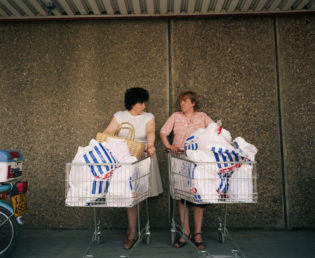
In supermarkets, trade fairs and luxury boutiques, Parr photographs what he calls our new religion: consumption, in all its hysterical, globalized forms. Close-ups, saturated colors and kitsch turn advertising’s seduction techniques against themselves, making our desires appear both comic and faintly monstrous. Humans drift through these temples of abundance as if they too were products on the shelves, priced, branded, soon obsolete.
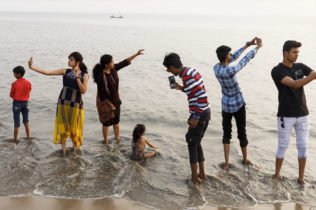
Travel, for Parr, becomes the theatre of a world homogenized by low-cost flights and Instagram poses, where the “global tourist” repeats the same gestures in Venice, Mumbai, Las Vegas or the Louvre. The postcard is scratched, crowded, degraded: monuments drowned in selfie sticks and ponchos, souvenir stalls and queues that seem to colonize the landscape. Beneath the humour runs a quiet study of North–South imbalance, of who looks and who is looked at.
Parr’s animals are never wild; they are pets, meat, attractions—loved, consumed, infantilized and exploited in a single ambivalent movement. In parallel, cars, telephones, screens and consoles sculpt new postures and addictions, bodies bent towards devices, ears chained to calls, eyes glued to pixels. “Global Warning” imagines a planet populated by human–machine mutants, barely coexisting with other living beings, in a reality filtered by glass, plastic and touchscreen.
Parr often insisted that he was no moralist, that he too participated in the carbon-heavy, over-connected lifestyle he photographed. His stance was closer to a tradition of British satire: a “visual guerrilla” that chips away at dominant images through irony, excess and the stubborn insistence on things we prefer not to see. He once noted that almost all his recent images were, indirectly, about climate change; “Global Warning” makes that intuition explicit, retroactively tinting decades of work with a darker hue.
Parr liked to say he created entertainment that contained a serious message, if one cared to read it. This exhibition, opening in Paris a few weeks after his passing, feels like a final joke and a final act of care: a dazzling funfair of images that refuses despair yet refuses consolation too. In the end, his homage is already on the walls—bright, crowded, a little cruel—a last, global warning from the photographer who made the middle of the world impossible to ignore.
Parr did not just change what photographs look like; he also changed how photography is organized, circulated and talked about, and Magnum Photos was one of his key stages. Admitted as a full member in 1994 by a single, controversial vote and later serving as president from 2013 to 2017, he dragged the agency’s mythic humanism into fluorescent daylight, proving that satire, kitsch and class discomfort could sit alongside war reportage and political history. Around Magnum, and through his curating, teaching, photobook evangelism and eventually the Martin Parr Foundation in Bristol, he helped ignite a global culture of photography—festivals, small publishers, vernacular archives—where the photobook, the seaside snapshot and the “bad taste” souvenir all became raw material for serious reflection on how images construct our world.
Later,
Diane