

Dear Shaded Viewers,
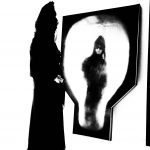
A city of edges returns to its master of edges. Kyoto, with its paper-thin thresholds and sudden shadows, becomes the perfect vessel for Daido Moriyama’s Retrospective—an exhibition that doesn’t just anchor KYOTOGRAPHIE 2026; it sets the festival’s pulse. To stand before Moriyama’s grain and blur is to feel photography re-learn how to breathe, to sense the medium’s perpetual brink—between seeing and sensing, fact and fever dream—exactly where this edition’s theme, “EDGE,” lives.
Housed in the Kyoto City KYOCERA Museum of Art, Moriyama’s survey unfolds like a city after rain: reflective, fractured, electric. Rather than a tidy chronology, it privileges the magazines and photobooks that forged his language—those tactile, serial pages where his images first learned to move, misbehave, and multiply. In this context, “EDGE” isn’t a metaphor; it’s the sharpness of a gutter between pages, the slash of a crop, the vertigo of an image pushed to rupture.
From Moriyama’s epicenter, the program ripples through Kyoto’s historic and unexpected spaces, drawing a map of thresholds—sacred, social, and technological. Juliette Agnel tunes our eyes to the quiet voltage of minerals and plants, while Linder’s incisive provocations recut cultural scripts around the female body, both artists speaking fluently to Moriyama’s refusal of comfort and clarity.



Sari Shibata’s vineyard chronicle, where a woman’s seasons echo the grapes, tracks labour and desire at time’s edge—an everyday radicalism Moriyama would recognize. Thandiwe Muriu’s CAMO and Kyoto-made works stage identity as apparition and announcement, pattern as both shield and shout, echoing Moriyama’s lifelong dance with the seen and the felt. Federico Estol’s “shine heroes” lift a marginal trade into myth, reminding us that the street—Moriyama’s oldest studio—still births its own legends.



Anton Corbijn’s portraits compress decades of legend into the fragile theatre of a face, each image a mask at the brink of slipping. A projection honoring the late Fatma Hassona turns a Kyoto residence into a room of afterimages, where presence persists in the light it leaves behind—another Moriyama lesson.



The South Africa in Focus thread brings three generations into conversation: a photobook library curated with A4 Arts Foundation, Ernest Cole’s first presentation in Japan, Pieter Hugo’s 23-year meditation, and Lebohang Kganye’s storytelling across mediums. Together they outline an “edge” defined by history’s pressure and the archive’s resistance—terrain Moriyama’s own book-led practice helps us navigate.
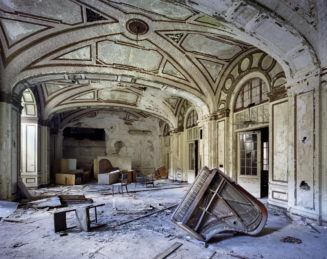

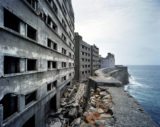
Yves Marchand and Romain Meffre’s modern ruins—which now entwine AI experiments with early photographic methods—stage the future as a slow collapse and a strange bloom. Atsushi Fukushima’s harvest theatre catches life at maximum voltage, where order and disorder wrestle in daylight, a rural mirror to Moriyama’s nocturnes.
Talks, workshops, a kids’ program, masterclasses, portfolio reviews, and a photobook fair turn Kyoto into a social darkroom where ideas develop in shared air. KG+ and KYOTOPHONIE extend the current through sound and satellite stages, amplifying the festival’s polyphony. And in the background, the 12-year anniversary volume—A Kyoto Story Story | A Twelve-Year Cycle—offers a living index of the community that made a Moriyama-centered moment like this inevitable.
In 2026, KYOTOGRAPHIE doesn’t just present “EDGE”; it hands us Moriyama’s knife and invites us to cut. On these pages and in these rooms, the image stays risky, breathing, and unresolved—exactly where it belongs.
Later,
Diane