
















Dear Shaded Viewers,
Introduction
As the days progress more shows fill the calendar, yet many attending never venture away from the big names. Gossip and social media do not always support smaller houses, newer names or even sometime the older and established. The amazing variety the FHCM calendar offers can be edited down into a few shows and thus gives a false impression of how couture as a bigger picture is functioning in 2025.
Wednesday 9th July
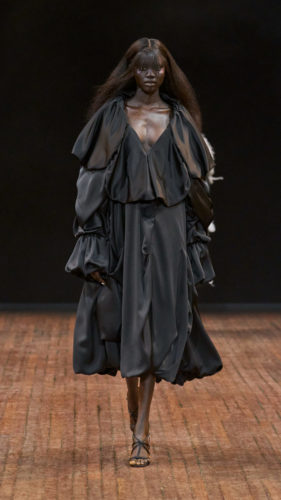
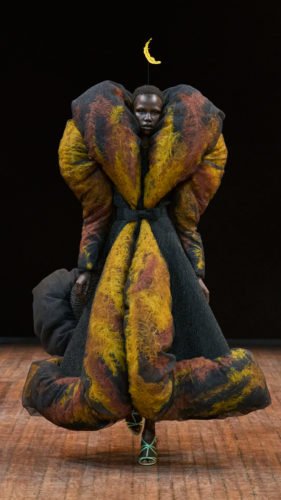
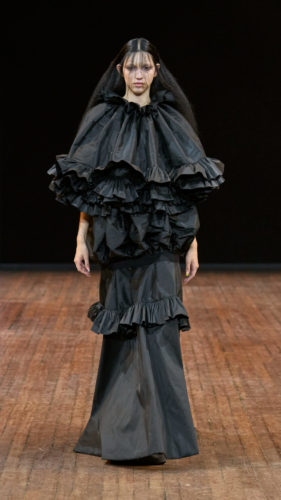
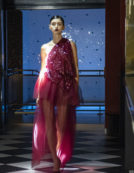
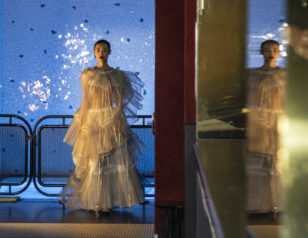
Robert Wun exemplifies a certain designer whose narrative is essential so he can create beautiful couture but also invent some pieces to tell the story. The client and the real world, alongside selling pieces, at times seems far from his creative urge. This season this resulted in a fair number of looks featuring extra arms alongside the models’ own arms and finally one model had a tiny creature placed on top of her head whose arms supported the long veil of the look. In his first collection shown there were stories and pieces where it was more extreme but there were beautiful things and fewer tricks. It seems as if each season passes Wun reaches further into conceptual ideas. This is a shame since he can make extraordinary fashion looks, does beautiful drapery, cuts great jackets, and uses embroidery and embellishments in imaginative ways. The opening look was a superb padded white satin coat with scarlet scattered blood embroidery, it could have stepped from a painting, as could the all black moire tailcoat with a devilish air, or the monochrome rose printed ballgown which had no need for extra arms holding a rose for its impact. Robert Wun is a good enough couture designer to be able to calm down, and although the young social media crowd adore how easy it is to take great pictures of his dramatic ideas, he should focus on his talent for creating beautiful clothes. The exquisite lilac rose sequinned dress and veil, the chalky white trapeze dress with ruffled sleeves and the long column dress in a wine stain shade were so strong and simple in their lines, truly great pieces.
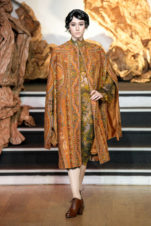
Franck Sorbier tells a story and introduces dance and movement and even a glimpse of ballet, but at the heart of the show is the collection of exquisite pieces. Hand work and ideas which transcend the season, offering loveliness and craft. This season baroque ribbon embroidery in black on a black frock coat, or intense autumn leaf textures on crushed velvet were fabulously gorgeous. A caped short coat in Victorian rich paisley was worn over aged bronze and verdigris lace, whilst a shawl collared knee length waistcoat was in what looked like hand painted velvet with trompe l’oeil edging. Lace was glimpsed again and again under pieces as simple tops and a black outfit was perhaps a dress or pieces in softest silk faille, with a large bow at the neck, balloon sleeves and layered flounced skirt; on one side a rose and dotted sash appeared and disappeared in the folds. This look as so often within the work of Franck Sorbier seems to tell a story to me just on its own, this had a feeling of the brilliant artists of Charivari in Paris, Gavarni or de Beaumont could have drawn this to step off the pages and into this show. In fact two more looks echoed this feeling, a tiny ruched velvet bolero in lie de vin over a soft sashed black dress or a filigree lace and tiny rosebuds Velasquez bodice with a full ball skirt. Enchantment and romance are two key words I would use about these clothes, a couture narrative that aside from the designer’s vision, we can extend into our own stories of an escape into beauty.
Balenciaga this season was Demna’s farewell to the role of Creative Director after a decade. Just before the catwalk show an exhibition had opened, curated by him, celebrating the ten years of his work. Featuring his edited version of key moments, it contained invitations, and everything from catwalk accessories to sporty daywear and through to enormous ballgowns. Demna demonstrated in the first couture for the house his respect and understanding of couture and the house of Balenciaga. If the day, street, and sport pieces are “out of tune” with the origins of the house that is because the world of the twenty first century is not the world of the 1930’s when Balenciaga was founded.
The other element missing from the exhibition is the narrative of the shows, the production, and the environment Demna chose to show in, be it a United Nations conference centre, the arctic tundra, or the original couture salon. He punched home the messages of corporate life, global warming, climate change, respect for the past with both these amazing environments and his casting.
So, in the end the final show presented more a summery of his Balenciaga work and was rather as expected and especially after seeing the exhibition, felt a little safe. Yet for me the great standout has always been the black tailoring and the grand evening wear, by balancing these two opposing elements of couture, Demna also indirectly pays homage to the old fashion concept of a house with two ateliers, the tailoring, and the flou (soft sewing and drapery). It was a tender farewell in the reinvented couture salons founded by one of the greatest couturiers ever. It closed a chapter and now we wait to watch the new era with the quite different vision of Pier Paolo Piccioli.
Yuima Nakazato
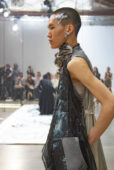
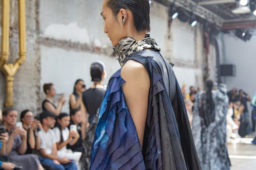
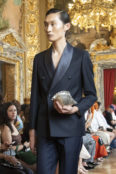
To innovate, to be original, to have creative vision that surprises and to have a distinct handwriting is incredibly special in fashion. Yuima Nakazato challenges us every season with his experimental investigations, across the seasons he has grown and matured, and his collections have become stronger, and perhaps above all, his pieces have a beauty that is truly individual. This season the layers, the contrast of the weighty against the weightless and the flow and ebb of the collection was like the tide. Long lines and fluid forms moved past us as though in a ritual or pageant not a fashion show. The atmosphere he creates is unlike any other designer showing at couture and his ability to take us on a journey enthralled the audience. A strapless dress with a monochrome handprint was wrapped with a section beaded like rock strata, a long printed coat unwrapped over a metallic bodice, a swagged mousseline overlayer drifted across another layer in deepest ocean tones. We gazed as aqueous textures and colours contrasted with virginal white, a draped half dress was worn by a model carrying a huge silver shell to conceal her bare breast, a series of printed “pages” in wire fluttered around the model as they walked, chain mail slashed across the front, surprise explosions of trailing panels elongated the already lengthened silhouette. They ceased to be models and became beings from another country imagined by the designer, Yuima Nakazato uses alchemy to create haute couture for another planet, and we are under his spell.
Viktor and Rolf are couture geniuses, it is where they started and where their love lies, it is their playground, and from dresses to hang on the wall to a whole collection based on the bell they surprise, excite, and amaze us. Their vision this season was two looks side by side, one soft fluid and elegant, the other side was the same pieces stuffed with literally thousands of feathers. The distortion of the proportions was extraordinary and the feathers emerging, fighting for escape, and sometimes exploding was manic. The collection was in black but the feathers in brilliant colours tinted the sheer fabrics or added a tiny frond or quill of colour. The stupendous proportions of the bouncy huge pieces were extended, balanced, and enhanced by Stephen Jones millinery confections. They ran the gamut from single quills soaring into the air to Folies Bergeres extravaganzas waving and nodding like gigantic fans accentuating the fashion. It was a superb show and collection from the very first entrance, and the applause told them of its total success. My stand out looks amongst so many were a soft black dress in slipper satin with triple puffed sleeves and a softly looped skirt and simple v neck, and a five tier looped sparkly strapless dress, plus a Pierrot collared long looped top to the hips with a double ruffled skirt. The long point d’esprit evening dress was amazing when in the second version the soft drapery at the back was stuffed with acid green ostrich feathers which emerged as quills along the back seam like a strange mating season invitation. Viktor and Rolf are entirely entitled to the term “original.”
Zuhair Murad has come a long way in his view of fashion, luxury and glamour and this season he really showed how brilliant his clothes can be. I felt as though the collection had been seen through the eyes of golden age Hollywood, or Jean Louis for Rita Hayworth. The seductive lines, the beautiful balance of rich embroidery, the long sweeping the floor stoles, spoke of quality and what can only be called “a class act.” Shimmering and seductive, wrapping and draping around the body his collection defined couture evenings. The use of so many weights of fabric from airy silk mousseline through to rich velvet, and colours which included a deep fir green, a bitter dark chocolate and a shade somewhere between cranberry and lie de vin was lovely, as were the softer cosmetic shades. I loved how as the models passed so many of the looks billowed and draped in the air, or moved against the wearers body, nothing impractical about these sirens, these clothes move with your every gesture. There were heavily bejewelled coats, tiny, beaded cover ups, and some capelets, there were draped dresses with long floating panels, very much in 1950’s style and certainly award acceptance ready, but perhaps my favourite didn’t really fit with what I’m saying; a long sleeved, high necked floor length, black velvet gown embroidered with a silver feathers tumbling down one side to the flipped out hem of the skirt. High wattage fashion under the spotlight.
Maison Margiela is not truly the madness that was Artisanal, nor is it straightforward Martin Margiela; it is a couture collection under the Margiela name, and since John Galliano’s departure and the announcement of Glenn Martens appointment many have been excited to see what this highly rated designer might do. I’m a huge fan of Martens, and I wasn’t at the show but as his debut collection I thought it all looked good, some didn’t work as well as others, I loved a lot and didn’t understand some. The beginning was strong, and all the first outfits and the clear vinyl and plastic was excellent. The silver dress with a cowl, and the three crushed metallic dresses felt odd, as did their placement in the running order, after that I really think the collection was stronger and worked more and more. The painted and patchwork and leather and assembled pieces and the swirling birds’ wings and the antique gold encrusted dress, and the beaded knitting felt so right. The three draped looks were OK but like the crushed metallic dresses they felt slightly Jean-Paul Gaultier not Margiela? The collection abounded in references to Margiela and Artisanal and used found objects, recycling, repurposing, and hand. Couture and invented crafts were used in delightful ways that recalled the past, but with no direct copying, no slavish hommage and with a strong overall darkness of beauty which the Belgian designers share. Overall, a great debut, first collection, and new beginning.
Thursday 10th July
Aelis
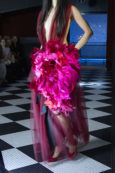
The romance of Aelis is heightened in the slow presentation of the collection. This season shown in a dark space at Les Bains there were so many individual beautiful pieces it is hard to pick out examples. The theme of the collection and Sofia’s inspiration is each look, not an overarching narrative to capture everything in, but a series of thoughts where the fabrics, and trimmings evolve into a look. There was of course black, white and amazing jewels often using found and vintage pieces remixed, jumbled and strung together. This season I especially loved the red pieces, a dark bitter red slipper satin draped toga like dress, a brilliant red skirt with a crisp white draped and folded handkerchief top, a red mohair textured throw over sparkling chalk white, dark red tulle with a slice of tonal dark red paillettes and gem embroidery, and red tulle again in a tiered skirt adorned with a huge bouquet of shaded red roses at the hip, its delicate petals and fronds almost like sea anemones rather than flowers. There was also a deep purple plum red silk faille dress looped and draped and cascading into a long swishing train behind the wearer. Last by by no means least a huge white skirt with a red velvet bodice created out of unfolding and folded origami, epitomising how at couture anything is possible.
Ardazaei
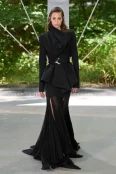
This was the second show for Ardazaei and although there were many lovely things, there were elements shown in the first catwalk show I missed this time. However, there were many great pieces and its was full of glamorous and beautiful ideas. The crocheted dress made out of mauve and black circular pieces spiralling around the body until spilling out into a train, the bois de rose shaded asymmetrically draped mousseline dress was one hundred percent classic couture, and the ruffled flamenco or samba dress was a stunner in graduated shades of bone multiple fabrics with arched corset bodice . The opening black gothic look with its curving tailored trench jacket and split panelled black georgette skirt was very dramatic, and it would have been good to see more of this look and style. It was indeed a collection of myriad ideas but perhaps some needed expanding rather than jumping on to the next. It also felt as if the mathematical and architectural creative thread had been down played after last season. Like the second album for a singer second collection are a challenge.
Peet Dullaert
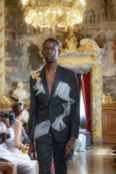
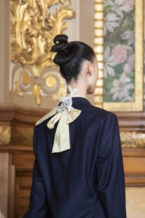
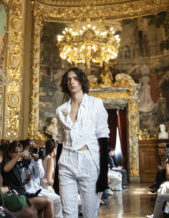
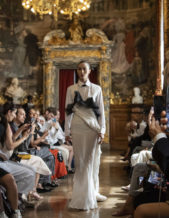
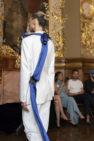
When designing haute couture there must be a consistent vision, but there must also be a variety for clients of different personal styles to shop. This season Peet Dullaert took us from perfect tailoring to lace, and from whispered minimalism to entrance making statements, yet all with his signature firmly placed upon them. Let me start with my favourite couture look of the season. A long tunic dinner shirt whose pin tucked bib was twice as long and twice as narrow as usual, a wing collar and French cuffs with cuff links and a diamond brooch, and then it was worn with a long narrow deep, navy blue sliver of silk charmeuse skirt. It was so discrete, timeless, ageless, and lovely, in the French couture manner of understatement taken to the extreme. In the collection the tuxedo and tailored pieces were fresh and immaculate and perfectly proportioned, for any client this is the house to come to for these pieces. The balance of decorative against minimal and the contrast of clean lines against softness and drape is always beautifully complimentary under this designer’s watchful eye. The ribbons trailing at the back of several looks again reminded me of Embassy or court attendance. It was also showing in silence in the gilded chandelier hung salons of the Opera Comique and it was so perfect for the collection. A black tailored jacket worn with a silk faille bustle skirt was a brilliant extraction of past fashion from the late Victorians and the 1940’s into 2026. The Rachel tulle skirt draped around the hips and floating around the sleek black dress underneath was a distillation of the ballet Giselle and the white draped dress with a waistcoat hinted at in the construction and swagged in a black ruffle was superb. The signature linear beading was beautiful in a dress Lana Turner would have killed for, and also, I loved the white tuxedo with blue ribbons, the iced sage green silk velvet skirt, and there I will stop. It was a mature, sophisticated, elegant, and fascinating collection, congratulations Peet Dullaert on making my heart beat faster.
Rami Al Ali
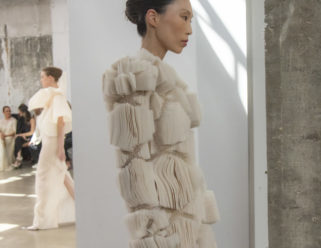
In spite of having an established business and having shown at Paris couture many times, this was the official debut of Rami Al Ali on the FHCM calendar. The first Syrian designer to be so named, he presented an outstanding collection for this season which more than justified his inclusion. Although he drew on his own culture and crafts and there were some more obvious references than others, this was not the most significant element to the collection; it was the beauty of the clothes and the workmanship which created his vision of what women might wear. The third dress was in palest ecru silk frills and silk organdie; it was a slim column dress and enfolding it were great multi layered petals ruffling as the model passed like a blossom in the breeze. Even as I gasped the fourth dress entered; a simple round necked long sleeved top of silk mousseline was entirely embroidered with tiny brilliants in a tracery pattern which entrapped with the ends of the work, just below the waist, dozens of folded “handkerchiefs” forming an umbrella like skirt. It vibrated and undulated as it moved, and the edges had classic linen entre jour edges and minuscule self fringe. Later the palest iced green silk organza dress was formed of loops of fabric like sails which gave the impression it could lift the model off into the air, somehow combining volume without heaviness or being unflattering. The bride had a veil, etched with the tiniest scattered embroideries, looped into a hood, and then released over an hour glass dress where the embroidery faded away towards the hem, and the entire look has a lightness and fragility to it that made it seem like a figure in a snow globe! The collection was confident and not one thing was out of place, Rami Al Ali had used his eye, his experience, and his ateliers to offer a truly lovely personal vision of haute couture. In a word – bravo!
Adeline André
In the divine cool space under the trees we watched as each model entered through an arched tunnel of greenery. Each look perfect, each model supremely confident and beautiful in their look, and we applauded as each paused for the photographers. The most select audience of connoisseurs who had taken the trip out to Passage Danzig to watch this seasons showing of pieces by Adeline Andre, a long time established couture voice in Paris. The unstructured simplicity, the colour magic, and the quiet elegance of her clothes is legendary, her ability to form fabric into a shell jacket, a long slender dress or a simple set of colour drenched separates was for me epitomised by the mint green layering of a weightless silk organza coat, over a soft jacket and a tunic with self tied bows, and a huge silk mousseline headscarf. Its beauty was effortless and in the shade its coolness was heartstoppingly lovely. There was a duchess silk satin jacket in deep azure with a midnight navy back, worn with a sliver of bright sap green silk charmeuse, and a long-sleeved floor length carmine, red silk jersey tee shirt dress where the only visible construction was a slight gathering around the high bateau neckline. The clothes are an extraction of couture and a definition of less is more. Those of us who were there were privileged and so happy as we left, we had had been witnesses to magic.
Germanier
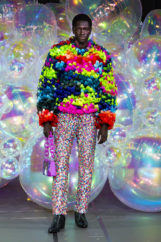
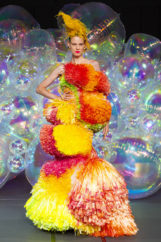
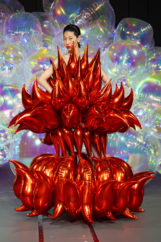
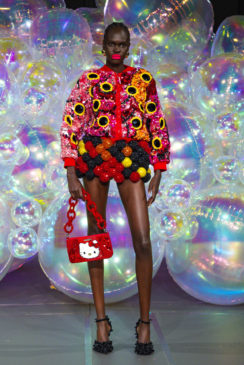
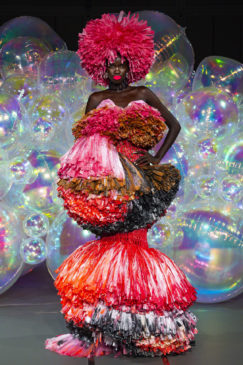
Closing the couture season for the second time Kevin Germanier entranced, surprised, delighted and entertained a packed space. The collection was a departure in some ways featuring ever more extraordinary creations, the story behind which, even just viewing them, you know is unexpected and special. Many of the pieces and looks enfolded, wrapped around, and encased the wearer, but the construction was perfect. Often with this style of creation wobbling models, bad fit, weird closures and a slightly theatrical impression is the result. None of this happened with a single inventive look as the models confidently walked and posed, everything fit perfectly, there was no hurried grabbing of the pieces to either stabilise or adjust them and the positioning of every leaf, petal, feather, or balloon remained immaculately in place. It is truly a couture approach to this genre of creation unlike any which has gone before. The beaded petals, the cascades of tumbling silver leaves, the gigantic ballgowns of inflatables, all have the same rigour as a tailored jacket in Savile Row. Kevin Germanier is Swiss and like the famous makers of timepieces his precision is brilliant. The other extraordinary element in his creative repertoire is colour; how he combines colour, cascades it, swirls it, and overlays it is simply amazing. It is never vulgar but joyous, it offers surprises but not shocks, and in whatever medium he’s using he delights. The final show is a difficult position but Germanier sent us out into the torrid heat of the evening smiling, applauding and indeed celebrating what Paris haute couture days can offer in the celebration of the craft and laboratory of fashion; marci beaucoup.
Tony Glenville