





Dear Shaded Viewers,
There is a smell that never quite leaves a stable — leather, sweat, hay, something animal underneath the polish — and it is that smell, more than any silhouette, that runs through Leo Prothmann’s AW26 collection. He competed in show jumping from the age of fourteen, and he has said that even at the top of that world, in the cleanest boots and the best-bred horses, “you’re still cleaning horse shit.” It is a line that could sound like a joke, until you see what he has built from it.
“The horse world looks incredibly glamorous from the outside: polished boots, beautiful leather, immaculate horses, competition,” he told me, from a train bound for Paris, still glowing from a morning of answering questions he clearly enjoyed. “But behind that there’s sweat, mud, physical work and, yes, a lot of horse shit. That contrast became very instinctive in the way I design. I like something polished next to something raw — an expensive leather treated quite brutally, or a controlled silhouette that suddenly collapses somewhere. Glamour is much more interesting to me when you can still feel the work underneath it.”
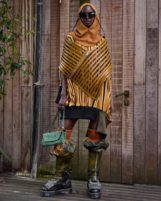
The collection itself began somewhere entirely unlikely — a tenth-anniversary trip to Mexico, to San José del Pacífico, its damp mountain air and its light. And yet what arrived on the AW26 runway refused the season’s usual mourning palette of black, grey and navy. Mustard. Deep burgundy. Teal. Forest. Colours that feel less like summer than like something sun-bleached, aged, remembered rather than reported. “The trip to Mexico left such a strong visual memory that it felt wrong to dull it down just because the collection happened to be AW,” he said. “Leather already gives you that weight and protection you associate with winter, so the colour could bring the heat.”
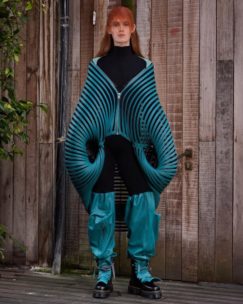
That leather does more than warm — in places it becomes architecture. The collection’s caged, spiral-cut leather dresses are built from a single continuous strip, pinned and placed by hand directly on the body, a process that takes days because, as Prothmann put it, “there really isn’t a shortcut.” He calls the result “couture furniture,” and the phrase is not entirely a joke. “I wanted almost the opposite of traditional leatherwork — one line travelling around the body, like drawing around it. The leather becomes the line but also the structure. You’re almost building an object around the body rather than simply sewing a dress.”
Elsewhere the tension softens into something more vulnerable: sheer tulle set directly against heavy, structured hide. “Tulle almost disappears. It reveals everything and feels very vulnerable, while leather can act like armour,” he said. “When you put the two together, neither material behaves exactly how you expect. The leather can suddenly look like it’s floating, and the tulle ends up holding something much heavier than itself. I don’t want sensuality to automatically mean softness, and I don’t think strength has to mean completely covering the body. I like someone looking vulnerable and armoured at the same time.”
Even the collection’s more overtly functional collaboration — a reworking of the Dr. Martens Jadon into something closer to a legwarmer grown out of a hiking boot — traces back to that same terrain in Mexico, and to a very specific discomfort. “We were doing these long walks through really damp terrain, and I remember thinking I wished I had a pair of Dr. Martens with me,” he recalled. What followed was cargo pockets, waterproofing, a silhouette pushed toward the protective and the strange in equal measure — “the softer part around the leg almost starts becoming clothing rather than footwear.”
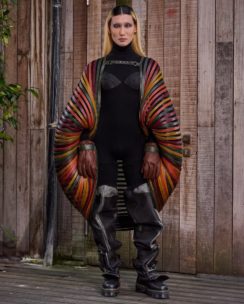
Prothmann grew up training horses in Mallorca long before he touched a sewing machine, and he traces his engineering instincts — balance, tension, where a strap needs to give and where it needs to hold — directly back to tack. He has since passed through the studios of Rick Owens, Craig Green, Matty Bovan and under the mentorship of Mandi Lennard, each leaving a different mark: Green’s structure, Bovan’s fearlessness with proportion, Owens’s scale, Lennard’s clarity about “what makes something yours.” But the volume that has become his signature — those winged, cocoon-like sleeves — is, he says, never decorative for its own sake. “I want it to change someone’s posture, how they enter a room and how the rest of the body suddenly looks against it.”
“Stable Glam” began, by his own admission, as something almost literal — horses plus glamour. Now, showing gender-fluid, unisex collections on the official London Fashion Week schedule, he describes it as a wider set of frictions: “discipline against excess, utility against decadence, masculinity against femininity, dirt against polish.” His idea of glamour has migrated too, away from expense and toward nightlife, transformation, the particular confidence of a person remaking themselves for one evening. “The stable is still the grounding part for me,” he said. “The glamour is the part that can keep changing.”
It would be easy to read clothes this maximalist — sculptural, event-scaled, built by hand in-house in London — as incompatible with the sustainability language Prothmann also uses: buy less, buy better, love it longer. He doesn’t see a contradiction. “I’d rather someone owns one completely insane leather jacket that they love for fifteen years, repair, lend to friends, wear to death and eventually pass on than buy twenty disposable versions of something because they were easy,” he said. “Longevity isn’t connected to how quiet a garment is. Sometimes the most dramatic thing you own is exactly the thing you never want to throw away.”
That, in the end, may be the truest description of Stable Glam: not a costume for the runway, but clothing built the way tack is built — for the body’s real weight, for years of use, for the particular dignity of things that have clearly, visibly, been worked.
Later,
Diane
