







Dear Shaded Viewers,
The legend always starts with the van. It is March 1986: six freshly graduated designers from Antwerp’s Royal Academy load their collections into a borrowed vehicle and drive to the British Designer Show in London, not yet aware they are about to redraw the map of European fashion. That road trip has been told and retold for forty years because it marks a genuine rupture—the moment Antwerp stopped being a periphery and insisted on being seen.
MoMu’s new exhibition, The Antwerp Six, opens on that fault line. From the first room, it’s clear this is not a nostalgic group portrait but an attempt to disentangle six distinct visions that happened to break through at the same time. Dries Van Noten, Ann Demeulemeester, Walter Van Beirendonck, Dirk Bikkembergs, Dirk Van Saene, and Marina Yee are framed as they always should have been: not a brand or a formal collective, but six independent practices whose shared education and shared gamble in 1986 created a critical mass that fashion could no longer ignore.
What becomes immediately apparent, moving from one designer’s space to another, is how radical their approach still feels. At a time when overt luxury and power dressing dominated, these six proposed something deliberately off‑centre: Ann’s slashed lyricism, Dries’s layered textiles, Walter’s saturated graphics, Bikkembergs’s athletic rigor, Van Saene’s ironic craftsmanship, Yee’s intuitive deconstruction. Together they dismantled the idea that fashion existed merely to signal status, and instead positioned it as a form of cultural commentary and personal research.
It’s against this backdrop that my own story with them begins. In 1993, while he was producing Dries Van Noten’s menswear spring/summer 1994 show in Paris’s Passage Brady—the so‑called Indian passage—Etienne Russo invited me to my first Dries Van Noten show in the city. I walked in already aware, in abstract, of the van, the Academy, the disruption they had caused; I walked out understanding, viscerally, what Antwerp meant when translated into fabric, light, and movement.
MoMu’s The Antwerp Six opened last night in Antwerp, but for me the story began thirty‑five years ago, under very different lights. I keep thinking that this exhibition has been two years in the making, yet in another sense it has been four decades in the making—stitched together from the van that left Antwerp for London in 1986, the backstage in Paris in 1991, and all the quiet, stubborn decisions six young designers made not to compromise.
It was Geert Bruloot who convinced the Antwerp Six to travel to London to show their work at the British Designer Show in March 1986. When they arrived that spring, they discovered their stand had been tucked away between bridal gowns and trashy kink, a no‑man’s‑land where no one even realized they were there. Marina Yee understood that this invisibility would kill them, so she quickly put together a flyer and sent it circulating through the fair, a small act of guerilla PR that drew buyers to their corner and led to their first order from Barneys New York.
I met Etienne Russo in 1991, when we were working on Susanne Bartsch’s Balade de L’Amour., an AIDS benefit. It was one of those nights where fashion, performance, and desire fused into an atmosphere rather than a “show.” Etienne was already a master of that invisible architecture—someone who could shape emotion with light and space but I was totally unaware of all of that when we first met. In the chaos of Balade de L’Amour and late-night problem‑solving, he carried himself with a calm precision that felt understated, exacting, almost conspiratorial.
If I hadn’t already been aware of what the world had started calling the Antwerp Six, that Dries show would have been enough to seduce me. It unfolded like a conversation in a language I somehow already spoke: prints hovering between memory and dream, saturated colours and quiet embroideries that glowed rather than shouted, clothes that felt both deeply personal and effortlessly wearable—less a fashion moment than a pure encounter with beauty.
What struck me even then about The Antwerp Six, was that this wasn’t a “collective look.”There was no logo to bind them, no identical manifesto. The Antwerp Six were never a brand, never a tidy group project. They were graduates from the same academy, shaped by the same city, but each one moved through fashion like a different temperament. The industry, needing a narrative shortcut, let’s just say they found the names difficult to pronounce, named them as though they were a band. In reality, they were six separate solitudes who happened to share a van to London and, in doing so, altered the coordinates of contemporary fashion.
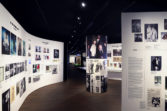
Last night at MoMu, that distinction was palpable. Walking into the exhibition, I could feel the weight of the two years of research and preparation behind it, but also the decades of myth and misunderstanding that needed to be untangled. The museum doesn’t present them as a homogenous bloc. Instead, it lets each designer speak in their own register, like six distinct instruments in a piece of music that occasionally aligns into harmony but never loses its individual timbre.
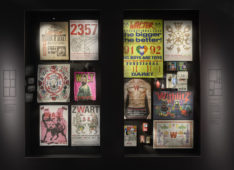
Dries’s world is, of course, the one I first encountered in person: the orchestrated tension between pattern and restraint, the way a print can hold a memory of another culture without sliding into cliché. His clothes have always felt like travel, not tourism—moving through references rather than collecting them. Ann Demeulemeester, by contrast, brings a different kind of intimacy. Her silhouettes are like sentences that trail off mid‑thought, all suspended hems and elongated lines, a perpetual dusk between masculine and feminine. With her, I feel the pull of the unsaid, the poetry that lives in restraint, a sensibility steeped in music. Those long, lean figures and poetic blacks are deeply entwined with the raw, romantic spirit of Patti Smith, whose words and image became a recurring muse and mirror for her collections.Then there is Walter Van Beirendonck, the joyous agitator. To stand in front of his early pieces is to remember how radical color can be when it is wielded with purpose. His work feels like a manifesto written in cartoon hues and hyperbolic shapes, but underneath the playfulness lies a serious engagement with bodies, gender, and the planet. Dirk Bikkembergs, on the other hand, anchors everything in physicality. His is a fashion of stadiums and concrete and sweat; he understood long before most that the athlete could be recast as a luxury figure, that sport could be erotic and elegant without losing its toughness.
Dirk Van Saene deserves more than a footnote. His work always felt like a small detonation inside the Antwerp narrative—quietly radical, fiercely idiosyncratic, and completely uninterested in playing to the crowd. Where others refined a recognisable signature, he seemed to delight in veering off-script, approaching fashion with the irreverence and curiosity of an artist rather than a brand.
The show MoMu has recreated makes that crystal clear. In a city overflowing with beautiful models, Dirk chose instead to stage a procession of store mannequins gliding past on a train track, an eerie, hypnotic parade that turned the usual hierarchy of runway and audience inside out. The clothes become part of a moving still life, a living sculpture park, and you sense how ahead of his time he was in questioning fashion’s rituals while still indulging in their magic. That same inventiveness now flows into his art and sculpture, where the wit, strangeness, and formal precision that once animated his collections have simply shifted mediums rather than dimmed.
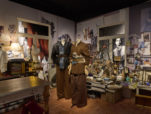
Marina Yee is perhaps the most elusive of the six, and yet her presence in the exhibition is among the most affecting. MoMu has reconstructed her atelier with meticulous care, preserving not just the objects but the particular choreography of her working chaos—the feeling of a mind in motion, surrounded by half‑finished ideas and recovered garments given a second life. The concept for this space was discussed with her in advance; Geert Bruloot had proposed it before her passing, and she knew exactly how it would be translated into the museum. That knowledge gives the room an added charge: it feels less like a set and more like a quiet farewell, which is why it becomes one of the most emotional passages in the exhibition.
The catalogue is dedicated to her, a gesture that underlines how central she is to this story, even if she remains the least known to the wider public. Within inner circles, however, she is spoken of with the utmost respect—as a designer whose sensitivity to form, reuse, and restraint helped shape an entire generation’s understanding of what fashion could be. It has often been said, discreetly, that Martin Margiela held her in very high, even deeply personal regard, and that traces of her image may have echoed through some of his early work; whether or not this can ever be fully substantiated, the idea feels fitting for a figure whose influence has always travelled more by quiet reverberation than by proclamation.
Standing in the MoMu galleries, I realized how much of this I had absorbed in fragments over the years, through shows and conversations and chance encounters. The exhibition doesn’t simply display “iconic looks”; it opens up the processes, the doubts, the small decisions that accumulated into what we now retroactively call a movement. It reminds you that the Antwerp Six did not set out to become a legend together. They were simply six stubborn individuals who chose to treat fashion as an artistic and intellectual practice rather than a service industry.
What moved me most was how little of it felt nostalgic. Yes, there are archival pieces, show imagery, objects from the studios that trigger a certain pang for another era of fashion—one less addicted to spectacle for spectacle’s sake. But the work itself does not read as “vintage.” It feels disconcertingly, almost uncomfortably current. The questions embedded in these garments—about authorship, integrity, independence—are still the ones we argue about today, only now they are filtered through the noise of social media and the acceleration of the market.
As I walked through the rooms, I kept flashing back to that first Dries show Etienne invited me to. I remembered the anticipation before the show started, the collective intake of breath, the quiet authority with which the clothes declared themselves. The Dries show in Passage Brady was also unique in the way the passage itself became part of the experience. The vendors lining that narrow, Indian arcade didn’t disappear behind the fashion; they were folded into it, their shops, smells, and everyday choreography forming a living backdrop to the clothes, blurring the line between runway and real life. I thought of Susanne Bartsch’s Balade de L’Amour, of that moment in 1991 when my own path crossed with this Belgian universe almost by accident.
It struck me that this exhibition, though meticulously curated and officially sanctioned, is also built from thousands of such personal intersections—people whose lives and tastes were quietly rerouted by a show, a silhouette, a mood. That same sense of considered intensity runs through the entire project at MoMu, right down to its remarkable catalogue: a nearly 400‑page volume of images, essays, and archival material that feels less like a souvenir than an essential extension of the exhibition itself. The Antwerp Six runs at MoMu in Antwerp from March 28, 2026 to January 17, 2027, giving visitors ten months to step into this world and, perhaps, rewrite a little of their own fashion history in the process.
Leaving MoMu, I didn’t feel like I had visited a shrine to the past. I felt more as though I had been reminded of a standard: of what it looks like when designers insist on following their own logic, even when it is uncomfortable or commercially risky. The Antwerp Six were never a neat collective, never a brand you could buy into with a single purchase. They were—and remain—six ongoing arguments about what fashion can be. Walking back into the night, I realized that those arguments are still shaping the way I see, the way I choose, the way I fall in love with clothes.
I love this interview it gives more context now on SHOWstudio:
Later,
Diane
