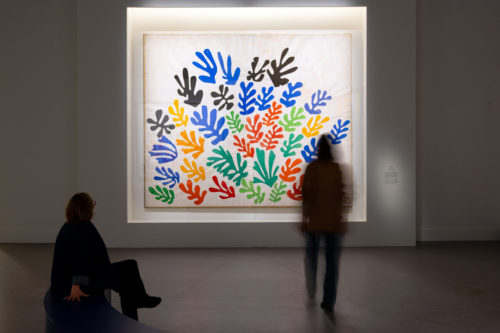
At the Grand Palais until 26 July, an exhibition gathers the thirteen final years of Matisse’s life, the most prolific of all, from a near-fatal operation in 1941 to his death in November 1954, brush or scissors still within reach. Matisse brings a quality of joy and harmony so rare and so generous that, at a moment when the world feels short of both, people will cross oceans to stand in these rooms.

A single stroke describes a shoulder, a gaze, the weight of a hand resting on a table. Matisse spoke of wanting to achieve in painting the same expressive ease he had in drawing, and here, you see exactly what he meant and how hard-won that ease really was. The most minimal sketches are the result of a process of identification with the subject so complete that the line arrives, apparently effortless, at the end of a very long journey. Along the way, a quote from 1950 floats on the wall: “I hope that however old we live to be, we die young.” A wish, a way of life that reads like a manifesto. To keep the eyes wide open, to meet the world with the wonder of a child encountering it for the first time. And there are the still lifes. Lemons, pomegranates, objects on a table, some stripped of all colour, with a precision that makes them even more alive. The French call them “natures mortes.” Dead nature. The English call them “still lifes.” Two formulas, two opposite worldviews. Matisse, definitively, was on the side of life.
Born into a family of weavers in Le Cateau-Cambrésis, Matisse spent the first twenty years of his life surrounded by looms producing the finest fabrics for Parisian Couture and the silk trade in Lyon. He never left that world behind. Throughout his life he collected textiles obsessively, bringing back from Morocco, Oceania and Tahiti rugs, hangings and embroideries that filled his studios and fed his eye. His contemporaries criticised him for using colour like a weaver. They were not wrong. The cut-outs are the logical endpoint of this thinking: born of cloth, they cut into colour the way a weaver cuts into thread. Standing before the stained-glass windows shown upstairs, their flat planes of ultramarine blue and bottle green, one thinks instinctively of Jean-Charles de Castelbajac, and of everything he would later understand about what line and colour alone can generate.

The series of young women, the seated figures, the faces repeated and transfigured across dozens of sheets, makes this process visible. Matisse described drawing as a way of gradually detaching himself from physical resemblance, absorbing the model’s inner life into the free flow of the stroke. What you see in the sequence is not repetition but accumulation: each version loosening something, releasing something, until the face becomes less a portrait than a sign. The line dissipates particularity to reach the universal. The face becomes a mask. The mask becomes a presence.
Nothing in the exhibition prepares you quite like the room devoted to the bedroom at the Villa Le Rêve. In 1948, Matisse covered the walls of his Vence bedroom floor to ceiling with pinned gouache cut-outs – aquatic forms, plant shapes, rearranged freely as inspiration shifted. The exhibition reunites the pieces without attempting to reconstruct the original arrangement, and the effect is immersive in a way that feels entirely right. You enter inside his experimental thinking. The spontaneity and impermanence that underpin the cut-outs as a medium are suddenly legible as principles. The gouache is fragile, almost living. On the night of the opening, the rooms were full of every kind of person. We even glimpsed Michelle Lamy moving through the galleries, pausing, absorbed.
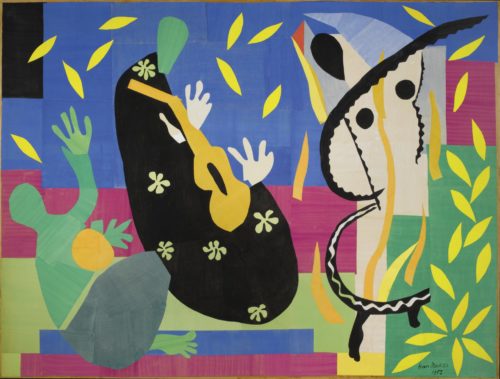
La Tristesse du roi, or The King Sorrow, stops you in your tracks. Matisse considered it equal to his best paintings, and it is easy to believe him. The composition, the king, the dancer, the guitarist, the flight of golden leaves, has the weight of a final self-portrait, a man confronting old age and transmuting the melancholia into joy. Not a cheap joy, not the decorative pleasure that the easy reading of Matisse may offer. A joy that has passed through difficulty, through illness, through the long labour of a life spent trying to understand what a line can carry and what colour can do to a room.
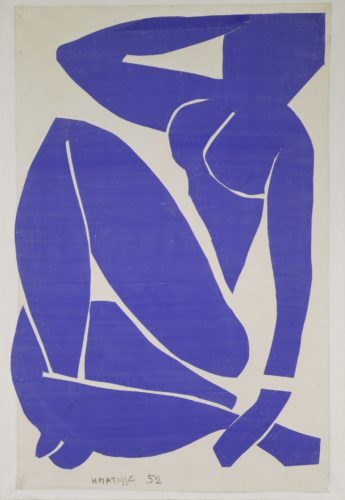
The exhibition ends with the Blue Nudes. Four figures cut from blue gouache, each made in a single gesture, a single cut of the scissors. They are the culmination of everything: the line, the colour, the decades of drawing that taught him to arrive at the essential with one stroke. They are also among the most quietly radical things in the building.
The cut-outs grew larger and more exuberant as his body failed. The chapel at Vence caught the light and scattered it. Matisse. 1941-1954 runs at the Grand Palais until 26 July, and the world will come. It should. One last thing: the shop. Budget extra time, and do not go in with any illusions about leaving empty-handed.
Matisse. 1941-1954, Grand Palais, Paris. Until 26 July 2026. Co-produced by the Centre Pompidou, currently closed for renovation, and GrandPalaisRmn, with the participation of the Musée Matisse de Nice. Works drawn principally from the Centre Pompidou collection, with loans from MoMA, the Metropolitan Museum of Art, the Barnes Foundation and the Fondation Beyeler.