
Dear Shaded Viewers,
Johan Creten has built a wall out of his father’s dead computers, and it is the most tender thing in Paris this season.
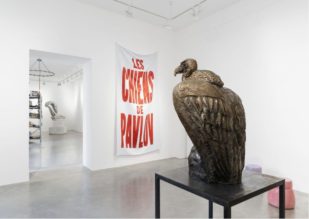
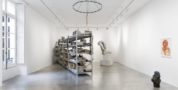
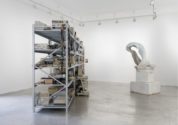
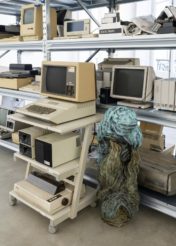
Les Chiens de Pavlov, his eleventh solo show with Perrotin and his sixth in the Paris space, is the most personal he has made. It begins with an inheritance: roughly a hundred obsolete machines, gathered by his father over forty years and left under dust in a building constructed just to hold them. Creten did not throw them away. He stacked them into a monument.
The title does the rest. Pavlov taught a dog to salivate at the sound of a bell. Creten asks what our bells are now. The ping of a notification. The buzz of a dating app. The small, obedient twitch of the thumb toward a screen.
Creten’s father died three years ago. He was an intellectual, a man who believed in machines the way an earlier generation believed in cathedrals. For four decades he collected computers, and he built a building just to keep them.
After his death, nobody knew what to do with them. “For three years, we had absolutely no idea,” Creten says. “The computers were there, covered in dust and completely abandoned.” His sister found someone who, with the help of artificial intelligence, identified each machine and drew up an inventory. Creten finds that paradox beautiful: the newest intelligence reading the oldest ones, machines that had become almost unreadable.
Then came the harder realisation. Towards the end of his life, his father’s memory began to fade. The obsolete computers, their data locked or lost, became “an incredibly direct allegory of what had happened to him.” The wall at Perrotin is an archive and a memorial at once. Tucked among the beige casings, his own ceramics and bronzes sit quietly, like a son’s hand resting on a father’s shoulder. As Creten puts it, “the accumulation itself becomes the work of art.”
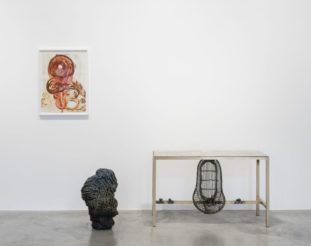
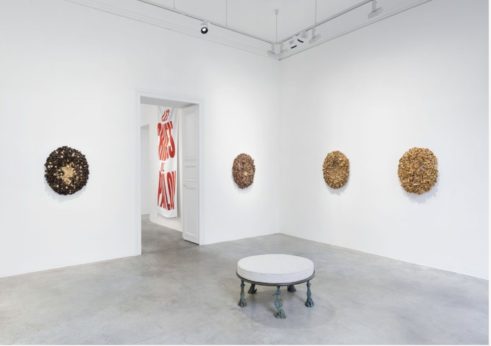
Around this wall, Creten lets his familiar vocabulary bloom. Flowers have long been his Trojan horse. Petal by petal, they build female bodies and torsos, seductive, almost decorative, until you notice what they carry inside. In Odore di Femina – Golden Rain (2025), the title alone promises a shower of gold.
Gold is his other seduction. In New Glory – Time and time again – Le Sablier (2024–2025), glazed stoneware finished in gold luster takes the form of an hourglass. It is glory and vanity in one object, and time running out. Beauty, for Creten, is a strategy: it pulls you close enough to hear the uncomfortable part.
Then the drawings, and the show’s quiet revelation. Two sheets from 1988 were made with his father. Together they wrote small programs that generated computer images, which the young artist folded into his own hand-drawn lines. In one, a skull has computer images where its brain should be. Nearly forty years ago, father and son were already sketching the fear of machines thinking in our place.
The key to the whole show came from a butcher’s window. During the installation, Creten was in a gloomy state. Walking home one evening through Saint-Paul, he saw lambs’ brains for sale and remembered childhood Wednesdays: lambs’ brains on toast. He bought some, hoping the happy memory might lift him.
While they cooked, a phrase arrived: fried brain. A burnt-out brain. “‘Fried’ is also the word we use when an electronic component, a light bulb or a computer burns out,” he says. “And suddenly everything connected.” His father’s fading memory. The machines that had lost theirs. The skull of 1988 with pixels for a mind.
That is the show’s quiet power. Creten does not lecture us about screens. He sits us down on his Seven Virtues seats and lets us feel the reflex for ourselves: the bell, the hand, the drool. Then, in the last room, the noise falls away into abstraction, a kind of stillness. It is a son’s goodbye, and a warning, delivered with gold, flowers and fire.
Johan Creten, Les Chiens de Pavlov — Perrotin, 76 rue de Turenne, 75003 Paris. Until October 10, 2026. Free entry.
Later,
Diane
