


Dear Shaded Viewers,
There is a moment, backstage at every couture show, when a dress stops belonging to anyone. The house releases it, the model wears it for exactly the length of a runway, the flashbulbs consecrate it — and then it vanishes into storage, or a private closet, or, if it is very lucky, a museum vitrine where climate control and darkness will keep it intact for a century it will never again be worn in. This is the quiet, almost morbid subject at the heart of “Look! 40 Years of Fashion at the Museum,” the exhibition with which the Musée des Arts Décoratifs marks the fortieth anniversary of its own founding as the Musée des Arts de la Mode in 1986. It is not, despite the title, a nostalgia lap through four decades of exhibition posters. It is a dissection — of how a garment is made, how it is desired, and how, against every one of its own instincts, it is made to last.
Organized under general curator Bénédicte Gady, director of the museums, and scientific curator Sophie Lemahieu, the show pulls 220 objects from the combined collections of the UCAD and UFAC — 57 full silhouettes alongside sketches, embroidery samples, patterns, archives, and fashion photography — and stages them across two distinct terrains inside the museum’s nave and side galleries: the atelier and the archive. One is about invention. The other is about survival. Between them sits the uncomfortable truth the exhibition keeps circling back to: that couture, an art form built entirely on the fantasy of the ephemeral, has spent the last forty years being systematically converted into an art form built on permanence.
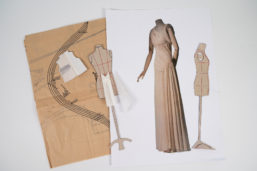
The exhibition’s first act belongs to the workshop — what the trade still calls, with a certain rueful affection, la ruche, the hive. It opens on the runway show itself, the “first moment of consecration” for any garment, staged here through a projection of contemporary couture presentations treated less as commerce than as performance art. From there the visitor is pulled backstage, into the actual mechanics: the première d’atelier who translates a designer’s idea into a toile, a muslin prototype sculpted in three dimensions before a single expensive fabric is cut; the pattern, cut apart on paper, that becomes the template for the real thing; the apprentices practicing simple seams while the complex work falls to secondes d’atelier; the fittings that adjust the garment on a house model or the client herself.
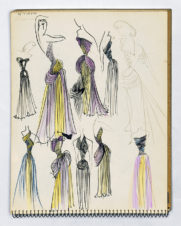
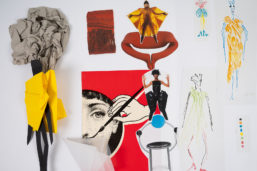
What the show is careful to point out is how differently the idea arrives in the first place. Some designers — Yves Saint Laurent, Karl Lagerfeld — worked the old way, fixing an idea to paper first, a sketch that dictates the garment’s silhouette before a hand ever touches cloth. Others, like Azzedine Alaïa, never drew at all: he pinned, draped, and cut directly on a mannequin, sculpting the form into being. A newer generation of artistic directors, Maria Grazia Chiuri among them, work from moodboards — collages of visual reference from which a modéliste extracts the first real prototype. Three completely different relationships to imagination, laid out side by side, as if to ask: where does a dress actually begin?
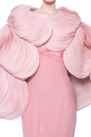
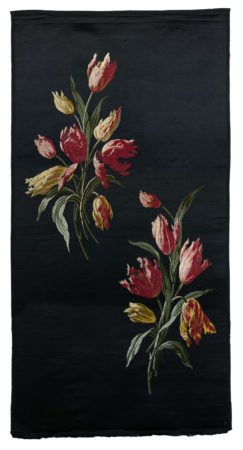
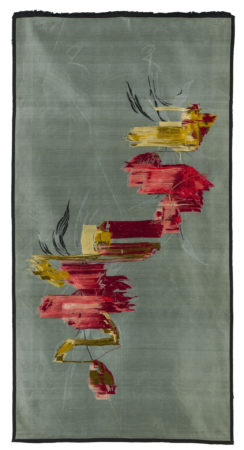
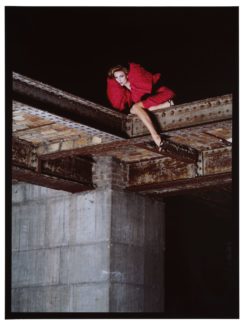
Around this central question, the show gives space to the specialist trades that couture depends on and rarely credits — the embroidery houses Rébé and Lesage, the pleating atelier Lognon, the printed textiles of Brossin de Méré now experimenting with 3D printing. These are the hands that turn fabric into surface, the layer of ennoblissement applied before a garment is even cut, and the show treats their samples with the same reverence it gives a finished Balmain gown. The first gallery closes, fittingly, on a wall of fashion photographs — the second, and arguably more permanent, moment of consecration, the one that turns a dress that existed for one night into an image that can circulate forever.
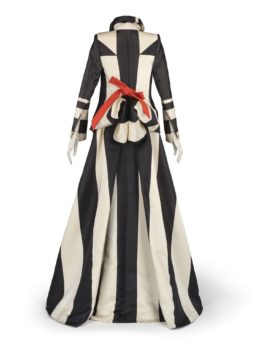
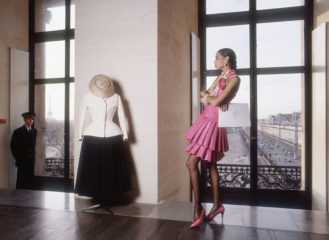
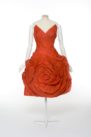
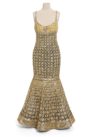
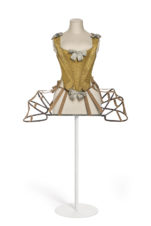
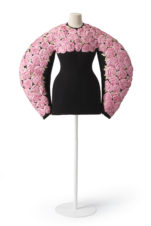
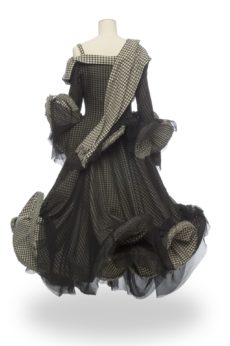
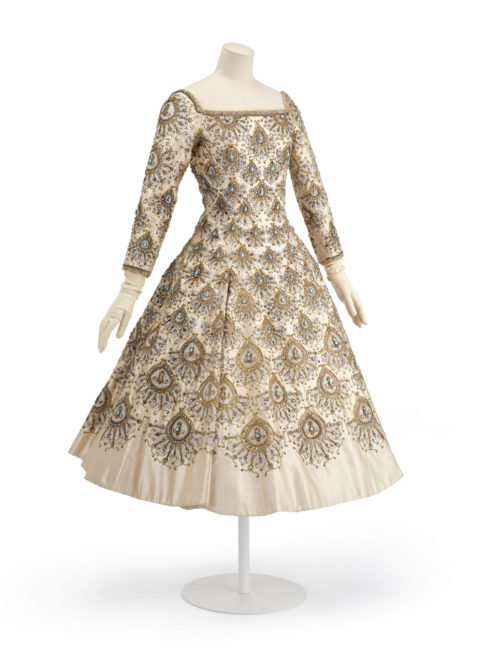
The show’s centerpiece is architectural as much as curatorial: forty iconic silhouettes, one for each exhibition the museum has staged on fashion since 1986 out of nearly seventy, arranged down the nave under a luminous installation evoking threads of couture, the podiums beneath them cut to resemble scraps of a dismantled pattern. Margiela stands near Balenciaga; a Chanel by Karl Lagerfeld near a Christian Lacroix, a Valentino, an Alaïa. The exhibitions being honored range in tone from “Yves Saint-Laurent: 28 Years of Creation” to “Paul Poiret: Fashion Is a Celebration,” from “Christian Dior, Couturier of Dreams” to the pointedly institutional-critical “Tenue Correcte Exigée” (“Proper Attire Required”) — a deliberate mix of hagiography and interrogation that suggests the museum is as interested in fashion’s contradictions as its glamour. Among the pieces surfacing from the deeper collection: an eighteenth-century panniered gown glimpsed on the grand staircase, a kimono signed by John Galliano, and the black dress Mireille Darc wore in Le Grand Blond avec une Chaussure Noire — proof that the museum’s idea of “iconic” runs from ancien régime formalwear to a 1972 comedy caper with equal seriousness.
If the nave is the seduction, the Rivoli gallery is the confession. Organized as a sequence of alcoves modeled on the museum’s actual working spaces, this second act turns the visitor into an intruder in the institution’s own backstage — the one place, the show reminds us, that is normally as invisible to the public as the atelier itself once was.
It begins with acquisition, and with a debt: the museum’s entire founding collection descends from the Union Centrale des Arts Décoratifs and the Union Française des Arts du Costume, and this room pays open tribute to the donors and patrons whose gifts — more often than outright purchases — built the institution. Once an object enters the collection, the exhibition notes with a certain weight, it becomes legally inalienable: it can never be sold, ceded, or altered again. That single administrative fact is the quiet key to the entire show — every dress on display has effectively been retired from the world of use and inducted into the world of permanent custody.
From there the galleries walk through what that custody actually requires. Textile fibers, the show explains bluntly, are extremely sensitive to light and environment — a fragility that forbids any garment from ever being permanently exhibited. The reserves where the collection actually lives are shown not as passive storage but as an instrument of science: climate stabilized against temperature and humidity swings, furnishings engineered against light, dust, and insects, garments laid flat in boxes or hung on padded “morphological” hangers shaped to a body that no longer wears them. These reserves are also, unexpectedly, a source of active inspiration — the show notes that designers like Dries Van Noten have drawn directly from them.
Two crafts get singled out for the kind of explanation usually reserved for couture itself. Mannequinage — a term the museum admits is essentially a neologism, unknown outside these walls — is the invisible sculpture of building a body double for a garment, layering supports onto a mannequin until it reproduces the exact silhouette of the era the piece belongs to, balancing conservation against the demands of historical accuracy and simple visual legibility. It is a discipline, the show notes, that is not taught in any academic program; it passes directly from one professional’s hands to the next. Conservation-restoration, meanwhile, is defined largely by what it refuses to do: washing is almost never attempted, and ironing — the most basic tool of any tailor’s shop — is strictly forbidden. The everyday reflexes of dressmaking become, in the reserves, the very things conservators must unlearn.
Tucked into the exhibition’s account of the museum’s own history is a story that deserves to be better known outside France. In 1945, in these same rooms, the Chambre Syndicale de la Couture Parisienne staged “Le Théâtre de la Mode,” an exhibition improvised entirely out of necessity: with fabric still rationed after the Occupation, French couture had no material for full-scale collections, so fifty-three houses dressed 70-centimeter wire dolls instead, accessorized by milliners, shoemakers, jewelers, and furriers, and posed them inside fourteen miniature sets designed by artists including Jean Cocteau. It was theater in the most literal sense — a couture industry reasserting its right to exist at a scale dictated by scarcity — and it worked. The exhibition toured Europe and the United States, restoring a relationship with American clientele that the war had severed. It is, in miniature, the whole argument of “Look!”: that fashion’s survival has always depended on invention under constraint, and that even a dress two feet tall can carry the full weight of an industry’s identity.
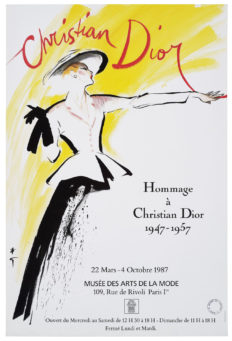
The final room, devoted to forty years of the museum’s own posters and catalogues, closes the loop. Somewhere between David Seidner’s photograph for the museum’s very first exhibition and the graphic identity of “Look!” itself, the show quietly admits what it has been arguing all along: that an exhibition, too, is a garment — designed, fitted to a moment, photographed, and eventually filed away for someone else to rediscover.
LOOK! 40 ANS DE MODE AU MUSÉE Musée des Arts Décoratifs, 107 rue de Rivoli, Paris 30 September 2026 – 4 April 2027 General curator: Bénédicte Gady · Scientific curator: Sophie Lemahieu, assisted by Hannah Morelle Tuesday–Sunday, 11am–6pm; late night Thursdays until 9pm for temporary exhibitions A 248-page catalogue with roughly 300 illustrations accompanies the show (€49) #expo_look · madparis.fr
Later,
Diane
