



Dear Shaded Viewers,
There is a particular kind of garment that bunches where we think it should fall, gapes where we think it should close, tears where it should hold — and in doing so, tells you exactly who made it. Comme des Garçons has spent half a century producing exactly that kind of garment, and this September, 265 of them will pass through a saleroom on Long Lane in London, in what may be the most complete public accounting of the label’s history ever assembled for auction.
The sale is called dot COMME: The Auction, and it is less a clearance than a transfer of custody. Every piece comes from the archive of Octavius La Rosa, the Melbourne-based dealer behind dot COMME, who has spent seventeen years building what is now a 4,000-piece collection — one he describes not as inventory, but as an obsession that happened to become a business. “The aim was always to build a collection first, business second,” he has said, “and nothing has changed — I still spend 70% of my waking hours thinking about Comme.” That collection is now relocating from Melbourne to Paris, and La Rosa is parting with a significant portion of it to make room for what comes next.
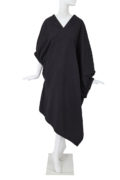
What makes the sale remarkable is its span. It opens in the 1970s, before Rei Kawakubo had shown a single collection in Paris — a period so rarely seen at auction that the eighteen lots on offer here amount to something close to a primary source. A black polyurethane raincoat from that decade already carries the DNA of everything that followed: the monochrome, the asymmetry, the refusal of the body’s expected shape.
From there the sale moves through the moment that made Kawakubo’s reputation: the 1981 Paris debut and its aftermath, when Comme des Garçons’ distressed knits and deliberately “flawed” fabrics scandalized and then reoriented the Western fashion establishment. Kawakubo has never fully explained the impulse, only defended it. “Those are tears to some,” she has said of the period, “but to me they’re not tears. Those are openings that give the fabric another dimension.” It is as good a mission statement as the designer has ever given.
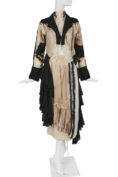
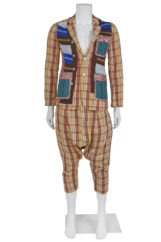
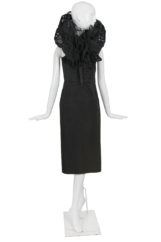
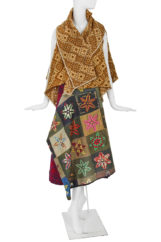
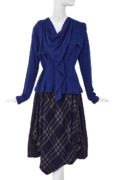
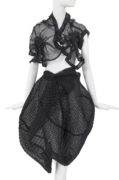
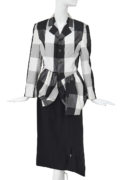
The 1980s pieces in the sale — tailored, structural, often buttoned in reverse from convention — trace how quickly that early rupture hardened into a vocabulary, one so influential that its fingerprints show up in other designers’ work; the checks and gathers of the 1986–87 “Bonding” collection, for instance, resurfaced a year later in John Galliano’s own runway. By the mid-1990s, the story turns again. The palette opens up, the shapes grow stranger and more theatrical, and the sale’s holdings from “Flowering Clothes,” “Body Meets Dress – Dress Meets Body,” “Transformed Glamour,” and “Broken Bride” capture a Kawakubo less interested in provocation for its own sake and more absorbed in pure, sculptural invention — clothing that behaves more like architecture than apparel.
Junya Watanabe, Kawakubo’s protégé and the house’s other great formal thinker, gets his own chapter within the sale: technically intricate, often literally engineered garments that earned him fashion’s “techno-couture” tag. A menswear selection spanning 1983 to 2013 rounds out the offering, a reminder that Comme’s radicalism was never confined to womenswear.
None of this would carry the same weight without La Rosa’s particular obsession behind it. He first encountered the label as an eighteen-year-old in Tokyo, working through the city’s second-hand stores and coming home with a suitcase he couldn’t close. Nearly two decades later, that suitcase has become one of the most significant private Comme des Garçons archives in the world — and, notably, one that has operated its own storefront in Melbourne for fifteen years, alongside pop-ups in Paris and, now, a permanent Saint-Germain address. The pieces going to auction have never been offered for sale on the dot COMME website; for collectors who have followed the archive from a distance, this is the first real chance to acquire from it directly.
dot COMME: The Auction takes place at Kerry Taylor Auctions, 249–253 Long Lane, London SE1 4PR, on 15 September 2026 at 10am, preceded by a press and VIP preview on 10 September and public viewings across the 11th, 13th, and 14th. Kerry Taylor Auctions — no strangers to significant fashion archives, having previously handled the wardrobes of Diana, Princess of Wales, and Audrey Hepburn, along with Martin Margiela’s personal archive — describes it as the most expansive single overview of Comme des Garçons ever to come to market. Given what’s on offer, from a 1970s raincoat to a 2013 mustard damask suit, it is hard to disagree.
Press contact: Giulia Felicani, Com & Stories — giulia@comandstories.com Specialist: Alex Baddeley, Kerry Taylor Auctions — abaddeley@kerrytaylorauctions.com
Later,
Diane
