



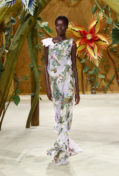
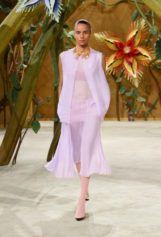
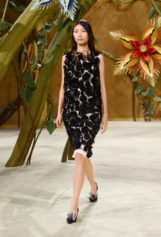
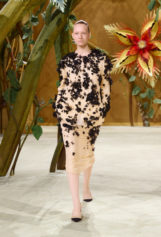




















Dear Shaded Viewers,
Watch the show here: https://www.chanel.com/fr/haute-couture/automne-hiver/
Once upon a time, in an apartment on the Rue Cambon, there lived a woman who had invented herself entirely, out of ambition, silk, and sheer will. Long after she was gone, a young designer went looking through her rooms not for answers but for clues, and on a shelf, half-forgotten, he found a small book. It was called Les Fées, Contes des Contes, a book of fairy tales. And he asked himself a dangerous, wonderful question: had Gabrielle Chanel’s whole life been a fairy tale all along?
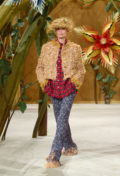
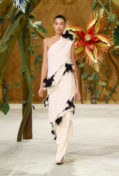
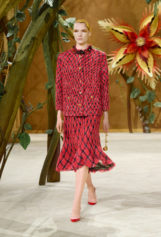
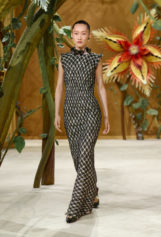
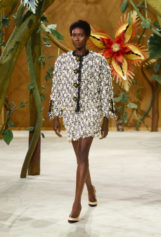
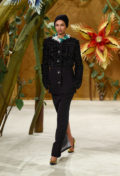
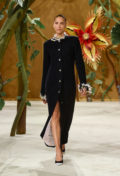
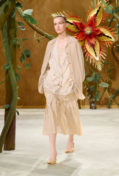
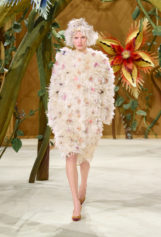
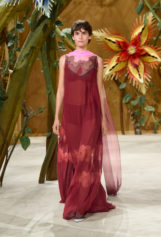
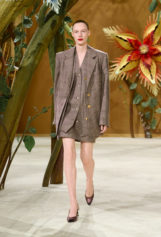
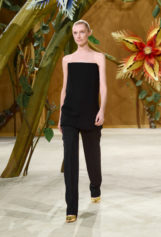
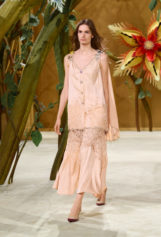
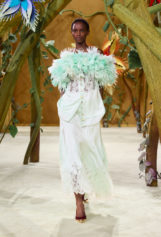
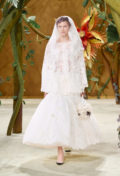
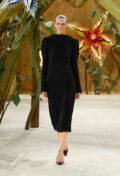
That designer was Matthieu Blazy, and that question is how his second Haute Couture collection for the house came to be born. He named it “Gaby and the Beanstalk,” and it is, quite simply, spellbinding.
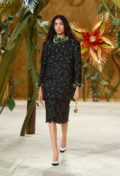
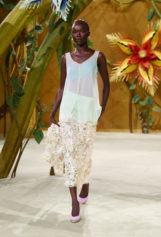
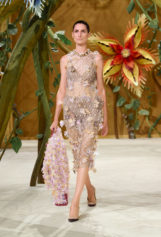
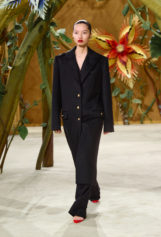
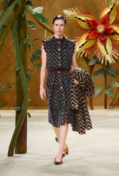
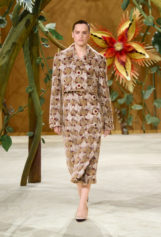
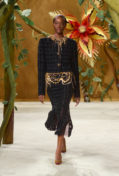
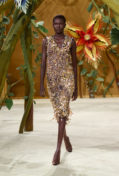
The tale opens, as all good ones must, with a single clue. The first look sent down the runway is a Chanel suit spun from guipure lace, its pattern climbing like the tendrils of a magic beanstalk, veiled here and there in silk mousseline so light it seems woven from morning mist. In her arms, the model carries the very book that started it all, lifted straight from Gabrielle’s own shelf, as if to say: this story begins where the last one left off.
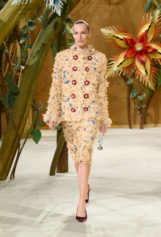
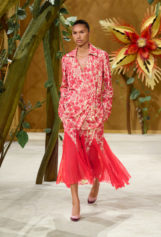
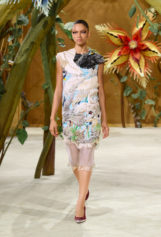
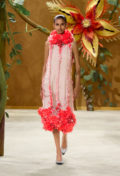
From there, the enchantment only deepens. Jack’s beanstalk twists through the collection. Goldilocks tiptoes through in spirit, testing what fits and what doesn’t, what belongs to whom. A vine creeps quietly up the heel of a shoe. A tiny minaudière curls into itself and becomes a sleeping bear. Watch closely and a line of buttons transforms, one by one, from an awkward little duckling into a swan. Nothing is merely decoration; everything is a clue left for those patient enough to look twice.
But the true magic, as in all the best fairy tales, is hidden where you cannot see it. Turn a garment inside out and there is a painted-silk lining meant for no eyes but the wearer’s own, a secret kept between the dress and the woman inside it. In the pockets and along the famous weighted chain, charms and memo notes and small stolen treasures gather like a magpie’s hoard, tokens of an ordinary life made extraordinary simply by being loved. This is the quiet spell Blazy casts: Haute Couture not as a costume to be admired from a distance, but as a private conversation between maker and wearer, whispered in silk.
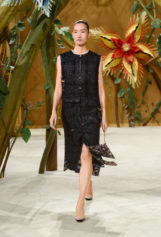
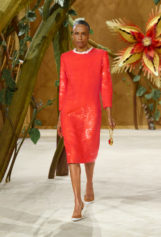
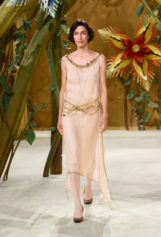
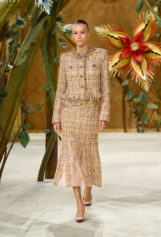
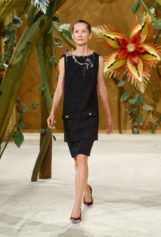
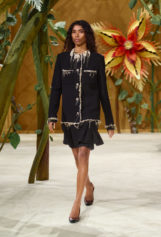
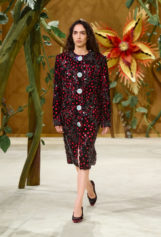
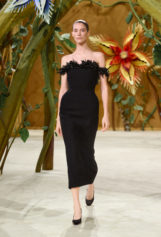
Even the setting conspired in the storytelling. The Chanel salon itself was transformed, overrun with poisoned vines and toxic flowers, a garden with a touch of danger in it, because Blazy understood something true about fairy tales, the good ones were never only sweet. Perrault’s original stories had teeth, and so, in the best possible way, does this collection. Beneath the whimsy sits real rigor: clothes slashed and cut with precision to free the body rather than confine it, made for women who live adventures rather than merely dream them. “Haute Couture at Chanel is not just a fairy tale,” Blazy has said. “In essence it is for women, their realities and their adventures of the everyday.” The magic, in other words, is meant to be worn out into the world, not left on a shelf.
And what of the storyteller himself? Every fairy tale needs an origin for its hero, and Matthieu Blazy’s is its own quiet adventure. Born in Paris to a French father and Belgian mother, he trained at La Cambre in Brussels before serving his apprenticeship at Balenciaga under Nicolas Ghesquière and at the house of John Galliano. He found his voice designing menswear for Raf Simons, then spent years conjuring the mysterious, closely watched Artisanal line at Maison Martin Margiela, work so striking that Suzy Menkes declared to the world that “you can’t keep such a talent under wraps.” He carried his craft to Phoebe Philo’s Céline, then to Calvin Klein as design director of womenswear. It was at Bottega Veneta, first as design director and then, from 2021, as creative director, that his name became legend in its own right, prized for warmth and craftsmanship over noise, and rewarded with growth few houses could match. In 2024 he was called to Chanel, stepping fully into the role in the spring of 2025, the first outsider entrusted with the house since Karl Lagerfeld himself. A tall order, by any measure. He has answered it by writing his own chapter rather than copying the last one.
Because that, in the end, is what “Gaby and the Beanstalk” really is: not a costume party dressed up as nostalgia, but proof that Gabrielle Chanel’s story never actually ended. She wrote her own life like a fairy tale once, out of nothing but nerve. Matthieu Blazy simply found the book she kept beside her bed, opened it, and kept writing.
But every good fairy tale keeps one page in reserve for after the final bow. Later that same night, we were spirited away to a private concert by Vanessa Paradis, newly returned with her album Le Retour des Beaux Jours, a copy of which was pressed into each of our hands on the way out, a keepsake to carry the spell home. It felt less like coincidence than fate: three decades before this jungle salon of poisoned vines and toxic blooms was ever dreamed into being, Paradis had already played Chanel’s own bird, feathered and singing, swinging in her gilded cage for the house’s legendary Coco campaign. To hear her voice fill a room still tangled in vines was to watch two Chanel fairy tales, one from 1991 and one from tonight, answer each other across the years. A lovely, unexpected way to close such a beautiful collection.
And they all lived, one hopes, most stylishly ever after.
Later,
Diane
