
A marvellous vivarium under spotlights, grandeur nature. Thirty creatures, undiscovered species, some bathed in silicone and latex, surfacing one after another, each doubled by its reflection in the mirrored runway as though rising through the skin of dark water. The expectation, at the opening of this Paris Haute Couture Week Fall-Winter 2026/27, was of Daniel Roseberry’s making. Since taking over the creative direction of the House in 2019, he has sent haute couture dripping beyond its sphere and its tiny handful of clients toward a vast public, because beauty breaks down walls and glass ceilings alike, and because his has always come with thought, limpid and profound.
The collection was born at an unlikely address, a special effects workshop outside Paris that produces hyperrealistic silicone infants for the cinema. Roseberry landed there after the winning formula of past seasons, the trip, the transcendent architecture, this time the Gaudí buildings of Barcelona, had delivered nothing. Fascinated by the plasticity of the material, he stretched it, sculpted it, poured it onto paper, baked pools of paint into sheets he could cut like cloth, in a palette remembered from Matthew Barney’s Cremaster Cycle, the American artist’s five films of prosthetic bodies and waxy flesh discovered in his student years, while the silks, satins and wools of tradition sat this season out. The ateliers followed him into the deep, months of trials alongside engineers to find densities of silicone that would drape rather than resist.
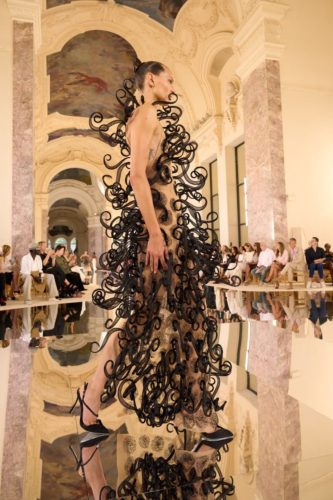
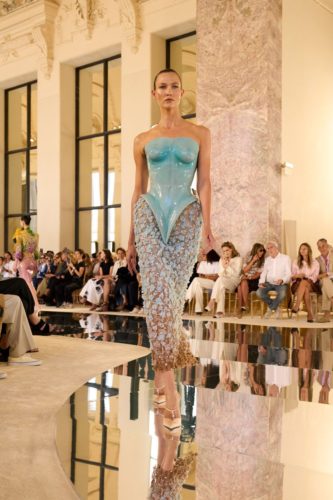
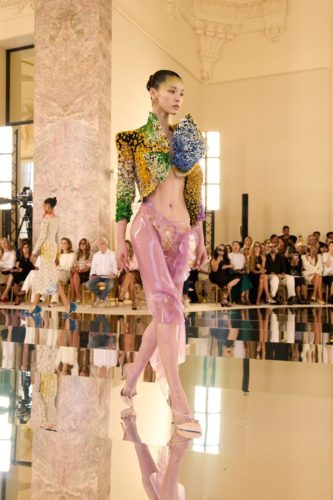
What emerged earns the zoology. Moulded busts in white and celadon with the sheen of glazed porcelain, their beaded fringe skirts shading from blush into silver. Bustiers backlit to mimic the bioluminescence of abyssal organisms, light escaping through crevices in latex. A jellyfish of a dress in tulle scattered with silicone dots. Black horsehair curlicues coiling over a nude gown like ink dropped in water. Real flowers fixed with sugared water, embroidered beside fish scales baked to keep their iridescence, seashells colonising low slung trousers, chokers shaped like sea anemones, urchin sandals, navel jewels worn as a second skin. And a living reef of a gown, more than 9,850 hours of handwork, its moulded bust lacquered in coral and sprouting flesh toned tentacles dotted with miniature bouquets.
Roseberry titled the collection “The Call of the Void”, and gave it a soundtrack, his recorded voice drifting over Ben Brunnemer’s basses, speaking of taking the wheel and driving off the cliff. Behind it stands a poem. In 1899, returning from a first journey through Russia where Orthodox piety had overwhelmed him, Rainer Maria Rilke began The Book of Hours, a sequence of prayers spoken by an invented character, a young Russian monk whose God is not light but darkness, fertile soil, a tangle of roots. The eleventh prayer, written on a single September day and never titled, is known today by its first words, You, Darkness. In it the monk loves the dark more than the flame, because a flame bounds the world to the circle it lights, and no being beyond that circle even knows it exists, while darkness holds everything at once, shapes and flames, animals, himself, and perhaps, close by, some great force already stirring. The last line is a credo, “I believe in nights.” For a couturier the lesson is ruthless, a formula is a flame. As for the void, Sartre understood its call better than the psychologists. Vertigo, he wrote in Being and Nothingness, is not the fear of falling. It is the anguish of jumping, the realisation that nothing stands between you and the leap except yourself. The void does not call us to die. It hands down Sartre’s verdict, that man is condemned to be free. Roseberry embraced the sentence, and the collection is his evidence, thirty exhibits of freedom.
The country these creatures come from has a name in robotics, the uncanny valley, that unease before what is almost human. Roseberry has simply built his house there, answering the silicon age with silicone and handing the material of the machines to the one workforce no algorithm can imitate, the artisans the trade once called petites mains, a belittling term (literally) it has since learned to retire.
One last piece of poetry hides in the ownership papers. Schiaparelli has belonged since 2007 to Diego Della Valle, the Italian industrialist behind Tod’s. The House never needed to borrow anyone’s promised land this week. It owns its own. Call it silicone Della Valle. Oh, and yes, Zendaya wore the dress just after, thanks to Law Roach, and yes, this is a big part of haute couture visibility, yada yada yada, but you’ll read that on Instagram elsewhere, as I don’t care to write about front rows here, just the clothes.
