A young label’s presentation, you go to meet. Lanvin comes with you, its ghosts a hundred years deep. The legacy and aura of the oldest French couture House still in business overflow the walls, before you have even seen a piece of the new collection. Jeanne Lanvin founded it as a hat shop in 1889 and, in 1926, did what no couturière had dared, dressing men when couture belonged to women alone. A hundred years on, its artistic director Peter Copping marks the anniversary with almost nothing to work from, the menswear archive having largely scattered where the women’s was kept. So rather than chase the lost silhouettes, he turned to Jeanne herself, to what she read, collected and looked at. He spreads his arms between the century behind him and the one ahead, and where they meet the present springs out.
Jeanne Lanvin built her house from almost nothing into the broadest empire any couturière of her time would command, women and children, fur and sport, perfume and decoration. The men’s house arrived in the loosened, electric Paris of the Années folles and gave men comfort, fluidity and fantasy where couture had given them nothing. A century on, the line reaches Peter Copping, in post since 2024 after Nina Ricci, Oscar de la Renta and the couture studios of Balenciaga, who reads that legacy less as an archive to raid than as a maker to admire.
A presentation is a show brought close. You come to the pieces instead of watching them pass, near enough to take the light wool between your fingers, or to measure a cut a runway would have hurried past. Across white sheets spread through the rooms of the Hôtel de Botterel-Quintin, an hôtel particulier of 1780, most of the looks lay flat on the floor. The models seemed to have vanished, each silhouette evaporated into beauty, clothes left hollow at the foot of a lover’s bed. Composed from above, jacket over knit over shorts, the shoes a polite distance below, the effect was faintly comic and quietly surreal. Everything was there and the men were gone, as if the bodies had grown too warm under the gilding and simply slipped away, leaving their wardrobes behind on the linen. Above the mantelpiece the lookbook prints stood in a row, the same looks photographed upright, a key to the puzzle on the floor.
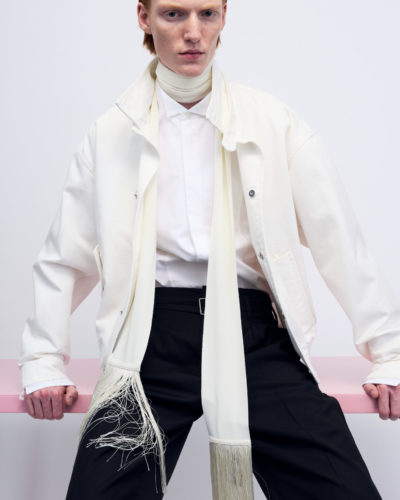
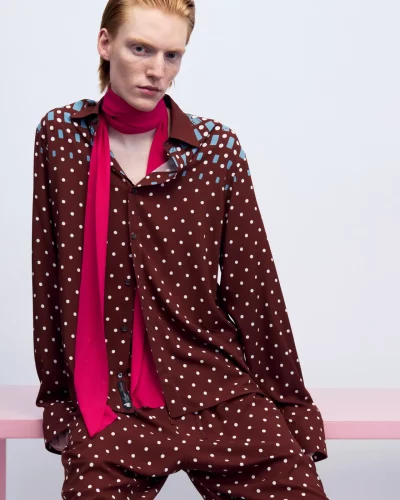
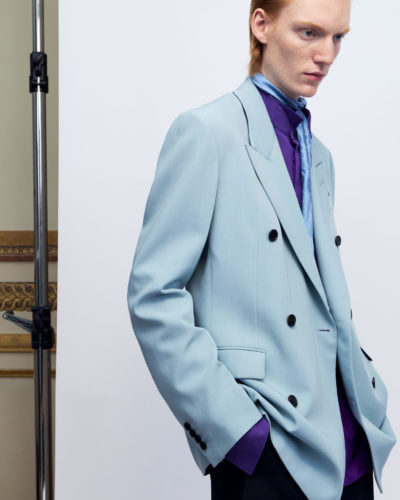
Copping staged the room as a moodboard you could walk through, reference images, patterns and swatches set beside the garments. A brown shirt scattered with dots hung next to old patent drawings for dominoes, the source and the piece side by side, a way of seeing turned into a room. Tailoring is the spine of Lanvin and he kept it there, only softened, the jackets eased and the trousers widened. A navy peacoat sat over a purple polo and mauve shorts in one look, a powder blue double breasted over a violet shirt in another. Up close the colour did the talking, a ribbed knit polo in deep cobalt meeting a red collar and a flash of fuchsia at the chest, belted in studded black leather, layering that reads as nerve rather than noise. The palette held to navy, black, khaki and beige, then broke into rose and blue, an optimism worn rather than announced.
The wit lived in the detail. A pale blue cotton shirt carried small mirrors and silver rods in a diamond grid across the chest, a disco glint on a daytime piece. An olive field jacket with black shoulder panels and snap pockets pulled the workwear thread the week has been worrying at, function cut in noble cloth. The shoes ran from leather buckle mules to tasselled loafers to low green trainers, the everyday set beside the tailored without rank.
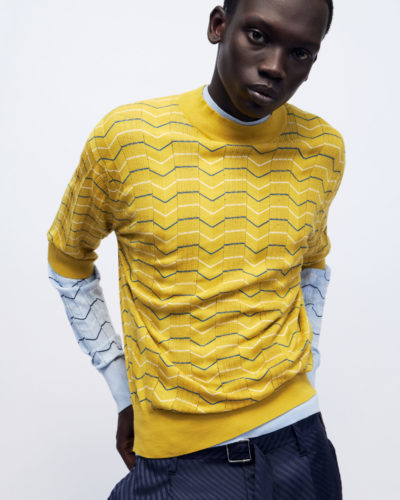
The knitwear came partly from John Smedley, the British specialist brought in for the centenary, its fine chevrons lifted from a motif the manufacturer once used on swimwear in the 1930s. English hand, French couture, the past quoted rather than copied. A hundred years on, Lanvin does not look its age. It looks like a House that has remembered how to be young.
