
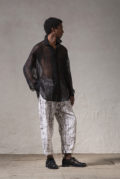
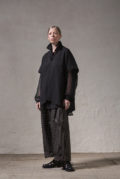
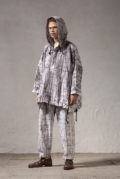
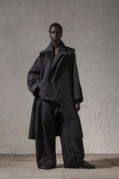
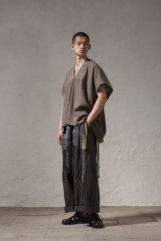
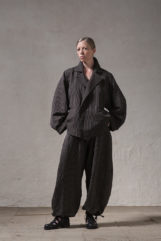
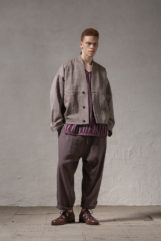
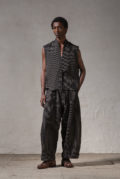

Dear Shaded Viewers,
There is a particular kind of confidence that comes from refusing to chase anything. For sixteen years, Jan-Jan Van Essche has built an entire house of fashion on that refusal — on the idea that a garment should be discovered once, in its essential form, and then spent a lifetime refining rather than reinventing. Looking at his newest collection, the seventeenth in the annual cycle he has kept since 2010, what strikes you first is not novelty. It’s recognition. These are unmistakably his clothes, and that, for Van Essche, has always been the point.
Van Essche graduated from Antwerp’s Royal Academy of Fine Arts in 2003 — the same institution that produced the Antwerp Six a generation earlier — and spent years working in set design and mass-market fashion before launching his own label in June 2010. That first outing was called Yukkuri, Japanese for “slowly” or “take it easy,” and the title was less a marketing flourish than a manifesto. It set the terms for everything that followed: an annual wardrobe rather than a seasonal one, garments built to be lived in rather than replaced, and a refusal to treat newness as a virtue in itself.
The structure he settled into is unusually disciplined for an independent designer. Each June brings a numbered Collection — Yukkuri, Satta Amassagana, In Awe, Uhuru Sasa, all the way through Khayal and Nashat, the latter being last year’s. Since 2013, each January has brought a parallel, more research-driven Project — Proceed, Redeem, Wadada, Arise, One Stone, Rite — each one built around a specific craft: patchwork, sakiori weaving, rope weaving, padded construction, natural dye. It’s a working method closer to a research lab’s lab notebook than a fashion calendar, and it’s why Van Essche could make his runway debut as late as January 2023, at Pitti Uomo in Florence’s Santa Maria Novella cloister, twelve years into running the brand — and why, two years later, Antwerp’s MoMu fashion museum could mount a full retrospective around a single current collection, Khayal, without it feeling premature. Fifteen years in, he had already built a body of work coherent enough to look back on.
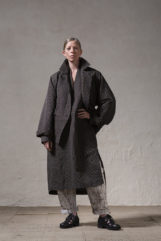
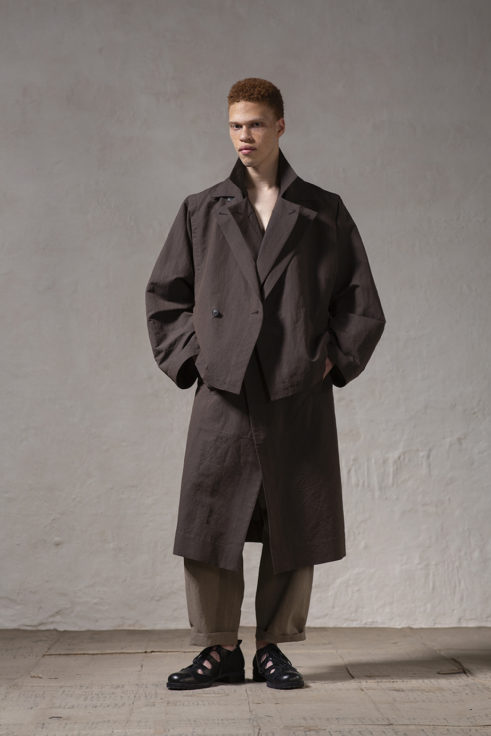
Van Essche’s central design conviction is almost ascetic: clothing should not impose a shape on the body, the body should be left free to shape the clothing. In practice that means patterns built around minimal seaming, generous unstructured volumes, and a small set of recurring “mother” silhouettes — the V-neck poncho-tunic, the sleeveless wrap vest, the wide drawstring trouser, the asymmetric collarless coat — that he returns to and re-cuts season after season rather than discarding for something new. The materials carry just as much of the story as the cut: undyed and loom-state cottons and linens, hand-woven cloth made in his own Antwerp studio with the Senegalese weaver Lamine Diouf, Eri silk hand-spun by indigenous weavers in Northeast India through his partnership with 7Weaves, and a deep, ongoing fascination with natural dyeing — fermented indigo, bincho-tan (coffee and ink), kakishibu persimmon tannin, and Japanese shibori resist-dyeing, all sourced through his twice-yearly trips to Japan.
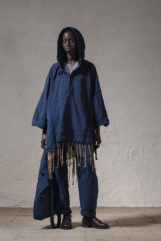
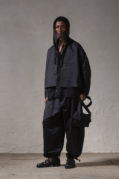
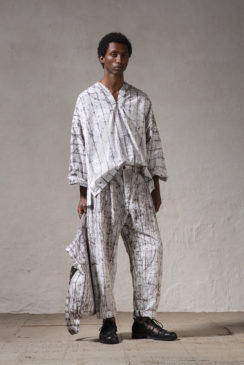
Set against that history, the new collection reads less like a departure and more like a deepening — exactly the pattern Van Essche himself has described in recent years, calling it less about reinventing and more about refining what’s already there. The shibori hand here is everywhere, and it’s doing real narrative work: ash-grey cottons and linens are shot through with the fine, spidery resist-dye lines that look almost like cracked porcelain or frost on glass, used across both an oversized hooded smock and matching trousers worn slightly cropped and cuffed. It’s a quieter, more wintry cousin of the wool shibori he debuted for Pitti, now translated into lighter cloth.
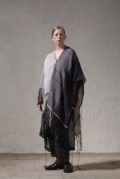
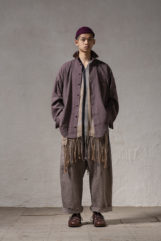
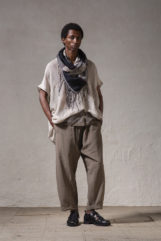
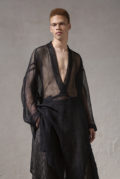
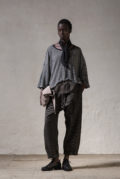
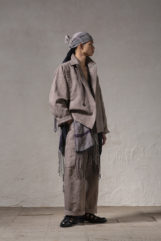
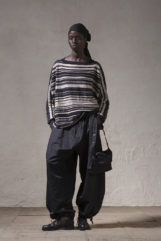
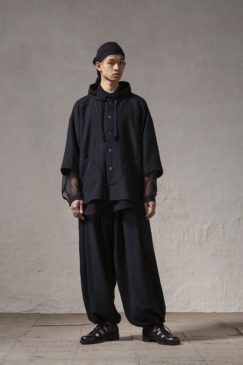
Layering remains his most expressive tool. A sleeveless wrap waistcoat sits over an open-collar shirt and another waistcoat beneath it, all in the same hairline pinstripe — three garments reading as one silhouette, a trick he repeats across the collection in slightly different proportions for both menswear and womenswear casting. Sheerness recurs as a kind of structural honesty: a black gauze shirt and a floor-length sheer robe let the body and the layers beneath show through, refusing the silhouette any false bulk. And running through nearly a third of the looks is the fringed, hand-loomed scarf-poncho — striped in indigo, oatmeal, and charcoal with loose knotted fringe — worn as a shawl, knotted at the hip like a sash, or wrapped high around the neck like a cowl. It functions almost like a signature punctuation mark, the one accessory that ties the formal trouser suits to the raw, undyed linen separates to the all-black hooded outerwear.
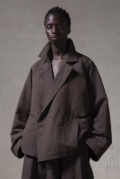
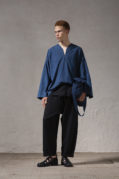
The palette stays disciplined: charcoal, bone, walnut, and aubergine, with black doing the work it always does in his collections — not as an absence of color but as its own deep register — and only the occasional ember of burgundy-striped knitwear or a single cobalt tunic breaking the earth tones. Footwear is constant throughout: a cut-out lace-up oxford in black or brown leather that reads as utilitarian and slightly monastic at once, grounding even the most voluminous silhouettes.
What makes Van Essche worth writing about, seventeen collections in, isn’t a single standout look — it’s the discipline of the whole. In an industry that prizes the new season’s “evolution” as a kind of performance, he has built something closer to a long, slow sentence, where each collection is a clause rather than a full stop. The shibori grays, the fringed scarves, the asymmetric coats: none of it would surprise anyone who has followed him since Yukkuri. That’s not a limitation. It’s the argument. Consistency, held this long and this carefully, becomes its own kind of radicalism — a quiet rebuttal to a fashion calendar that mostly forgets what it made six months ago.
Later,
Diane
