
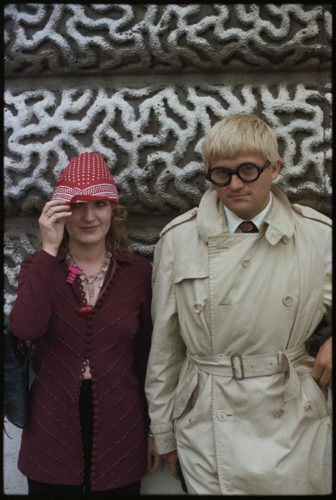
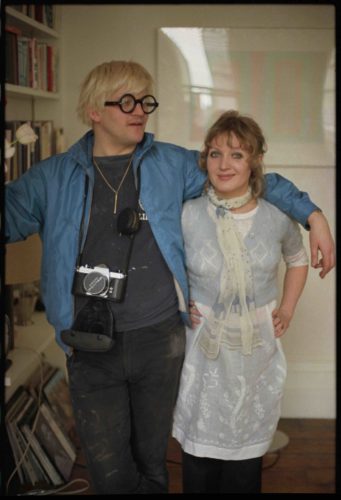
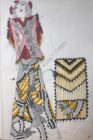
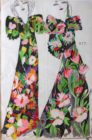
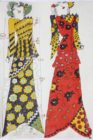
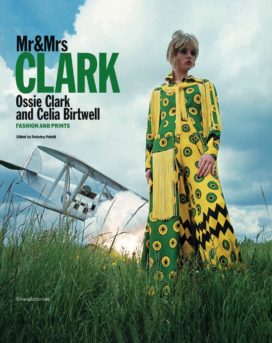
In the London of the 1960s and 1970s, three names became intertwined in a creative and personal bond destined to become legendary: Celia Birtwell, the life and creative partner of the celebrated fashion designer Ossie Clark, and the painter David Hockney. Their connection went far beyond the social circles of Britain’s most vibrant cultural era; it was a profound friendship that came to embody the spirit of a generation. The three first met within the creative crucible of the Royal College of Art, at the heart of a London that was reinventing itself. Hockney was already emerging as the enfant terrible of British painting, Clark was establishing himself as the most talented and visionary fashion designer of his generation, and Celiaith her love of art, sensitivity to colourand understated elegance—would become the muse of them both. Together, Hockney and Clark travelled to New York, where, in the orbit of Andy Warhol’s Factory, they encountered the alternative worlds of fashion, art and music that were reshaping contemporary culture. Meanwhile, Ossie and Celia fell in love and formed one of the most influential creative partnerships in British fashion. He designed the flowing, romantic silhouettes; she created the printed textiles inspired by flowers, birds and Art Nouveau motifs that seemed to emerge from a dream. Hockney served as best man at their wedding in 1969, a role that symbolised a friendship already marked by both extraordinary promise and underlying fragility.
THE PAINTING THAT IMMORTALISED THEM: MR AND MRS CLARK AND PERCY
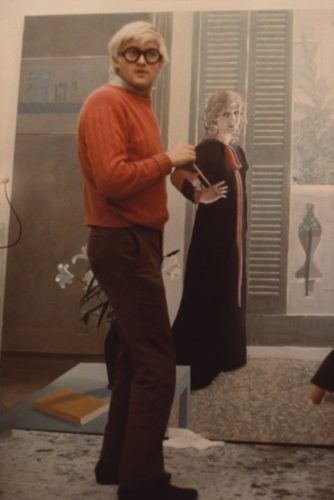
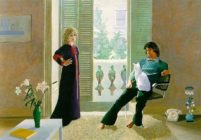
In 1970–71, Hockney painted what would become one of the most celebrated portraits of the twentieth century: Mr and Mrs Clark and Percy. Now housed at Tate Britain in London, the large-scale canvas depicts Ossie standing beside a seated Celia, while their cat Percy rests on his lap. The light is still, the atmosphere suspended and faintly unsettling. Despite the apparent serenity of the newly married couple, the painting conveys a subtle tension: each figure seems absorbed in a different inner world. With this work, Hockney did more than portray two of his closest friends; he captured something elusive about love, companionship and the loneliness that can exist even within intimacy. It was an act of affection, but also an extraordinarily perceptive reading of a relationship that would eventually unravel. Ossie and Celia also appear in A Bigger Splash (1974), the celebrated documentary centred on Hockney’s life and work, which vividly captures the creative energy of an era in which fashion, art and music were deeply intertwined. Their marriage collapsed during the 1970s, strained by Clark’s infidelities, an increasingly chaotic lifestyle and shifting cultural tastes. Yet Hockney remained loyal to both of them, offering the quiet steadfastness that only true friendship can provide in moments of rupture. Celia remained a constant presence in his life and work, appearing in numerous portraits over the decades, always retaining that unique combination of ethereal grace and grounded strength, as though she embodied something permanent in a world of constant change. Clark, by contrast, entered a period of decline. His fame faded, and the separation from Celia also marked the end of the creative partnership that had defined his success. Hockney never entirely abandoned him, even when Clark found himself increasingly removed from the world he had once dominated. His tragic death in 1996, murdered by a neighbour in London, deeply affected all those who had known and loved him.
A LEGACY THAT ENDURES: DAVID IN CELIA’S MEMORY
The emotional triangle formed by Celia, Ossie and David remains significant not only as an example of creative friendship, but also as a living document of an era—Swinging London and the flower-power generation—seen through the eyes of artists. Their story reminds us that the most meaningful relationships are not necessarily the easiest ones, but those capable of surviving time, change and even loss.
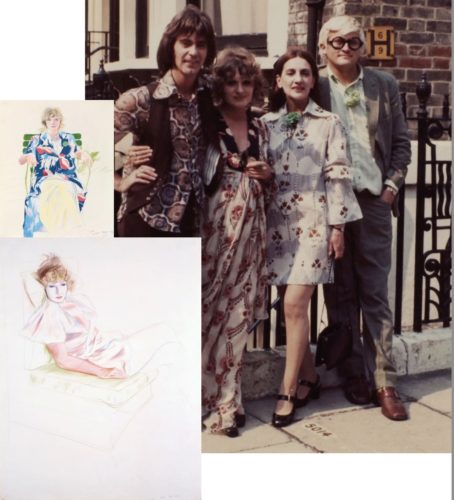
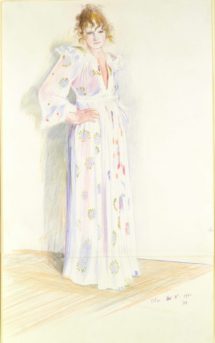
After Ossie’s death, David and Celia continued to stay in touch, often through video calls in their later years, sharing their enduring passion for art and travel. Until the very end, Celia remained close to her friend, following his achievements and growing international acclaim with characteristic discretion and affection. That enduring bond can still be seen in the many drawings and portraits Hockney devoted to her over the years: images of a lifelong friend, a companion in creativity and a witness to countless shared journeys.
