





Dear Shaded Viewers,
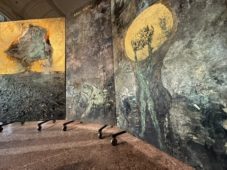
Anselm Kiefer has always worked in the territory where history collapses into myth, where matter becomes memory, and where painting is less an image than an event. In The Women Alchemists at Palazzo Reale, Milan, he turns his monumental gaze toward a lineage that is at once obscured and foundational: women as keepers of transformation, as figures of both erasure and genesis.
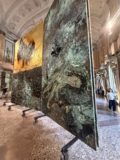
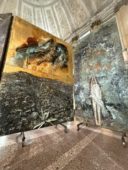
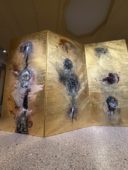
The exhibition unfolds like a slow incantation. Kiefer’s vast canvases and sculptural accumulations—laden with lead, ash, dried flora, and sedimented pigment—do not simply depict; they metabolize. Here, alchemy is not metaphor but method. Surfaces crack, oxidize, and bloom as if time itself were the medium. The works feel unearthed rather than made, as though they have endured centuries of burial and resurrection.
At the heart of the exhibition is a re-inscription of female presence into the traditionally male-dominated mythology of alchemy. Kiefer invokes women not as muses, but as practitioners of transformation—figures who transmute knowledge, body, and material into something both fragile and enduring. Names hover like ghosts across the works, half-legible, half-lost, suggesting histories that resist full recovery. This is not a corrective gesture; it is a poetic one. Absence is allowed to remain absence, but it vibrates with meaning.
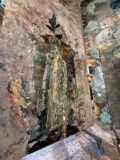
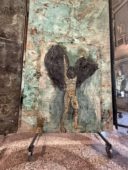
Straw, earth, and scorched textures recur throughout, evoking both fertility and destruction. Dresses appear—empty, monumental, spectral—standing in for bodies that have dissolved into process. These garments, often embedded into the works, become vessels: of memory, of labor, of disappearance. They suggest that the feminine, in Kiefer’s universe, is not fixed but continually transmuting, caught in cycles of decay and renewal.
Palazzo Reale, with its classical grandeur, offers a charged counterpoint to Kiefer’s raw materiality. The tension between the opulent architecture and the works’ elemental brutality heightens the sense of dislocation. It is as if the paintings are undoing the space, pulling it back toward a more primordial state.
What lingers after leaving the exhibition is not a single image but a sensation: that of having moved through a field of transformation where meaning is never stable, where beauty and ruin are inseparable. Kiefer does not illustrate alchemy—he performs it. And in The Women Alchemists, he extends that performance into a meditation on the feminine as both origin and afterlife, as something that cannot be fully seen, only continually re-imagined.
This is an exhibition that resists resolution. It asks instead to be absorbed, like a material slowly changing form in the dark.
Later,
Diane
