
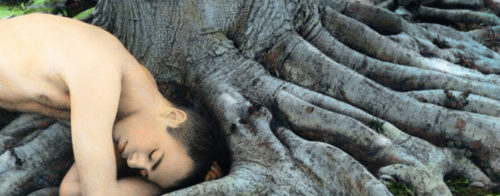
Youssef Nabil (1972)
Self-portrait with Roots, Los Angeles, 2008
© Youssef Nabil Courtesy Youssef Nabil
Dear Shaded Viewers,
Since the early 1990s, the French‑Egyptian artist Youssef Nabil (born in Cairo in 1972) has been developing a body of work with an immediately recognisable visual signature, to which the Musée d’Orsay has contributed in a decisive way. His first trip to France, as an aside, that is when we met, and his encounter with Orsay’s collections in 1992 became a founding moment, a reservoir of images and atmospheres that has nourished his practice for more than thirty years. The self‑portrait The Dream (2021), in dialogue with Puvis de Chavannes’ Le Rêve, crystallises this long‑standing conversation between the artist and the museum. With To Dream Again, Nabil becomes the first contemporary artist to inhabit the museum’s Orientalist galleries, creating a shimmering mise en abyme in which his works are woven among the paintings that shaped his imagination.
Nabil’s photographs are black‑and‑white gelatin silver prints that he painstakingly hand‑colors using an almost vanished technique inherited from the studios of Cairo and Alexandria. This method, learned in the early 1990s from some of the last studio colorists in Egypt, allows him to summon the “glorious, fantasised Egypt” of his childhood—an Egypt saturated with the glamour of mid‑century cinema, studio portraits, and Technicolor film posters. Drawing on the aesthetics of the golden age of Egyptian cinema, Nabil stages his images like stills from an imaginary film, with friends, actors, artists and himself performing scenes of suspended drama and quiet intimacy.
The chromatic range of his work—velvety yellows, tender blues, acidulated reds—conjures both nostalgia and an almost unreal serenity. His Egypt is not the one we see in news images, but a place of memory and projection, at once lost and insistently present: a Mediterranean world without borders, fantasised and idealised. Through this lens, the artist turns Orientalist codes—desert horizons, languid bodies, saturated skies—into a sensual, consenting orientalist reverie, reclaiming a visual language historically shaped by others.
Installed at the heart of the Orientalist galleries, To Dream Again proposes a subtle, transhistorical dialogue between Nabil’s photographs and the nineteenth‑century works that marked him. The exhibition’s aesthetic axis oscillates between Orientalism and Symbolism: on the one hand, an Orient of light, colour and desire; on the other, the inner landscapes of dreams, exile and metamorphosis. Nabil’s pared‑down décors, dominated by fields of blue and white, echo Symbolist explorations of solitude, silence and spiritual yearning.
Recurring themes of exile, rebirth and the dream haunt his images. His self‑portraits—often shown from behind, anonymous silhouettes facing sea, desert or city—are steeped in melancholy yet retain an enigmatic openness. By withholding his face, Nabil transforms autobiography into a shared condition: the figure becomes every exile, every traveller, every spectator standing on the threshold between two shores.
The exhibition title, De rêver encore (To Dream Again), foregrounds the central place of the dream in Nabil’s work while also echoing the Orientalist and Symbolist currents that underpin it. It is drawn from a celebrated passage in Act III, Scene 2 of William Shakespeare’s The Tempest, a monologue spoken by Caliban, the enslaved, mixed‑race inhabitant of the island who is often read as a figure of colonised indigenous populations around the Mediterranean. The unexpected lyricism of his speech—so at odds with the coarse language that otherwise defines him—has made it one of the most striking declarations of the right to dreams in all of English literature.
In this monologue, Caliban evokes an island “full of noises, sounds and sweet airs” that give pleasure without harm and speaks of waking from sleep only to wish to “dream again.” The scene is represented in the exhibition by Odilon Redon’s emblematic work Sommeil de Caliban, which resonates closely with Nabil’s interest in reverie as both refuge and resistance. Between Redon’s asleep Caliban and Nabil’s mute, turned‑away figures, a constellation emerges: dream as a place where history, violence and desire are reconfigured in secret.
The exhibition unfolds like the itinerary of an artist of our time, structured in five major chapters punctuated by historical counterpoints. It opens with nineteenth‑century photographs from expeditions to Egypt, drawn from Orsay’s rich holdings, which establish a crucial distinction between artistic production made in the Orient and the Western invention of “Orientalism.” Against this backdrop, Nabil’s images appear not as echoes of colonial fantasies but as a rewriting from within, using some of the same visual tools to tell other stories.
A second chapter revisits the artist’s youth in Cairo, the city where he began photographing in 1992 and where he encountered both the last studio colorists and the mythic universe of Egyptian popular cinema. The third section centres on his first visit to the Musée d’Orsay in 1992 and the tutelary figures he found there—Puvis de Chavannes, Odilon Redon and others—whose works opened new ways of thinking about the relationship between image, memory and the unconscious.
The penultimate gallery is devoted to Nabil’s “crossed identities,” on both sides of the Mediterranean, in works that weave together the symbols of East and West in hybrid, syncretic compositions. These images reflect the trajectory of an artist who left Egypt in 2003 for a residency at the Cité internationale des arts in Paris before settling between Paris and New York, carrying with him a sense of permanent in‑betweeness. Finally, the exhibition culminates in a space dedicated to moving image, where two of Nabil’s films are projected, echoing his deep passion for cinema and his desire to see his images “come alive” in time.
Nabil’s photographs have always been profoundly cinematic, and his passage to film was inevitable. In 2010, he wrote, produced and directed You Never Left, an eight‑minute film with Fanny Ardant and Tahar Rahim in which an allegorical, disappearing Egypt becomes a metaphor for exile, mourning and return. This was followed by I Saved My Belly Dancer (2015), starring Salma Hayek and Tahar Rahim, which combines golden‑age Egyptian film aesthetics with a meditation on the erosion of artistic traditions such as belly‑dancing. More recently, The Beautiful Voyage (2021), featuring Charlotte Rampling and the artist himself, reflects on life as a passage—both intimate and universal—in which no one knows when the “director” will call cut.
These films extend, in motion and voice, the questions that run through his still images: What does it mean to belong? How do we live with exile, whether geographic, emotional or temporal? How can the past be re‑imagined not as a prison of nostalgia but as material for new, luminous fictions? In the galleries of the Musée d’Orsay, surrounded by nineteenth‑century visions of the Orient, these questions acquire a new resonance, inviting visitors to read both the historical works and Nabil’s images through the prism of contemporary experience.
Over the past three decades, Youssef Nabil’s work has been shown in many of the world’s major institutions, including the British Museum and the Victoria & Albert Museum in London, the Centre Pompidou and the Maison Européenne de la Photographie in Paris, the Pérez Art Museum Miami, the Kennedy Center in Washington, and the 53rd Venice Biennale. In 2020–2021, the Palazzo Grassi in Venice devoted his first major retrospective, Once Upon a Dream, to his photographs and films, underlining the coherence of an oeuvre in which every image seems to emerge from a single, ongoing reverie.
At Orsay, To Dream Again inscribes this oeuvre within a longer, European history of images, from early photography to Symbolist painting and Orientalist fantasy. Yet the experience it offers is fundamentally intimate: each visitor is invited to inhabit, for a time, the quiet, coloured space of Nabil’s dreams, and perhaps to recognise, in the figure turned away at the centre of so many works, their own desire to escape reality without ever ceasing to question it.
The exhibition is curated by Sylvain Amic, President of the Établissement Public of the Musée d’Orsay and Musée de l’Orangerie – Valéry Giscard d’Estaing (24 April 2024 – 31 August 2025), and Nicolas Gausserand, advisor to the President in charge of international and contemporary programmes. Organised as part of the “Saison Méditerranée” and within the framework of the Bicentennial of Photography 2026–2027, To Dream Again situates Youssef Nabil’s work at the crossroads of Mediterranean dialogues, photographic history and contemporary artistic creation.
Later,
Diane
