Dear Shaded Viewers,
You can start wherever you like.
I don’t know why I’m here.
That’s not a problem.
Today everything felt…the same.
And yet, something wasn’t right.
What wasn’t right?
The way I was moving.
As if I were imitating myself.
And where were you?
I don’t know…like when you’re about to change direction, but you haven’t taken the step yet.
Is it a place you know?
No.
We can stay here for a moment.
If I stay…something will surface.
Why do you think that?
I can already feel it But what if I ignore it?
It will surface anyway.
So…can I stop explaining myself?
Cy Twombly’s Palazzo, tucked away in Bassano in Teverina, is a place immersed in a weave of time
and matter. Cy Twombly purchased the villa in 1975, making it his sanctuary for over thirty years – a
creative laboratory where his work could slowly sediment within the tufa walls, away from the urban
roar. Twombly lived here with ascetic simplicity, opening his doors only to a close-knit circle of
friends and collaborators. On this quiet, intimate threshold some of his most defining works took shape.
Even today, the palazzo retains a profound stillness – untimely, gloriously out of step with the present.
Every surface bears the marks and gestures of a past that feels very much alive. Twombly’s presence
remains palpable, like an interior landscape woven into the very fabric of the architecture.
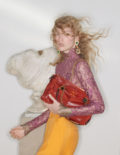
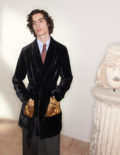
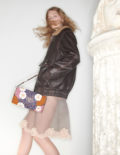
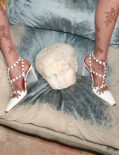
The Pre-Fall 2026 campaign takes shape within this constellation of echoes and presences. Cy
Twombly’s Palazzo is more than a backdrop here; it operates as an intentional gesture, a reactivation
of a specific genealogy of the gaze. Indeed, the entire project unfolds along a broader trajectory, one
rooted in the very history of Maison Valentino. In 1968, Henry Clarke photographed Valentino
Garavani’s white collection inside Cy Twombly and Tatia Franchetti’s Roman apartment for Vogue
US. Today, the campaign unfolds within another of the artist’s homes – a way of rendering both
distance and continuity visible at once. This is not about returning to a familiar visual archive, but
rather intercepting a deeper vibration, allowing it to resurface in unexpected forms. It is an exploration
of persistence – not meant as a static permanence, but as a trace that cuts through time and transforms.A line that breaks, deviates, and refracts into the present, generating shifts, slippages, and new
possibilities of meaning.
In the 1968 images, the figures are staged – composed and contained – within a pre-existing geometry.
Their white garments become a form of discipline, shaping an equilibrium where fashion leans into
space, extending its stability. By contrast, the Pre-Fall 2026 campaign unveils a fracture, or rather, an
opening. Space is no longer a container but a sensitive surface; the body does not settle there, it moves
through it, disrupting it, setting it back in motion. Untamed hair, an elusive gaze, and the vibration of
fabric introduce an unstable, almost atmospheric dimension. Color erupts, shattering that unity: where
there was an immobilizing pose, there is now a gesture that escapes fixity. The entire narrative turns
around a figure charged with energy, momentum, and instability. No longer a presence standing neatly
within a space, but a body that questions and pulls taut an environment still inhabited – where the work
of Cy Twombly and the visual memory of Valentino Garavani continue to resonate.
The Pre-Fall 2026 campaign video makes this mechanism explicit and pushes it further. It stages the
relationship between body and space as a continuous flow where presence, memory, and movement
interweave without ever settling into a fixed form. Temporalities unfold at different speeds and along
divergent trajectories. The dialogue feels intimate, rarefied, almost surreal. It seeks no explanations; it
opens a threshold. As if space itself begins to speak. Or perhaps it is Twombly’s voice, echoing.
Through hesitations, deviations, and suspensions, a quiet dissonance surfaces: the sense of not fully
coinciding with one’s own gestures. The dialogue does not resolve this fracture – it embraces it,
allowing something else to emerge. Not the reassembling of identity, but the loosening of it: the
interruption of the need to explain oneself, an acceptance that the subject can exist as a shifting field,
traversed by multiple states.
Alessandro
Note:
The Palazzo in Bassano in Teverina was purchased in 1975 by Cy Twombly under the advice of Giorgio
Franchetti. It is currently home to the Iris Foundation, a trust dedicated to the promotion of cultural
diffusion in the artistic field.
Credits:
Creative Director: Alessandro Michele
Art Director for photography: Christopher Simmonds
Photographer: Johnny Dufort
Stylist: Jonathan Kaye
Hair stylist: Esther Langham
Make Up Artist: Yadim Carranza
Manicurist: Sara Ciufo
Casting Director: Rachel Chandler
Talent: Sombr
Female Model: Apolline
Music: Original Composition by Wladimir Schall
#ValentinoPreFall2026
@MaisonValentino
@fondazione.iris
