
















Dear Shaded Viewers,
LITKOVSKA’s show at Les Halles unfolded like a lucid war-time requiem, the sharpest articulation yet of Lilia Litkovska’s ongoing attempt to make beauty and terror occupy the same fragile space. The searchlights slicing through the dark and the final image of ash-like fragments drifting down over the runway pushed her language into something raw, cinematic and, I would argue, her strongest collection to date. From the opening look, there was a sense that we were no longer witnessing “a show” but entering a charged corridor between Kyiv and Paris, one that she walks constantly in real life.
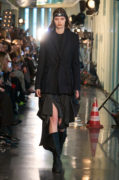
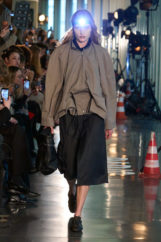
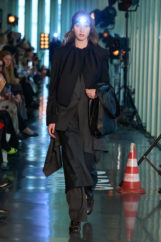
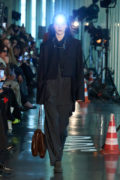
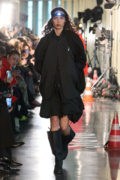
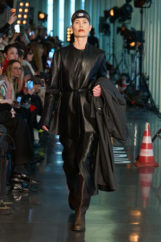
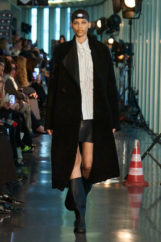
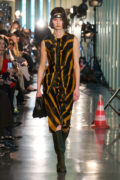
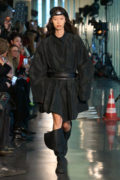
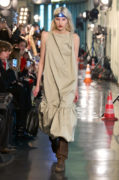
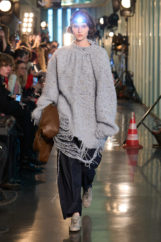
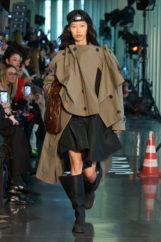
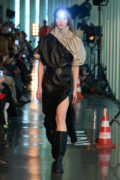
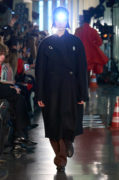
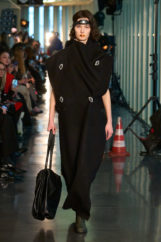
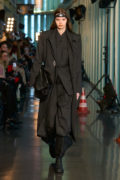
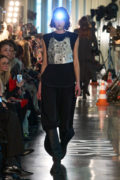
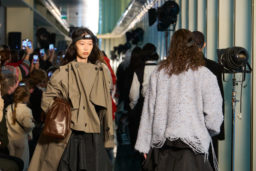
On the body, the clothes carried this tension with a quiet ferocity. Her deconstructed tailoring, a signature for years, felt stripped of any residual romanticism. Jackets were flayed open, seams exposed, shoulders hovering slightly off the body as if ready to bolt at the sound of the next siren. Coats wrapped, unfolded and re-wrapped around the torso, suggesting a perpetual need to adapt, to protect, to find a new way of standing upright in uncertain territory. The palette moved through soldier greys, smokey charcoals and off-whites that flirted with the colour of dust, as though each garment had already walked through debris and refused to surrender its elegance.
The space itself became a collaborator. At Les Halles, the sweeping beams of light were more than theatrical devices; they recalled air–raid choreography as much as runway lighting, an ambiguous illumination that made the models look at once exposed and hunted. When the “ashes” began to fall at the end, they landed not as a tidy metaphor but as a visual echo of burned-out apartments, scorched fields and factories that continue to function under permanent threat. There was no triumphalism in that moment, only the recognition that what we were watching is the daily reality her team in Kyiv cannot step away from.
That team, and the Kyiv factory that houses them, sit at the heart of Litkovska’s practice. She comes from a lineage of tailors and has always insisted on producing in Ukraine, treating the atelier not simply as a production site but as an extension of family that she refuses to outsource even when logistics collapse. Since the full-scale invasion, her journeys back to Kyiv have meant working under sirens, negotiating blackouts, navigating streets that might not exist on her next return from Paris. For a time, the war forced her to move parts of production westward, and even to negotiate army use of her former spaces just to retrieve fabrics and machines; bringing operations back to Kyiv became an act of stubborn faith in the city’s future.
This is not an abstract struggle. Litkovska has spoken about leaving her partner in Ukraine at the beginning of the invasion, knowing he would remain involved in the defence of the country while she shuttles between frontline reality and the surreal glamour of fashion weeks. That split life — mother in exile with a young daughter, partner at war, team scattered across Ukraine and European capitals — seeps into everything she does. The clothes in this collection walked as if they were carrying absent bodies, people who should be in the room but are at the front, in shelters or in cities that now appear only in casualty reports. Holding the atelier together, paying salaries, keeping a shared project alive: these are as central to her vision as any silhouette on the catwalk.
Since founding her label in 2009, LITKOVSKA has been refining a language that hovers between masculine tailoring and fiercely vulnerable femininity, using deconstruction, raw edges and visible seams to draw the outlines of instability without sacrificing precision. In recent seasons, her Paris presentations — from camouflage nets turned into pink, dreamlike installations to motifs of ice-encased wheat — have established her as one of the clearest fashion voices emerging from wartime Ukraine. The Les Halles show pushed that vocabulary further. The searchlights extended her ongoing meditation on visibility and invisibility, evoking both the scrutiny of the stage and the surveillance of conflict. The ash-like finale crystallised the stakes of her project, reminding us that these are not merely poetic images but lived experiences for the people sewing, fitting and finishing each garment.
What keeps the collection from collapsing under its own symbolism is its insistence on wearability. Transformable jackets, fluid skirts and reconstructed shirts all retain a pragmatic ease, ready to slip into a wardrobe and travel, literally, out into the world. In that sense, the show does not simply speak about Ukraine; it functions as a moving archive of what it means to keep creating while everything familiar hovers on the brink of turning to ash. In a season full of noise, this was one of the rare moments where every gesture, from the first beam of light to the last falling fragment, felt entirely, painfully earned.
Later,
Diane
