
























Dear Shaded Viewers,
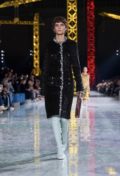
Matthieu Blazy’s Chanel at the Grand Palais felt less like a fashion show than a controlled detonation of destiny: a metamorphosis unfolding under glass, in real time, on the body of a house and a man who clearly always knew he would end up here.
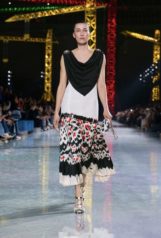
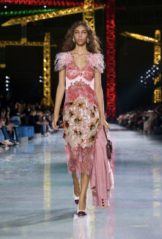
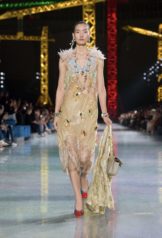
The Grand Palais was transformed into a kind of celestial construction site, an illuminated solar system of light and shadow where silhouettes seemed to hatch rather than simply appear. Day slid into night like a time‑lapse of a chrysalis turning to wing, the clothes tracing that arc from the caterpillar of pragmatism to the butterfly of spectacle without ever losing their structural logic. What impressed was not just the beauty of the image, but the sense that every seam was an axis of transformation: jackets that opened like portals, skirts that broke into movement as if the fabric had remembered it once was air.
Blazy’s Chanel is obsessed with how things are made, and he shows you the skeleton without ever breaking the spell. Tweed, that old Chanel workhorse, arrived unburdened, enriched with pliant fibers so it clung and released with each step, like an exhale of the archive. Dresses cut on the bias slipped around the body with lingerie lightness, French‑seamed mousseline floating away from the skin so that transparency became an architecture of intimacy rather than a gimmick of exposure. Even the accessories spoke the language of construction: crescent bags as soft armatures cradled in the hand, 2.55s treated as living objects, their patina and “lived‑in” creases elevated to design principles rather than flaws.
To watch this collection knowing Blazy’s trajectory is to feel the click of fate falling into place. The boy who showed a fiercely disciplined, concept‑driven graduation collection at La Cambre in 2006 now edits the codes of Chanel with the same instinct for line, volume and controlled eccentricity you noticed from the very first look back then. Raf Simons, who plucked him straight from that show and put him through a five‑year “school of precision” in tailoring, clearly honed the architect in him: the Flemish rigor, the cerebral construction, the insistence that fantasy must sit on a perfect foundation. You see that training in the way a blazer holds its plane while the skirt beneath it breaks into engineered fringe, in the way a shirt – maybe the most modest item on the runway – is cut with the kind of exactitude that turns a collar into an event.
Last night at the show, sitting next to his friend Pierre – they were just graduating from La Cambre together back in 2006 – he told me that when he asked the 28‑year‑old Blazy where he wanted to be, Matthieu simply replied, ‘at the house of Chanel.’ Last night, that offhand ambition became a fully lit proscenium dream, and what could have slipped into reverence instead vibrated with a kind of lucid joy – as if he understood that the only respectful way to handle a myth is to keep it moving. Echoes of the reviews already swirling around him – the insistence on sensuality and lightness, the recognition of a “new universe” for the house, the sense, noted by early commentators, that he is re‑imagining Chanel’s narrative rather than merely servicing its image – all felt crystallized in this outing. Even in the social‑media immediacy of reactions, you could feel that rare collective intake of breath: this is not just a new chapter, it is a new tense – Chanel as becoming, not being.
What lingers is how reachable this dream felt. For all the astral scenography and chainmail chequers glinting under the vaults, there was a profound warmth toward the women who will actually live in these clothes: pockets that matter, knits that wrap rather than constrict, shirts that invite touch as much as they command respect. It is the old Chanel paradox rewritten for now: couture‑level attention applied to weekday tempo, not to perform a role but to inhabit a life. For someone who fell for Blazy at La Cambre and tracked the Raf years as a quiet apprenticeship in rigor, last night at the Grand Palais felt like watching a long‑imagined building finally stand complete – not as a monument, but as a house whose doors have just been flung wide open.
Later,
Diane