

In London, at least, the theatre has lost its grip on glamour. The West End is saturated with blockbuster cheese fests and stunt-cast revivals. Its auditoriums are comprised of bridal parties in fancy dress hollering from the gods, Essex mums in greige 2-pieces and F[H]ermes sandals, tourists who refuse to disrobe their puffer jackets, and millennials in their office fits. At the opera house, on rare occasions, one might spy the odd ballgown or 3-piece suit, but with that comes the embarrassment of looking foolishly try-hard. The art of dressing for the theatre has been all but lost.
In greener pastures, however, the theatre still remains a fashionable occasion. I once made a pilgrimage to Verona to see the opera Aida. A Roman amphitheatre lies in the heart of the modest city and during its opera seasons, like a pebble dropped into still water, an infectious buzz radiates outwards from L’Arena. In the hour leading up to curtain, attendees slowly filter in wearing linen suits and silk dresses.Before any show begins, there is a moment of infectious tension. Individuals settle into their role as a collective. The audience begins to breathe as a whole. Tummies tighten, the lights dim and the room is dampened with silence.
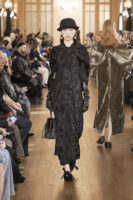
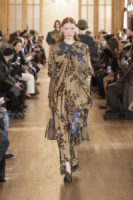
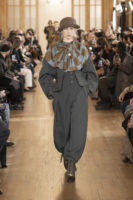
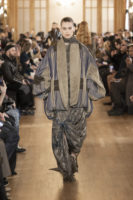
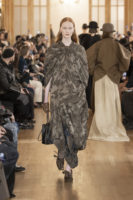
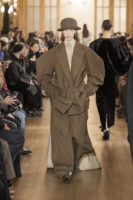
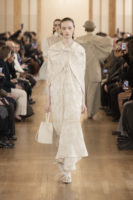
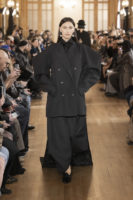
For her FW26 collection, Uma Wang hones in on the moment of anticipation before an opera house opens its doors. For most, a queue is a period of annoyance, of waiting, of limbolic suspension. For Wang, it’s a moment of subtle refinement: A bow straightened. A fold gently corrected. The quiet confidence of a brocade coat. Spending much of her time in Verona, Wang has drawn from the warm-summered elegance of its opera.
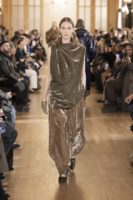
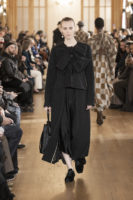
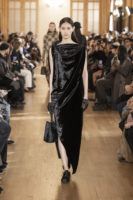
Many of the looks echo the mechanics of theatrical curtains. A stuffed jacket droops over a pinned, draped jacquard dress like an Austrian drape, its folds gathered and sagging as if pulled by stage cords. Elsewhere, skirts and dresses fall into asymmetric stepped hems, recalling the legs and valance that frame a stage in fabric.
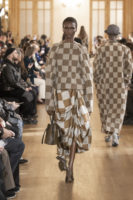
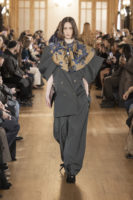
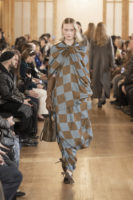
Structured shoulders extend outward past the elbow, inflating the body’s frame. Pockets are built externally in rigid box shapes, like the protruding royal boxes of an opera house, architectural balconies designed to display their occupants. Striking teal and brown checkerboard silk embodies the commedia dell’arte Arlecchino (Harlequin).
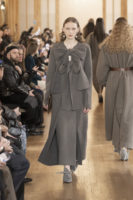
Oversized bows punctuate the collection. Pony-haired shoes are wrapped in leather bows; wool and linen bows jut from garments like decorative rosettes. The gesture calls to 18th-century court dress – powdered wigs, opera goggles, aristocratic spectacle – a visual language long borrowed by opera aesthetics.
At times looks billow outwards, swollen and theatrical; at others they are cinched tight and meticulously tailored. Wang sets up a tension between operatic architecture and corseted dress, between the inflated scale of the theatre and the disciplined compression of the body. Striking teal and brown checkerboard silk embodies the commedia dell’arte Arlecchino (Harlequin). The collection is sharpest where its opposing fabrics collide.
At times looks billow outwards, swollen and theatrical; at others they are cinched tight and meticulously tailored. Wang sets up a tension between the inflated scale of the theatre and the disciplined compression of the body. The collection is sharpest where its opposing fabrics collide.
Wang has collapsed vast historical theatrical aesthetics into wearable elegance. Reference becomes occasion.
