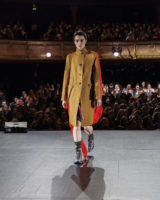
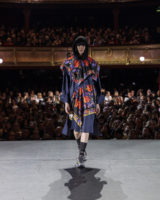

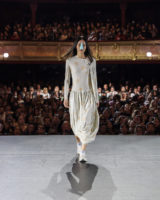
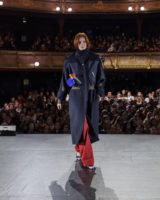
This season, Zomer opened fashion week. It was presented in partnership with La Watch Party, an initiative birthed by influencer and fashion ‘journalist’ Elias Medini, better known as Lyas. Originally conceived as a protest after Medini failed to secure an invitation to the Spring/Summer 2024 Dior show, LWP has grown steadily, amassing a cult Gen Z following and, is supposedly re-distributing the hierarchical structure of the fashion industry, infamous for its aggressive exclusivity. Opening PWF within La Watch Party officially accredits Medini’s ‘alt’ establishment nouveau as an integral cog to the industry at large. But has Medini’s original intentions for inclusion grown into something else entirely?
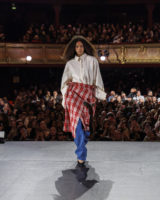
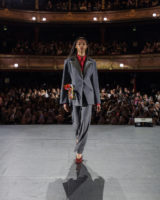
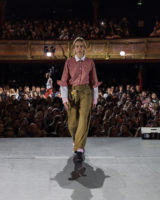
The collection itself featured subtle reinventions of personal fashion memorabilia – the argyll socks buried at the back of your sock drawer you just can’t throw away, their soles worn and frayed; coat pockets overflowing with pens, pencils, watches and necklaces because you forgot your bag; the ugly puffer jacket you’ve had since you were a teenager. Moments of familiarity and safety were recut into elevated wearable form. It also drew from its setting at the Théâtre du Châtelet by evoking Victorian theatrics: coats metamorphosed into red and purple flowing capes while dresses were held off the floor by chains attached to rings, mimicking victorian skirt-lifters designed to keep women’s dresses from trailing through the thick mud of the city streets.
However, the focus of the collection was swallowed by its entombment within Medini’s burgeoning LWP empire. The show began with a live voice over from Lyas, and closed with him taking the designer bow in place of Danial Aitouganov and Imruh Asha. Rather than a celebratory collaboration, it felt like a business deal favouring both parties: Zomer using Medini’s influence to bolster its brand appeal and marketability, Medini using Zomer to secure his integration within the systemic industry structure. While this could be said about many business relationships within the fashion industry, my issue here is with intention. La Watch Party feigns inclusion and accessibility, yet in reality it has created a cult-scene-machine hell bent on propagating and defending an individual personal brand.
LWP has quickly bureaucratised. The “democratising” gesture of streaming shows for people who aren’t invited has effectively become a new media property. Supported by large brands, notably M.A.C cosmetics, Meta, Vestiaire Collective and L’Oréal, these sponsorships function as brand marketing deals – Casio and Asic products littered the Zomer runway.
Often, challengers of hierarchical systems fail at eliminating hierarchy and rather substitute a new one. In his theory of cultural fields, sociologist Pierre Bourdieu describes this as a tension between the dominant ‘actors’ and challengers within a system. Dominant actors possess recognised authority and established forms of capital. Challengers attempt to destabilise that authority by redefining what counts as value. Once the challengers gain recognition, their once-radical criteria become the new orthodoxy: the opposition becomes institutionalised.
Does the dismantling of one establishment require another? Is the left really better than the right? The fashion industry has no leader at large. It’s a conglomerate whose rules and exclusivity are built upon years of discipline and craft. Will democracy succumb to dictatorship? The industry’s exclusivity maintains brand desirability and marketability; fashion is about creating a fictional fantasy. It’s a tool for escapism that allows us to become whoever we want to be. If it becomes wholly accessible will we still want it? That isn’t to say it’s impenetrable. Both McQueen and Galliano were working class boys from London. Through talent and relentless artistry they redefined and restructured the industry that should have excluded them.
Medini is attempting self-accension to stardom. It is a relentless and dangerous art form, attempted by many and mastered by few. Fame and power are protein for the Ego. The more that is accumulated and consumed, the more destructive the ego becomes. Are these the early warning signs of what’s to come?
It is by no accident I haven’t written extensively on the Zomer collection itself. designers shouldn’t need to embed their own creative endeavours within someone else’s attempt at self-mythologising. Ruby Wax always re-iterates that fame is a disease. I fear something contagious is going around…
The opinions in this article do not reflect the perspective of the publication.
