



Dear Shaded Viewers,
In these days of Google, AI, and instant online research it is refreshing that Monsieur Astuguevieille is invisible, a phantom and a brilliant presence only though his work, and to those who know and understand his creative influence. I will try to point out to those unfamiliar with his work why his death shocks and saddens so many.
As a key player in several quite different companies, roles, and outcomes he is impossible to pin down or place neatly in a category. When I first knew his name in the early 1980’s he was a creative director, a jewellery designer and a creator of delicious furniture, yet his possibly most famous role was as a nose and parfumeur for Comme des Garçons, having met Rei Kawakubo, the founder of the company back in 1991.
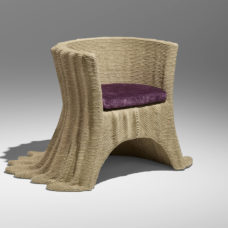
He was born in France in 1946 and, according to research, after his education at a Montessori school and early explorations of the Provençal countryside, his lifelong obsession with sensory perception was born. What is true regardless, is his feeling for form, and for surface which was the core of his three dimensional work, jewels that seemed formed through eruptions of the earth, forms in weighty metals that glittered but were never sparkling, they had an almost primitive allure to them. In the same manner as the rope and jute he wrapped furniture in, from a commode to a mirror, wrapped and wrapped, tightly and tensely, sometime over worked with colour, or also allowed to have tufts spring from the construction’s tightness.
This has come about because passionately committed to eliciting sensory reactions through everything he creates, in the 1980s Astuguevieille became interested in the Japanese aesthetic of wabi-sabi and in furoshiki – the art of wrapping objects in textile bundles. A natural progression from this departure point, it set in motion the foundation the segment of his career designing and making rope-wrapped furniture and objects.
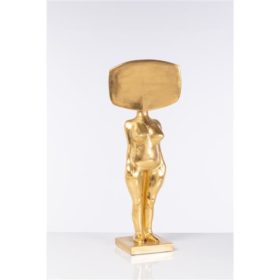
The liner shapings allied to the rope, or fringe, gave a tribal and primitive look to some pieces, as though discovered on some forgotten isle or created by a culture we had not known about before in the tropics. The ritual quality that he bought to his work gave it a splendour and a ceremonial strength of presence. Some one said it was “totemic, inspired by ancient civilisations in Asia and Oceania.” He often blurred the lines between the functional and sculpture, revelling in the finished piece for its effect as much as for its splendour. I once owned a slate grey dark diamanté brooch of his that was so heavy that its only really suitable accompanying garment was a heavy great coat.
He worked with Pierre Frey and Holly Hunt, Rochas, Lanvin, Nina Ricci and other houses at various times but his work and his aesthetic remained totally his. At his home in Bayonne, where home and the studio stopped and started was blurred by being both personal and professional in its collected contents.
He had met Rei Kawakubo in Tokyo when the Comme des Garçons store was displaying his sculpture. He worked in partnership with her to present the brands first fragrance Eau de Perfum, launched in 1994 in it’s distinctive pebble shaped bottle. Many others followed, such as Concrete, and they were always unconventional in inspirations, and names, and packaging. Sun dried laundry or other references moved fragrance away from flowers and romance, the press releases bringing a totally different approach to fragrance and its description.
Someone described his furniture as looking as though “it belongs in a Brothers Grimm tale set in an African savannah” and in his “series of unclassifiable anti-perfumes – the French polymath challenges the canon of every design category he steps into”
I quote again from Guy Trebay in The New York Times
‘Christian Astuguevieille is one of those rare polymaths one encounters in the design world, an occupational dabbler who, resisting pigeonholes, made a name for himself over the past several decades as an artistic director of both fashion and fragrance houses and also as a sculptor, a furniture designer, a maker of jewellery and objects and, not least, as the nose behind the fragrances produced by Comme des Garçons.”
So, farewell Monsieur Christian Astuguevieille who might be described as a Renaissance man, a polymath, a creative, but whose refusal to be pigeonholed or categorised meant he was free to make his own rules. His work bears witness to a mind whose inventiveness knew no limits be it in the air or on the ground, from the seriousness of a weighty bergere chair covered in rope, to the lightness of a fragrance.
I close with a rare quote from the man himself and a few words of reminiscence from my editor Diane.
‘Christian Astuguevieille
“All of my work is about creating new ways of experiencing the senses, whether it is with perfume or rope”


Diane Pernet “
I met his gold chair before I met him, I sat in the gold rope chair and felt like an empress and had to meet the creator. Thanks to Rosa the owner of Persuede in Bilbao I did. I spent many hours with him discovering his work, his invented language and of course the magical Comme des Garçons perfumes. I never could afford my dream chair i think it was around 30k, but he gave me a bronze statue he made painted florescent pink. I treasure it. xxx
Tony Glenville