





Dear Shaded Viewers,
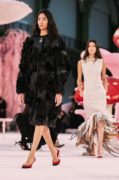
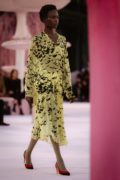
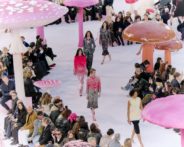
Matthieu Blazy’s couture debut for Chanel unfolded like a lucid dream in a mushroom grove – a world suspended between fairy tale and haiku, where each look felt like a fleeting vision caught just before it took flight.
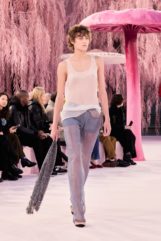
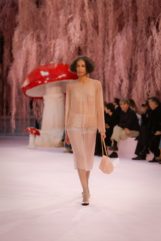
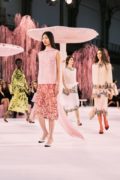
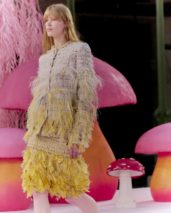
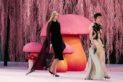
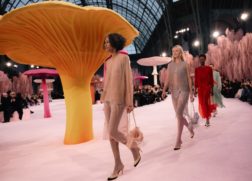
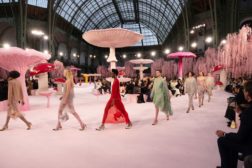
Under the glass vault of the Grand Palais, guests stepped into a ring of outsized, pastel mushrooms and powder‑pink willow trees, a set that turned Chanel’s return to couture into an enchanted clearing rather than a monument to itself. The whole scenography picked up the anonymous haiku Blazy cited – a bird alighting on a mushroom, then gone – and translated it into space: a circle for gathering, softness instead of grandstanding, couture as a fleeting encounter rather than a fixed tableau. Even the details around the show – invitations as tiny mushroom charms, heels shaped like toadstools, gill‑like pleating under tops – extended this quiet psychedelia with wit rather than spectacle.
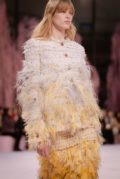
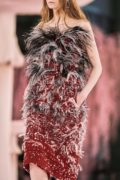
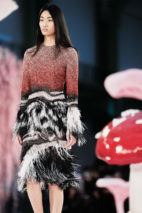
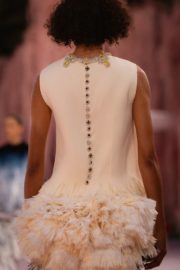
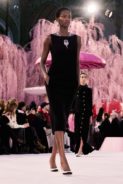
From the first exits, birds emerged less as motif than as attitude: the women seemed to perch, hover and dart through the set rather than simply walk it. The ateliers translated avian references into cut and motion – raven‑black tailoring that sharpened the line like a crow’s shadow, then gradually loosening into layeredlooks whose volumes suggested pigeons, herons, spoonbills and cockatoos. Featherwork, that old couture shorthand for “bird,” was largely replaced by suggestion: pleats that rippled like wings mid‑beat, embroidery that read as plumage only once it caught the light, weaving that mimicked feathers’ depth without their weight. By the finale, the cast drew together briefly in a soft murmuration before dispersing back into the mushroom grove, underlining Blazy’s idea of couture as an intensely present moment that disappears as quickly as a bird leaving its branch.
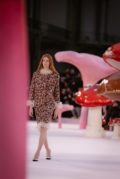
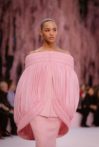
Blazy opened with the most sacred code: the Chanel suit, but reduced to its barest architecture and then made almost translucent. Cut in sheer silk mousseline and gauzy tweeds, in dove greys, blush pinks and ivory, the classic twinset appeared porous, as if filled with air and memory rather than padding and strictness. Here, the “bourgeois armour” of the suit became something more intimate: jackets that hovered just off the body, skirts that moved with a liquid, birdlike swish, chains at the hem still present but gentler, like a whispered reminder of the house’s weight rather than a rigid anchor. Several suits felt almost like after‑images of the archetypal Chanel silhouette – familiar in line, radically new in fabric and transparency – and it’s in this transformation that Blazy’s couture voice came through most clearly.
The collection’s real emotional charge lay in its embroidery and fabric alchemy, which turned surfaces into diaries rather than decorations. Love letters, a vial of N°5, a sliver of red lipstick, even a key or a lighter appeared stitched into linings, tucked inside transparent pockets, or dangling from re‑imagined hem chains: tokens of private lives carried inside couture’s most canonical forms. Bird imagery was treated with the same restraint – flurries of beads that resolved into a swallow mid‑flight only on second glance, or seams “replaced” by trails of birds flying along the body instead of conventional stitching. Toadstools blossomed across tweeds as tiny, near‑abstract embroideries; elsewhere, raw‑edge organza was collaged into painterly textures that read like undergrowth, while quartz and pearls edged hemlines with a mineral shimmer that made the light itself part of the design. It was as if the suit had been walked through a forest and come back carrying traces of it on its skin.
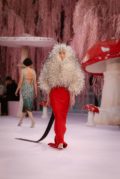
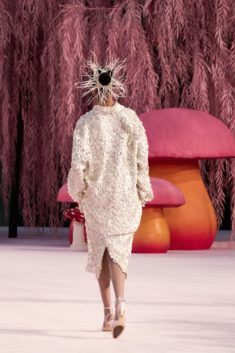
Technically, this was a show about pushing fabric to its furthest expressive limit while keeping Chanel’s codes entirely legible. The tension between tailleur and flou became a choreography: rigorous, raven‑black looks that showcased the precision of the ateliers, followed by soft, layered dresses and skirt suits whose transparency, pleating and layering generated new, feather‑like colours rather than relying on print or literal ornament. Traditional tweeds were lightened and aerated, sprouting with feather‑like threads or embroidered toadstools, sometimes woven so loosely that they behaved more like chiffon than wool, but always tethered to the house through line, buttoning and proportion. Even the iconic bag was reworked in transparency, the quilted structure intact but its contents visible, a clever echo of Blazy’s stated wish for clothes that become “as much about the wearer as the designer.” A scarlet column of a gown carries a shaggy, pale plume of a top, like a bird that has just landed in the middle of the mushroom grove. The look is pure vertical drama: a long, straight red skirt skims the floor with a tiny knot at the hem, anchoring the silhouette, while the cropped, hyper‑textured ivory cape explodes outward in every direction, obscuring the torso and almost swallowing the head.
The upper part reads as an electrified cocoon of faux‑feathers or fringed tufts, dense yet buoyant, catching the set’s pink light so it seems to vibrate against the forest of mushrooms. The contrast between the strict, liquid line of the skirt and the wild, halo‑like volume above creates a totemic, almost surreal presence – half toadstool, half exotic bird – perfectly in tune with Blazy’s enchanted‑forest, avian narrative.
The casting extended Blazy’s idea of lightness beyond the clothes, with a runway populated by women of notably different ages and presences, a rarity on haute couture catwalks and a clear signal of his affection for real, lived‑in beauty. That mix of generations made the mushroom grove feel less like a fantasy populated by interchangeable nymphs and more like a community passing through the same enchanted clearing, each woman carrying her own history into the suits and feathered dresses.
The soundtrack wrapped that vision in a soft, bittersweet glow: Joan Baez’s “Barbara Allen” threaded its folk melancholy through the show, before her “Diamonds and Rust” closed the collection with a honeyed, reflective croon. Those Baez tracks, nestled among Disney’s “Sleeping Beauty,” Moby and an instrumental “Bitter Sweet Symphony,” lent the whole experience a time‑spanning tenderness, as if Blazy were braiding protest, romance and fairy tale into a single, quietly radical couture lullaby.
In the end, what made the show feel so thrilling was not just the mushroom magic or the flutter of birds, but the sense that the Chanel suit itself had finally exhaled and taken flight, without ever losing sight of where it came from.
Later,
Diane