












BLACK HOLE
Dear Shaded Viewers
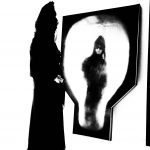
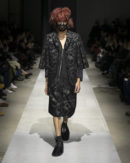
Black Hole opened like a warning flare in the dark: a mostly black procession, punctured by metal and vinyl, ruffles and fencing masks, as if Rei Kawakubo had staged a ritual for climbing out of despair without ever turning on the lights. The atmosphere was stark and airless, runway stripped to concrete and shadow so that every flicker of fabric, every scrape of a boot, felt amplified, like sound in a vacuum. What emerged was not a story of color or seasonal optimism but a stubborn insistence that beauty can be carved out of density, repetition and almost monastic restraint.
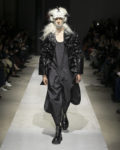
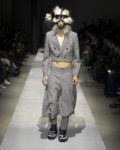
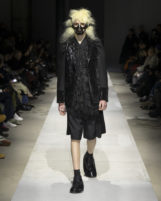
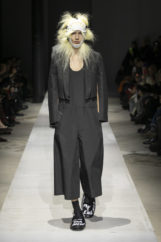
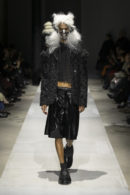
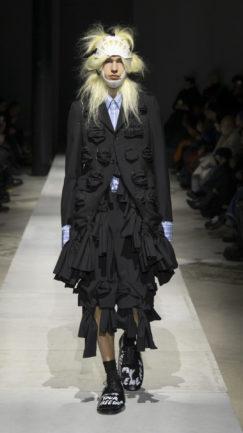
The first thing you saw was not the clothes but the heads: wild, haloed hair teased into feral, static clouds, bound or bisected by rigid headpieces that evoked fencing masks, chastity cages, medieval visors. They sat like instruments of control on top of all that chaos, containing the electricity of the hair without extinguishing it—a perfect metaphor for the collection’s tension between discipline and revolt. Those head structures, sometimes in stark white or hard silver, created an eerie chorus line: identical crowns of restraint atop wildly individual tangles, the “black hole” expressed as a psychic condition rather than a sci‑fi backdrop.
Against this charged headscape, the clothes advanced in waves of black, the surface constantly shifting: matte tailoring, plush velvet, dry wool, oil‑slick vinyl, with ruffles erupting like aftershocks. One of the most striking images was the near‑monochrome black coat swallowed in vertical ruffles, worn over a billowing white underlayer that drifted around the legs as the model walked. The look had the gravity of funeral attire and the softness of a nightgown, as though mourning and tenderness had been sewn into the same garment. Nearby in the sequence, a crushed‑velvet tuxedo mottled with pale, galaxy‑like patches, its lapels flashed in white and its shirtfront dissolved into froth, turned the wearer into a fallen dandy who had brushed against a star and come back scarred by light.
Kawakubo’s recurring gesture this season was the cropped little jacket perched on top of long dresses and jumpsuits—menswear spliced with a nun’s habit or a school pinafore. In pure black or micro‑check, sometimes revealing a strict white collar, these ensembles had a quiet ideological charge: they pulled traditional “women’s” silhouettes onto men’s bodies without drama, not as drag but as uniform. The jackets sat high, almost shrug‑like, stiff with tailoring memory, while the dresses underneath swung in generous arcs, somewhere between priest’s cassock and slip. As they moved, the tension between the upper structure and lower fluidity felt like a bodily version of the headpieces: control hovering over unruly emotion.
Ruffles, always a loaded device at Comme, became the collection’s respiration. They crawled down fronts of jackets, built up at shoulders, or bloomed in thick vertical cascades along the torso, like exoskeletons made of gathered satin. One unforgettable look paired a sleeveless black dress with a jacket whose sides erupted into swags of ruching, so that from the front you saw a narrow column of body framed by two swollen, protective wings. Elsewhere, ruffles were less romantic and more abrasive—crushed into velvet, stiffened so they read as ridges rather than frills—undoing any easy association with softness. In this black hole, decoration is not there to pretty things up; it is there to complicate, to insist.
Within all this darkness, the moments of shine and written language became lifelines. A silver short suit—tiny, tailored jacket and wide, cuffed bermuda shorts in a harsh, metallic cloth—flared down the runway like a flare gun, youth and alien armor fused into one. Vinyl looks, glossy and almost liquid under the lights, turned the wearer into walking oil spills, the most literal embodiments of the collection’s title, sucking in reflections and refusing to give them back. On a few pairs of swollen lace‑ups, hand‑scrawled slogans—“Your Freedom,” “My Energy”—appeared like notes scribbled in the margins of a dark manuscript, a reminder that under the discipline there is still a pulse, still a desire to escape.
Taken together, Black Hole did not offer an easy way “out” so much as a study of how it feels to live inside one and keep dressing, keep composing yourself, anyway. The straps and masks, the strict cropped jackets, the long black skirts and dresses, the relentless ruffles: they staged the psyche as a layered, armored, sometimes suffocating construction, but one shot through with stubborn flickers of light—silver, vinyl, handwriting, hair you can’t quite tame. Kawakubo’s answer to the void was not brightness but friction, not optimism but persistence, the insistence that even in near‑total blackness, form, texture and silhouette can still carve out a space to breathe.